'World's unluckiest man' struck by lightning inside home

John Wade Agan, who has a reason to call himself the 'unluckiest guy in the world', said the last thing he remembers was using a corded phone as he leant over a metal sink.
In the last four years, the taxi driver has also reported being robbed at gunpoint in his cab, stabbed in the chest with a butcher's knife and bitten by two venomous snakes at the same time.
His daughter, Misty Agan, 26, said she saw the latest incident first-hand.
She told the St. Petersburg Times newspaper that she heard the phone drop and her dad saying 'Oh!Oh!Oh!' before he fell to the ground shaking.
Her father, who was admitted to Tampa General Hospital on Tuesday evening, said he woke up surrounded by paramedics with a hole burned in his sock.
According to several news reports, the 47-year-old was complaining of soreness and ringing in his ear as he lay in his hospital bed on Wednesday.
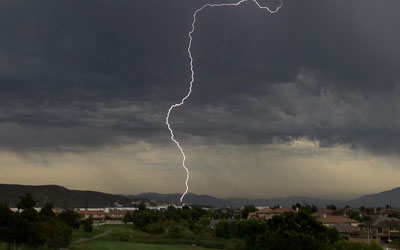
Some remain sceptical of the extent of Agan's misfortunes, and have alleged he is either exaggerating in order to receive pain medication or possibly seeking attention.
But two lightning experts said a strike while using a corded house phone is not unusual.
Dr. Mary Ann Cooper, a widely cited expert in the narrow field of lightning injury research, said: "It's certainly possible."
Related Stories

Water Crisis: Cities Running Dry Across India
Delhi's groundwater levels have fallen approximately one meter per year for two decades—a decline that is measurable, inexorable, and unsustainable. Bangalore's aquifers are nearly depleted despite being a major metropol...

Tier-2 Cities: India's New Growth Engines Are Still Sputtering
For the past fifteen years, development experts and policy makers have confidently predicted that India's Tier-2 cities—Pune, Surat, Lucknow, Chandigarh, Indore, Nagpur—would absorb India's relentless urbanization and be...

The New Indian Middle Class: Aspirations, Anxieties, Consumption
India's middle class—roughly 250-350 million people with annual household incomes between ₹10 and ₹50 lakh—represents a purchasing power that shapes entire economies. Yet their consumption patterns reveal a psychology di...