The Strange Power of Holding Two Opposing Truths
What a physicist's discovery about light and a psychologist's struggle with suffering reveal about the possibility of change.

Top photo: Niels Bohr's coat of arms in the chapel of Frederiksborg Castle in Hillerød, Denmark, with his motto, "Contraria sunt complementa," above a red and black yin-yang. Photographed on March 18, 2017, by Kim Bach; cropped. CC BY-SA 4.0, via Wikimedia Commons.
In 1961, a 17-year-old girl named Marsha Linehan was admitted to a psychiatric hospital in Connecticut. She was deeply distressed, repeatedly harming herself, and unable to imagine a way out of her suffering. Years later, she would describe that period of her life in three words: "I was in hell."
She made herself a promise. If she ever escaped that hell, she would return to help others do the same.
Linehan eventually became a psychologist, working with patients who were suicidal and struggling with severe emotional distress. But the treatments available to her presented a frustrating problem. Traditional behavior therapy emphasized changing harmful thoughts and actions. Her patients often experienced this as criticism, as though their suffering were their own fault. When she tried the opposite approach, offering acceptance without pushing for change, they were equally frustrated. They wanted to be understood, but they also wanted their lives to improve.
Linehan gradually came to a realization that would transform her work. Her patients needed two things that appeared contradictory: to be accepted exactly as they were and to be helped to change.
The insight became the foundation of dialectical behavior therapy, or DBT, which she formally introduced in a treatment manual in 1993. Its central premise was that acceptance and change could coexist, and that lasting improvement often required both.
Decades earlier, a physicist confronting an entirely different problem had arrived at an unexpectedly similar way of thinking.
For centuries, scientists had argued about the nature of light. Isaac Newton described it as a stream of particles. Later experiments, particularly Thomas Young's demonstration of interference in 1801, suggested that light behaved like a wave. By the late 19th century, the wave explanation appeared firmly established.
 Thomas Young's drawing of interference: waves spread from two narrow openings, A and B, and overlap, meeting in different phases at C, D, E and F. Drawing by Thomas Young, public domain, via Wikimedia Commons.
Then Albert Einstein showed in 1905 that light also behaved as though it arrived in discrete packets of energy, later called photons. Scientists found themselves with two apparently incompatible descriptions, each supported by experimental evidence.
In 1927, the Danish physicist Niels Bohr proposed a way to understand the contradiction. He called it complementarity.
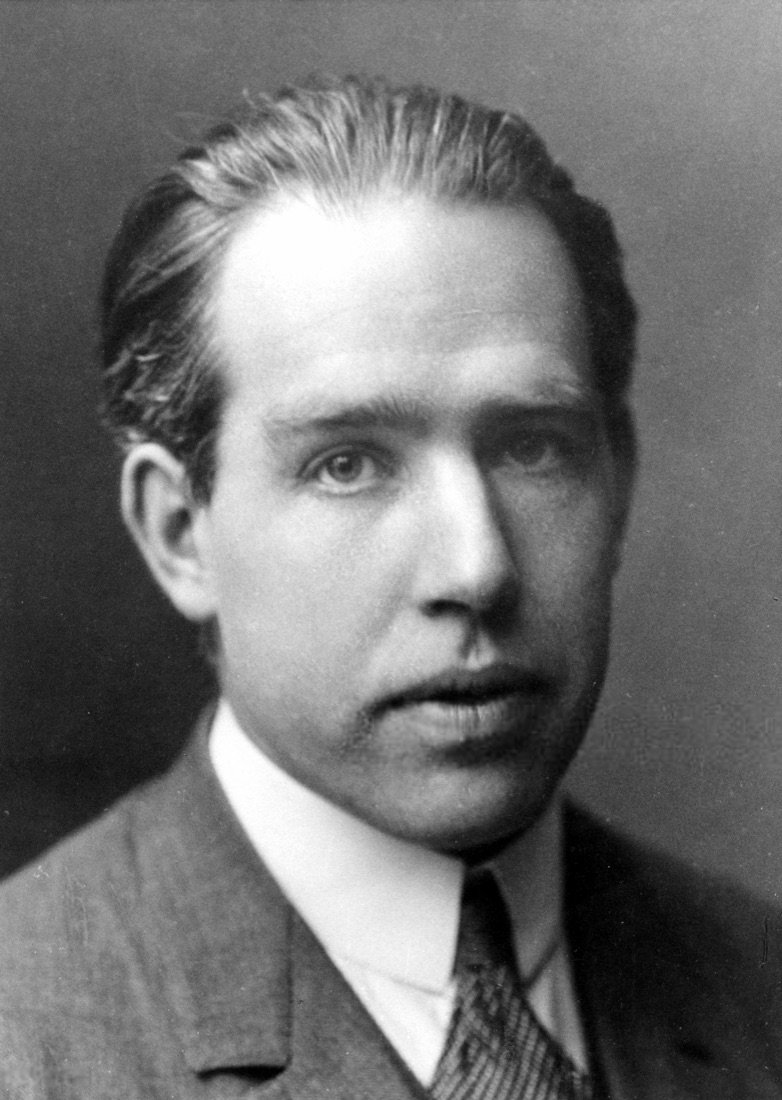 Niels Bohr in about 1922, the year he received the Nobel Prize in Physics. Photo by AB Lagrelius & Westphal for the Nobel Foundation, public domain, via Wikimedia Commons.
Wave and particle descriptions, Bohr argued, were both necessary to understand quantum phenomena, even though they could not be observed simultaneously in the same experimental arrangement. Neither description alone was sufficient.
The idea mattered so deeply to him that in 1947, when he was admitted to Denmark's Order of the Elephant, he placed a yin-yang symbol on his coat of arms. Above it were the Latin words Contraria sunt complementa: Opposites are complementary.
Bohr's discovery belonged to physics, while Linehan's belonged to psychology. The relationship between them is an analogy, not a scientific connection. Quantum mechanics offers no proof that a psychological treatment works.
But both stories illuminate a habit of thought that can limit our understanding of the world and ourselves: the assumption that when two ideas appear to oppose each other, one must be wrong.
For Linehan, rejecting that assumption had practical consequences.
One of the skills taught in DBT is radical acceptance, the practice of acknowledging reality without demanding that it be different before we can respond to it.
Consider a student who has performed poorly on an important exam. She may feel disappointed, embarrassed or angry. She may spend days thinking about what she should have done differently, or interpreting the result as evidence that she is incapable.
Acceptance does not require her to approve of the grade or abandon her ambitions. It means recognizing what happened without turning a disappointing result into a judgment about her worth. She can then decide how to prepare differently next time.
The distinction sounds simple, but it can be difficult to practice. We often resist accepting painful experiences because we mistake acceptance for surrender. Linehan's approach suggests that acknowledging reality may be precisely what allows us to change it.
Research has demonstrated the value of DBT for some forms of severe emotional distress. A 2021 Cochrane review of four trials involving 270 young people found that 30 percent of those receiving DBT repeated self-harm, compared with 43 percent receiving other forms of care. The researchers rated the evidence for this finding as high-certainty.
The results do not mean that DBT works equally well for every condition or every patient. But they offer evidence for a treatment built around an insight that once seemed paradoxical: helping someone change may begin with accepting them as they are.
This tension between acceptance and change is particularly relevant during adolescence.
Teenagers are surrounded by expectations about achievement, confidence and self-improvement. They are encouraged to perform well in school, cultivate interests, build friendships and prepare for their futures, often while navigating emotions they are only beginning to understand.
Under these pressures, acknowledging distress can feel like failure. A student may believe that admitting to anxiety means she is weak, or that recognizing her limitations means accepting that she cannot overcome them.
In many communities, the problem is compounded by stigma surrounding mental health. A small 2010 study of college students in California found that South Asian students held less favorable attitudes toward psychological counseling than white students, with personal stigma helping explain the difference. Although the findings cannot be generalized to all South Asian families, they point toward cultural barriers that can make seeking support difficult.
I have thought about these barriers while developing HAAL, a mental-wellness app for teenagers. I wanted to create a place where young people could acknowledge difficult emotions without feeling compelled to hide or justify them.
The idea was shaped by a simple question: What becomes possible when someone feels able to admit that they are struggling?
Linehan's work offers one answer. Acknowledging distress does not have to mean identifying with it permanently. A teenager can be anxious and still develop confidence. A student can recognize a weakness and still aspire to excel. Someone can be dissatisfied with a part of life while believing that life is worth living.
There is a difference between accepting an experience and allowing it to define us.
In 1938, Bohr suggested that complementarity might have relevance beyond physics, noting that the act of analyzing our feelings changes the experience of having them. He was careful not to extend the laws of quantum mechanics into psychology. Yet he recognized that some aspects of human experience resist being captured by a single description.
Perhaps that is what makes his motto enduring.
We spend much of our lives trying to resolve contradictions. We want to be strong rather than vulnerable, successful rather than struggling, satisfied with ourselves rather than dissatisfied.
But the experiences that matter most rarely fit into such clear categories. We can love someone and be angry with them. We can be grateful for an opportunity and frightened by it. We can take pride in who we have become while recognizing how much we still want to change.
Linehan spent years developing a treatment around the idea that acceptance and change belong together. Bohr, confronting the peculiar behavior of light, found that two seemingly opposing descriptions were necessary to understand the same phenomenon.
Their achievements were different, but they leave us with a related question: What might we understand differently if we stopped insisting that only one side of a contradiction could be true?
Sometimes, the beginning of change is simply the willingness to accept what is already there.
If you or someone you know is struggling, help is available. In the United States, call or text 988. In India, call Tele-MANAS at 14416 or 1-800-891-4416. This article is general information, not medical advice.
Maya Sharma is a senior at Neuqua Valley High School in Naperville and the founder of HAAL, a mental-wellness app for teenagers. More of her work is at mayasharma.org.





Comments
Loading comments…