The Tutoring Trap: Why Worksheets and Gamified Apps Are Failing Our Children—and How Adaptive Socratic AI Is Changing the Math
Executive Summary: The Modern Learning Paradox
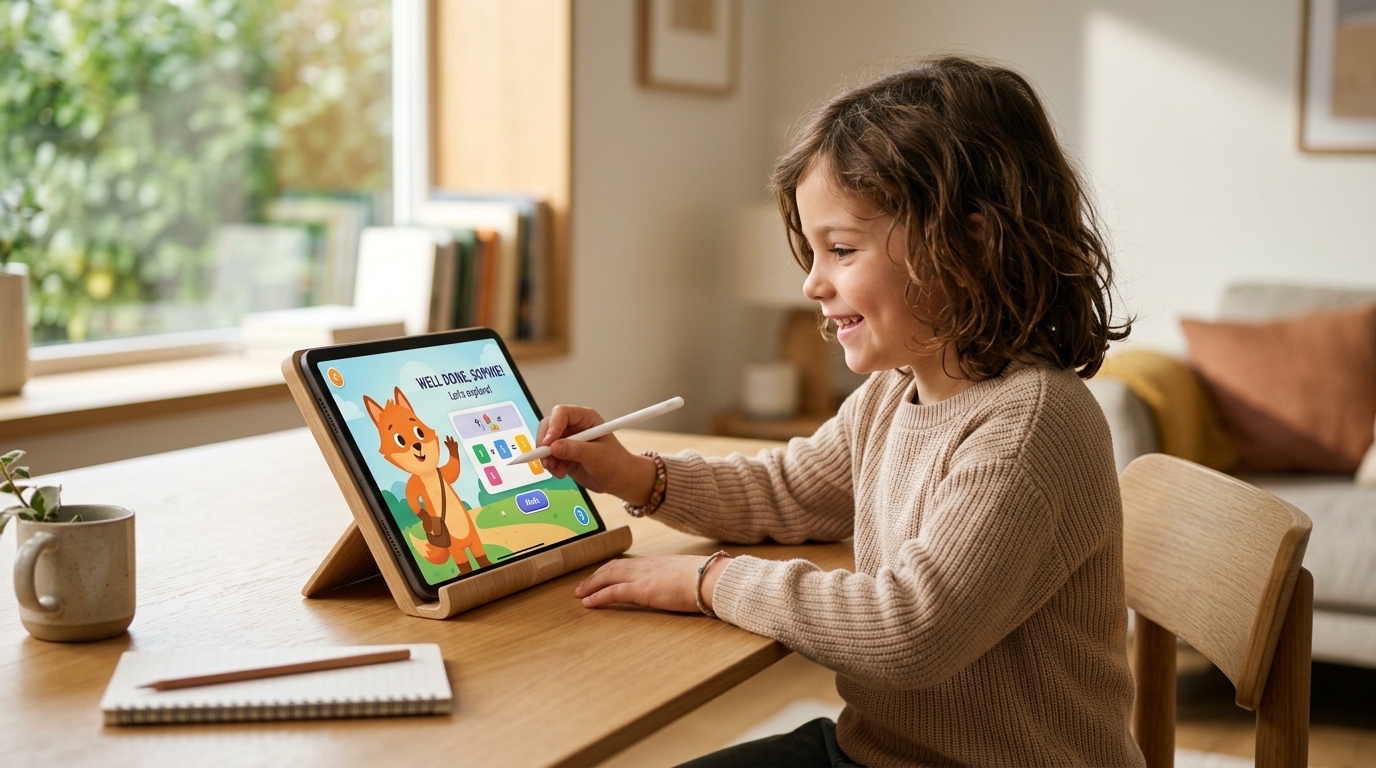
If you walk into the living room of an ambitious suburban household at 6:30 PM on a Tuesday, the scene is almost universally the same: an exhausted child sitting over a stack of repetitive paper worksheets, or slumped in front of an educational tablet app that looks suspiciously like a video arcade.
Parents today are investing more financial resources, time, and emotional energy into their children’s education than any generation in modern history. In competitive school districts from suburban Chicago (Naperville, Barrington, Hinsdale) to Silicon Valley and North Dallas, supplemental after-school tutoring has quietly become a second mortgage. Families routinely spend $400 to $800 a month on commercial learning franchises, or $80 to $120 an hour for private human tutors, all to protect their children from slipping behind in reading comprehension, analytical writing, and high-stakes placement exams.
Yet despite this unprecedented investment, standard national educational metrics tell a sobering story: reading comprehension scores have declined to multi-decade lows, and middle schoolers entering advanced placement tracks or high school test cycles are struggling with critical reasoning, textual synthesis, and complex multi-step problem solving.
The problem is not a lack of effort from students or devotion from parents. The root cause is structural: the two prevailing models of academic support—the 1980s Paper Worksheet Mill and the 2010s Gamified Screen Trap—were engineered for an era that no longer exists.
A quiet pedagogical breakthrough is now taking shape. By combining classical Socratic dialogue with real-time adaptive artificial intelligence, modern learning environments are finally solving the hardest challenge in childhood education: how to teach a child how to think, rather than merely what to bubble in.
I. The Two Failures: The Worksheet Mill vs. The Dopamine Trap
To understand why so many bright children hit an academic ceiling between the 3rd and 7th grades, one must critically evaluate the instructional mechanisms they are handed outside of school hours.
1. The Rote Worksheet Mill (Kumon & Traditional Drill Centers)
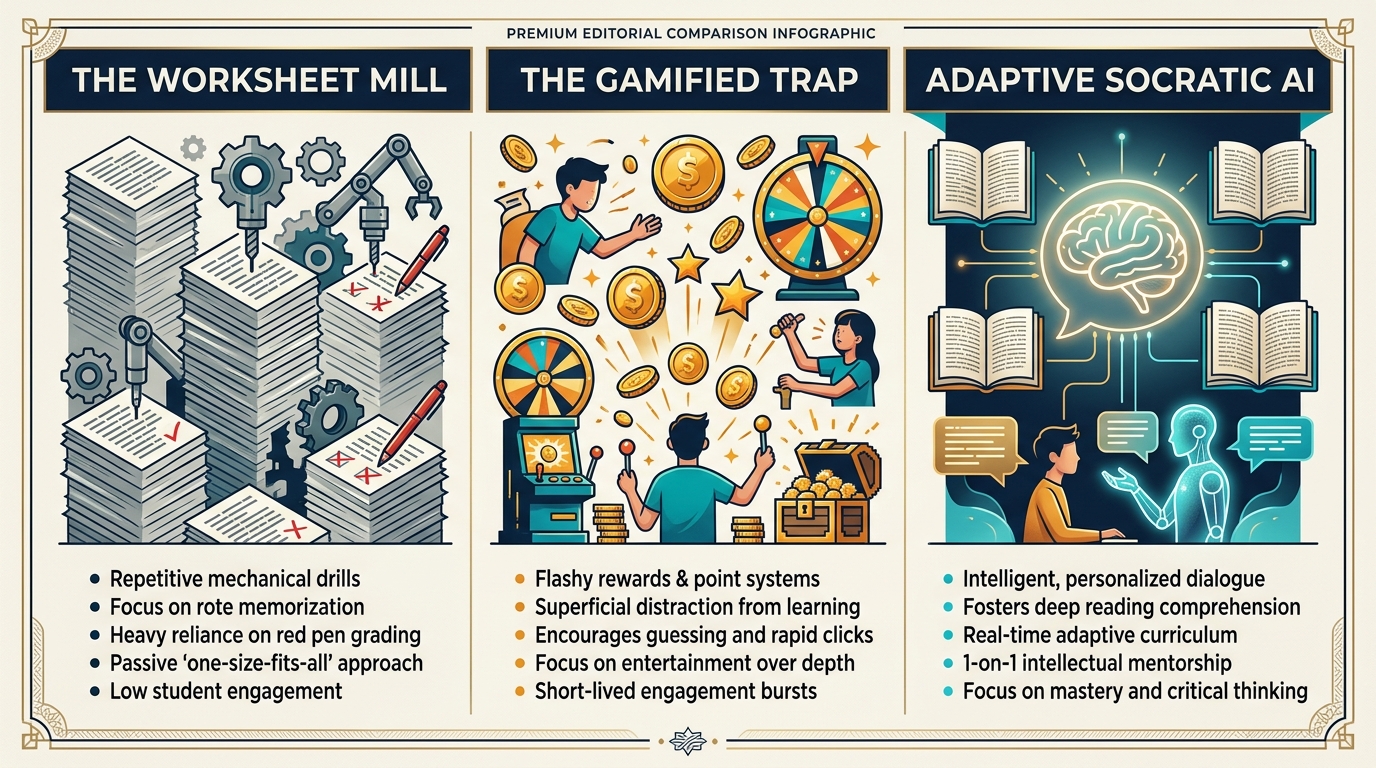
The legacy tutoring franchise operates on a 70-year-old industrial philosophy: repetition builds speed. A student is given forty nearly identical arithmetic operations or grammar fill-in-the-blanks. If they make three errors, they are handed forty more identical sheets the following week.
While rote repetition does build basic computational speed in early primary school, it encounters a catastrophic wall when children meet higher-order cognitive demands:
- Syntax Without Semantics: It trains pattern recognition without conceptual understanding. A student learns where a comma goes in a drill sentence, but cannot construct a compelling, coherent argument in an open-ended essay.
- Mechanical Scanning: It reduces reading to scanning for keyword matches rather than absorbing subtext, tone, and character motivation.
- Acute Intellectual Burnout: It conditions children to associate learning with compliance and drudgery, stripping away natural intellectual curiosity before middle school even begins.
2. The Gamified Screen Trap (Passive EdTech Apps)
In reaction to the tedium of paper drills, the first wave of educational technology software swung to the opposite extreme: hyper-gamification.
These platforms wrapped elementary math and reading into animated cartoon mascots, coin economies, spinning wheels, leaderboards, and streak badges. But developmental psychologists and cognitive scientists quickly documented an unintended consequence: gaming the reward loop.
Children quickly learn how to guess rapidly on four-choice multiple-choice prompts to trigger animations, collect digital gems, and unlock cosmetic accessories—without reading the passage or processing the underlying logic. The student’s eyes are glued to the screen, but their prefrontal cortex is effectively disengaged. When presented with an un-gamified paper exam or a dense book chapter, their stamina collapses within minutes.
II. The Socratic Breakthrough: The 2-Sigma Solution
In 1984, legendary educational psychologist Benjamin Bloom published his landmark study on the "Two Sigma Problem." Bloom proved empirically that an average student tutored one-to-one using mastery learning techniques performed two full standard deviations above conventionally instructed classroom students—catapulting an average 50th-percentile student into the 98th percentile.
┌────────────────────────────────────────────────────────────────────────────────────────────────────────┐
│                              BLOOM'S TWO-SIGMA PHENOMENON & INSTRUCTION                                │
├─────────────────────────┬──────────────────────────┬───────────────────────┬───────────────────────────┤
│ INSTRUCTIONAL MODEL     │ MEDIAN PERFORMANCE      │ COGNITIVE ENGAGEMENT  │ FEEDBACK LATENCY          │
├─────────────────────────┼──────────────────────────┼───────────────────────┼───────────────────────────┤
│ Conventional Classroom  │ 50th Percentile (1.0σ)   │ Passive Listening     │ 3–7 Days (Graded paper)   │
│ Commercial Worksheets   │ 60th Percentile (1.3σ)   │ Rote Repetition       │ 24–48 Hours (Red pen)     │
│ 1-on-1 Socratic Tutor   │ 98th Percentile (3.0σ)   │ Active Inquiry & Meta │ Real-Time (<5 Seconds)    │
└─────────────────────────┴──────────────────────────┴───────────────────────┴───────────────────────────┘
The profound power of 1-on-1 tutoring was never about lecturing. It was the Socratic interaction:
When a child makes an error, an exceptional tutor does not say "Wrong, the answer is C." Nor do they simply give the answer away. Instead, the tutor pauses and asks a targeted, diagnostic counter-question:
- "What specific phrase in paragraph three makes the narrator sound reluctant?"
- "You subtracted 12 from the left side, but what happened to the negative coefficient on the right?"
- "If that rule applied here, what would happen to the plural ending?"
This immediate conversational friction forces the child's brain to retrieve knowledge, identify their own misstep, and self-correct. It creates permanent neural pathways.
Historically, this level of individualized, unhurried Socratic mentorship was an exclusive luxury reserved for families capable of paying $100+ an hour for top-tier private educators several days a week.
Modern artificial intelligence has shattered that economic barrier.
III. The Cognitive Trajectory: From Foundational ELA to the Digital SAT
This structural pedagogical gap is the exact foundation upon which FlyingMinds was built.
Developed as a dedicated K–10 learning platform, FlyingMinds introduces an always-on AI learning companion named Fred. Fred is engineered not as an automated grading calculator, but as a patient, intellectually demanding Socratic coach who meets each child exactly where their reasoning breaks down.
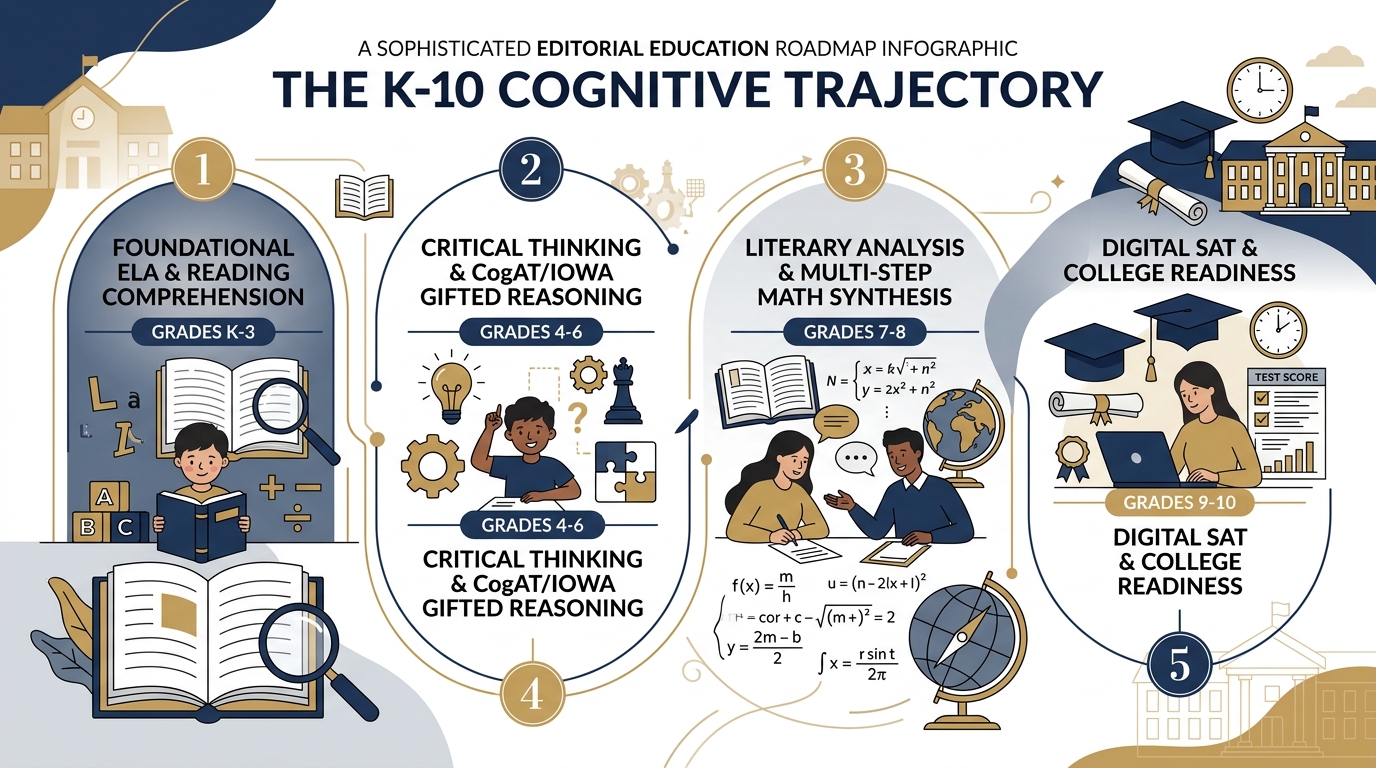
The platform addresses four critical dimensions of the modern academic trajectory:
1. English Language Arts (ELA) and Deep Reading Comprehension
While 90% of educational apps focus strictly on elementary arithmetic (because multiple-choice numbers are trivial to code), FlyingMinds tackles the primary pain point of modern schooling: reading comprehension and expressive writing. Fred guides students through dense passages, unpacking vocabulary in context, identifying rhetorical structures, and guiding the construction of structured written arguments with real-time feedback.
2. CogAT, OLSAT & Iowa Gifted Assessment Mastery
In top-ranked public and private school districts, placement into accelerated, honors, and gifted tracks is decided by standardized cognitive ability examinations—most notably the CogAT (Cognitive Abilities Test), OLSAT, and Iowa Assessments. These exams do not test memorized facts; they evaluate non-verbal spatial reasoning, verbal analogies, and quantitative relationships. FlyingMinds systematically trains children to decipher these spatial and verbal puzzles, building cognitive confidence months before school testing windows open.
3. High School & Digital SAT/ACT Readiness
As high school standardized testing shifts entirely to adaptive digital formats, test stamina and multi-step speed have become decisive. By training with Fred on adaptive digital passages and multi-tiered math formulations throughout grades 6 to 10, students develop natural fluency with digital assessment interfaces, eliminating the standard panic and cramming associated with high school test prep.
4. The Economic Arbitrage: $29/Month vs. $100/Hour
By replacing repetitive human administrative overhead with responsive AI architecture, FlyingMinds delivers full, unlimited curriculum access across all grade levels and subjects for $29 per month—less than the cost of a single 20-minute session at a traditional retail tutoring storefront.
IV. The Parent’s Modern Playbook
Childhood education is undergoing the exact transition that modern medicine experienced over the last two decades: the migration from blunt, one-size-fits-all batch treatments to high-precision, personalized care.
Our children do not need more stacks of bleached paper worksheets printed from decades-old templates. Nor do they need colorful games that barter their developing attention span for digital tokens and animated fireworks.
They need what great scholars throughout history have always needed: a dedicated mentor who listens carefully to how they articulate an idea, identifies their unique cognitive blindspots, and guides them patiently toward mastery.
For parents navigating the modern academic gauntlet, platforms like FlyingMinds represent an overdue realignment—putting world-class Socratic mentorship directly onto every child’s desk, and giving them the cognitive foundation to read deeply, think critically, and fly on their own.
Explore FlyingMinds and test interactive sample learning sessions with Fred directly at flyingminds.org.
Related Stories

The 3:00 AM Awakening: Why Your Nervous System Surges in the Quiet of Night
There is a particular kind of exhaustion that arrives not when your head hits the pillow, but five hours later. You wake up between 2:00 and 4:00 in the morning. The room is dark and silent, yet your eyes are wide open....

The 2026 Enterprise Innovation Benchmark: Accelerators vs. Venture Client Units vs. Curated Adoption Desks
Executive Summary: The Five-Year AI Re-Buy Window Over the next 60 months, the core software and operational systems of the Fortune 500 and Global 1000 will undergo their most aggressive capital replacement cycle in deca...

The Science of Vamkukshi: Why Both Ayurveda and Modern Medicine Insist You Sleep on Your Left Side
In the classical canon of Indian medicine, sleep (Nidra) is not considered an unconscious void or an unproductive biological pause. It is regarded as one of the three foundational pillars of life—the Trayopastambha—stand...