The River We Carried With Us
From the Subarnarekha in Jamshedpur to a backyard in suburban Chicago, the ancient festival of Chhath has followed generations of families across continents.
From the banks of the Subarnarekha in Jamshedpur to a backyard in suburban Chicago, the ancient festival of Chhath has followed generations of families across continents.
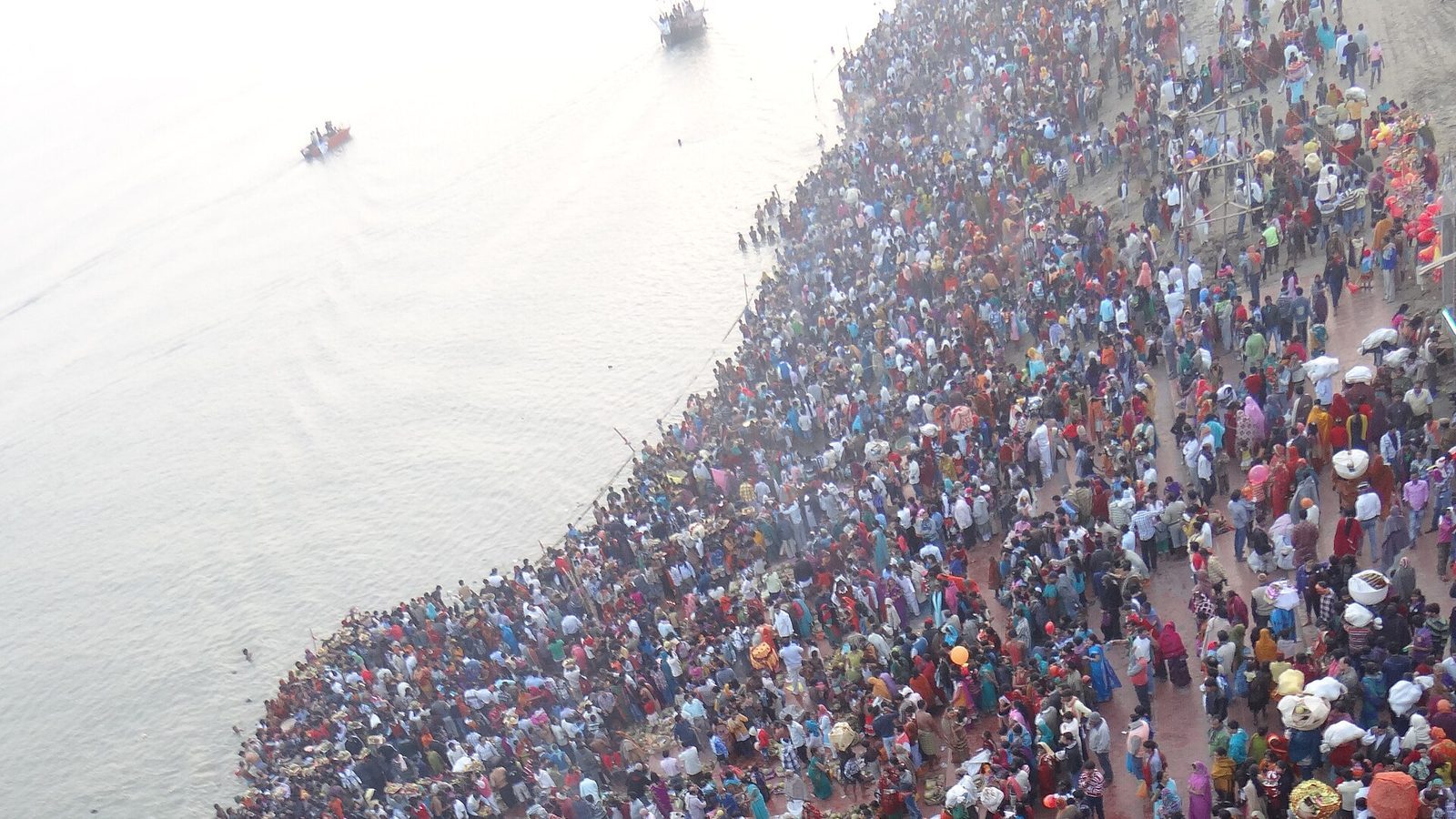
Top photo: Devotees crowd Barani Ghat on the Ganga in Bhagalpur, Bihar, for the morning arghya of Chhath on November 20, 2012. Photo by Vkumarv (cropped), CC BY-SA 4.0, via Wikimedia Commons.
My first memory of Chhath is from when I was seven years old.
It was a cold November morning, a few days after Diwali, when my mother woke me well before dawn. Still rubbing my eyes, I found a bucket of warm water waiting for my bath. Afterward, I put on my school uniform. We were going to the Subarnarekha River in Jamshedpur for the final morning prayers of Chhath, and my father would drop me at school on our way back.
I wasn't the only child in uniform. There were many of us at the river that morning, standing among families who had gathered to offer arghya, a ritual offering of water or milk, to the rising Sun.
The atmosphere was festive. Little diyas floated on the river. Women stood in the water, their foreheads marked with long streaks of sindoor, the vermilion running from the bridge of the nose to the hairline. Even the cold November air seemed to carry a certain warmth.
I remember watching everyone fold their hands in prayer to Surya Bhagwan, the Sun God. I was too young to understand the significance of the ritual, but the reverence of that moment stayed with me.
And then came the part we children loved most: the prasad.
Once the prayers were over, we could approach any family that had performed the puja and ask for thekua. Sweet, slightly hard, and rich with ghee, it was delicious. We went from one group to another collecting our share before heading to school.
Years later, schools in Jamshedpur began declaring a holiday for Chhath. But I still remember those mornings when the festival and an ordinary school day existed side by side.
Only much later did I begin to appreciate the history behind what I had witnessed.
Chhath, one of the most important festivals of Bihar and parts of eastern India, has its roots in the ancient practice of Sun worship. The Rigveda, among the oldest sacred texts of Hinduism, contains hymns dedicated to Surya, the Sun, and Usha, the goddess of dawn. For people whose lives depended on the seasons and the harvest, the Sun was a source of life and sustenance.
The Vedic hymns establish the antiquity of Sun worship in India, although there is no documented history tracing today's four-day Chhath festival directly back to the Vedic period. Its present form developed through the folk traditions of Mithila, Magadh, and Bhojpur, regions that encompass parts of modern Bihar, Jharkhand, eastern Uttar Pradesh, and Nepal's Terai.
The festival's name comes from Shashthi, the sixth day of the lunar fortnight. It is observed during the bright half of the Hindu month of Kartik, shortly after Diwali.
Its origins are also preserved in stories from the Ramayana and Mahabharata.
According to a regional tradition associated with the Ramayana, Rama and Sita worshiped the Sun after returning to Ayodhya from exile. In Munger, Bihar, the Sita Charan temple, which stands on a rock in the Ganga, is associated with the belief that Sita observed Chhath there. Rama's connection to the solar dynasty, or Suryavansha, adds another layer to the association.
The Mahabharata offers another connection through Karna, the son of Surya. Regional accounts describe Karna standing waist-deep in water and offering prayers to the Sun, a practice that resembles the central ritual of Chhath. Another tradition tells of Draupadi and the Pandavas worshiping Surya during their years of hardship, seeking the restoration of their kingdom.
These are religious traditions rather than verifiable accounts of the festival's beginnings. Yet they reveal how deeply Sun worship is embedded in the stories people have passed down through generations.
Chhath is also dedicated to Chhathi Maiya, the goddess associated with the protection of children and the well-being of families. She is identified in some traditions with Shashthi Devi, whose stories appear in the Puranas. Her relationship to Surya varies across regional beliefs: some regard her as his sister, others as his consort.
For devotees, these traditions come together in an unusually simple form of worship.
Chhath requires no priest, temple, or idol. The Sun itself is the deity, and a river, pond, or other body of water becomes the place of worship.
The festival also reverses the order one might expect. Devotees first offer prayers to the setting Sun, then return the following morning to worship the rising Sun. Both are worthy of gratitude.
Women traditionally undertake much of the fasting and ritual preparation, although men also observe the vow. Many pray for the health of their children or the welfare of their families. Others perform Chhath in thanksgiving for a wish fulfilled.
The observance lasts four days. It begins with Nahay Khay, a day of bathing, cleaning, and simple vegetarian food. On the second day, Kharna, devotees fast until evening, when they prepare an offering of kheer, usually sweetened with jaggery, and roti. Those observing the full traditional vow then begin a roughly 36-hour fast without food or water.
The following evening, families gather at the ghats carrying bamboo baskets filled with bananas, coconuts, sugarcane, thekua, and other offerings. The devotees stand in water, facing the setting Sun. They return before dawn for the final offering to the rising Sun, after which the fast is broken and prasad distributed.
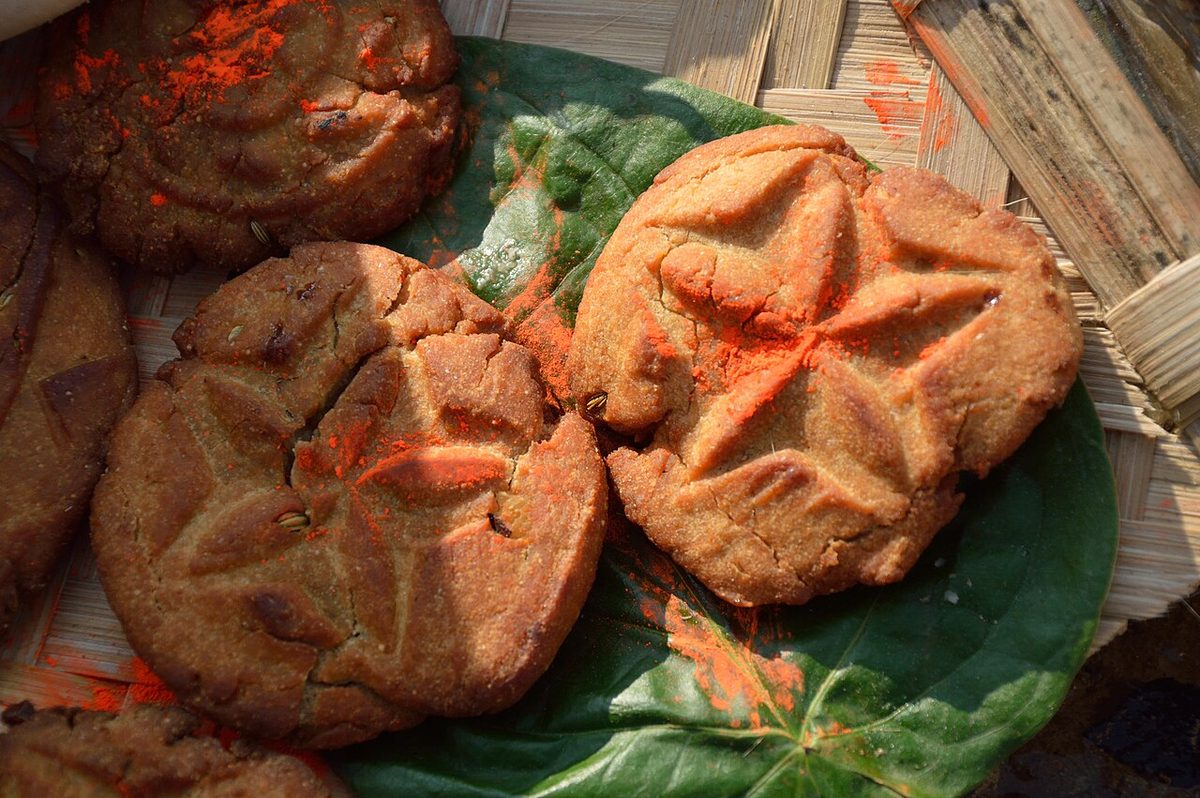 Thekua in an offering basket during Chhath on the bank of the Hooghly River in Kolkata, November 9, 2013. Photo by Biswarup Ganguly, CC BY 3.0, via Wikimedia Commons.
The food is as much a part of the tradition as the prayers. Thekua, made from wheat flour, jaggery or sugar, and ghee, is often pressed into carved wooden molds before being fried. Every family seems to have its own recipe. It keeps well, too, which is perhaps why it travels so easily in suitcases from Bihar and Jharkhand to the rest of the world.
Chhath is often praised for its closeness to nature. Its offerings are largely agricultural produce, and its worship takes place in the open air. Yet maintaining that relationship with nature has become harder as the festival has grown. Polluted rivers, discarded offerings, and overcrowded ghats now require considerable civic attention.
In Jamshedpur, the Subarnarekha and Kharkai rivers remain central to the celebration. The city, built around Tata Steel, has long been home to families who migrated from Bihar, Uttar Pradesh, Odisha, Bengal, and elsewhere. Their festivals became part of Jamshedpur's cultural life.
This November, as the city prepares for Chhath, municipal authorities have begun cleaning and repairing the major ghats along the two rivers. Lighting and other safety arrangements are being put in place for the thousands of devotees expected to gather there.
But Chhath has long since traveled beyond the rivers of eastern India.
When I moved to Chicago, I was surprised one day to receive a call from a friend who, like me, had come from Jamshedpur. She asked whether I wanted to attend Chhath puja.
I had never imagined that the festival I associated so closely with the Subarnarekha would be celebrated here.
The puja was being performed by Neelu di, as we affectionately call her. She observes Chhath every year. Instead of standing in a river, she stepped into a giant tub filled with water to offer arghya to the Sun.
I remember being struck by the sight. The familiar ritual was taking place thousands of miles from Jamshedpur, in a very different setting. Yet the prayers, the offerings, and the devotion were the same.
That was many years ago, and the celebration was miles from my home.
Today, in Naperville, where I live, several of my friends have become vratis, devotees who undertake the Chhath vow themselves. Every year, we look forward to gathering for Chhathi Maiya's puja.
What once seemed a surprising reminder of home has become part of our community's annual life.
This is how Chhath has spread across the world. In Nepal's Terai, it has deep regional roots. In Mauritius, Fiji, and Suriname, families have preserved it across generations. More recent migrants have carried it to Europe, the Middle East, and North America.
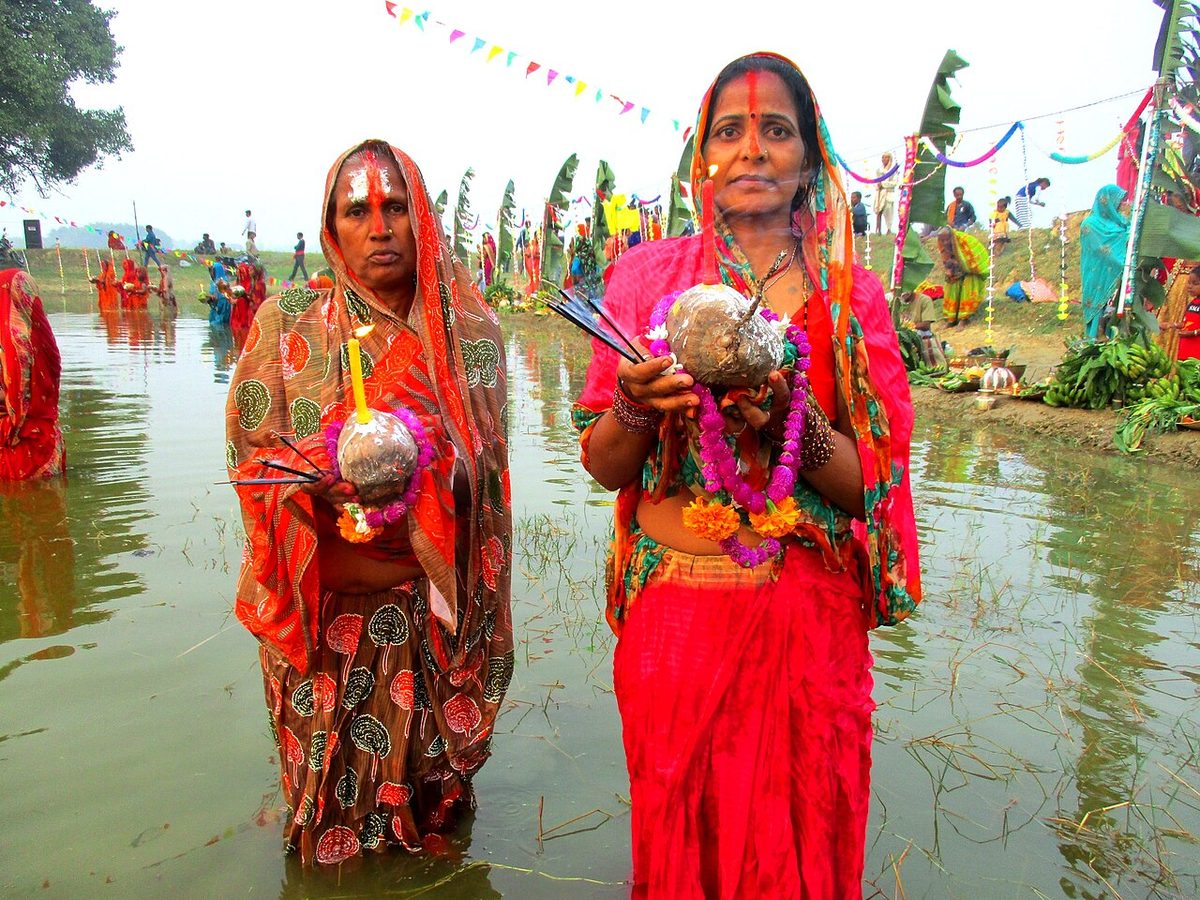 Women offer arghya to the Sun during Chhath in Kataiya, Saptari district, in Nepal's Terai, November 2018. Photo by Subhmanish, CC BY-SA 4.0, via Wikimedia Commons.
For many of these families, music provides another connection to home. For decades, the voice of Sharda Sinha, the beloved folk singer known as the Bihar Kokila, or Nightingale of Bihar, accompanied Chhath celebrations. Her Bhojpuri and Maithili songs played in kitchens, along village roads, and at crowded ghats.
Sinha died on November 5, 2024, just as that year's Chhath celebrations were beginning. Her recordings continue to accompany the festival, but her absence is deeply felt.
In 2026, Chhath will be observed from November 13 to 16, with the evening offering to the setting Sun on November 15 and the final morning prayers on November 16.
This year's celebration comes as India seeks international recognition for the festival. The government has nominated Chhath Mahaparva for UNESCO's Representative List of the Intangible Cultural Heritage of Humanity in the 2026–27 cycle. The Ministry of Culture has also held discussions with countries including Suriname, the Netherlands, and the United Arab Emirates to support a multinational nomination.
The festival has not yet been inscribed on the list. But the nomination acknowledges something that families have demonstrated for generations: a tradition can remain alive even as its practitioners move across borders.
For me, Chhath still brings back that November morning on the banks of the Subarnarekha. My mother's bucket of warm water, my school uniform, the women standing in the river, the little lamps floating on the water, and the taste of thekua.
Years later, I watched Neelu di offer the same prayers while standing in a tub of water in Chicago. Today, I watch friends in Naperville observe the same vow.
I did not know, at seven, how old the tradition was or how far it would follow me. I remember standing quietly among the worshipers as the Sun began to rise. Everyone had folded their hands in prayer, and for a few moments, even we children stopped thinking about the prasad.
That is the image I carry with me, wherever Chhath is celebrated.



Comments
Loading comments…