Sarvam, India's sovereign AI pick, now serves Chinese models and draws a backlash
Sarvam AI, the startup India chose in 2025 to build its own large language model, now runs Chinese models from DeepSeek, Moonshot AI and Z.ai on Indian servers. Critics question the mission. The founders say the chips are paid for with private money.
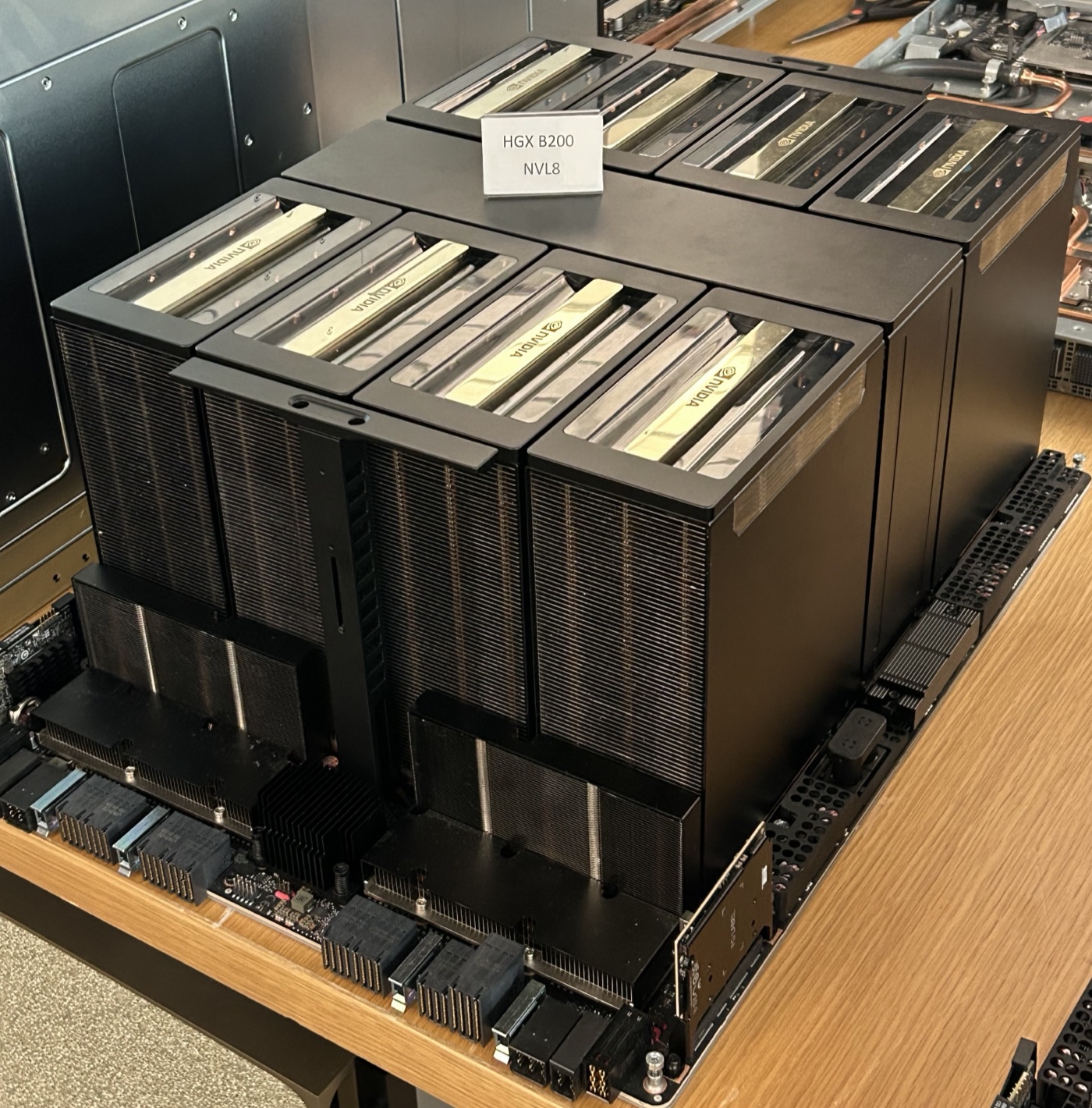
Top image: An Nvidia HGX B200 board carrying eight graphics processors, the chip generation Sarvam AI says it runs, photographed on September 7, 2025. The photographer did not record the location. Photo by Pokiiri, CC BY-SA 4.0, via Wikimedia Commons.
In April 2025, India's IT ministry picked Sarvam AI, a Bengaluru startup, to build the country's first sovereign large language model, Mint reported. Now it also sells access to Chinese ones.
The new service is called Token Factory, and Sarvam launched it on Monday, November 16. It serves open-weight systems from the Chinese labs DeepSeek, Moonshot AI and Z.ai on computers in India, Bloomberg reported in a story carried by Business Standard. Sarvam's own model sits on the same menu. By Thursday the company faced an online backlash.
The fight is over public money and public purpose. The IndiaAI Mission, a ₹10,370 crore government program, aims to cut India's reliance on foreign technology, ANI reported on Monday. Homegrown models are one of its goals. Sarvam was one of the first startups it gave subsidized computing power, according to the Bloomberg story. Bloomberg called the company the poster child of India's push for AI built around its own languages.
Token Factory sells inference. That is the step where a trained AI model reads a prompt and writes an answer, and customers pay per token, a small unit of text, Business Standard explained. Open-weight models are ones whose makers publish the files. Anyone with enough chips can run them.
Sarvam's launch post lists GLM 5.3, DeepSeek V4 Pro, Kimi K3.1 Pro and Google's Gemma 4 31B beside its own Sarvam 105B. All run on chips in India. The post said Sarvam already serves more than 450 billion tokens a day on DeepSeek V4.1 Flash. That model is Chinese. It costs ₹14 per million input tokens and ₹55 per million output tokens at introductory rates, Sarvam's price list shows. Sarvam 105B is listed at ₹10 and ₹25.
One early critic was Sanchit Monga, chief executive of RunAnywhere, a US-based AI inference company. India's sovereign AI lab is "mostly serving Chinese models from Indian GPUs," Monga wrote on X on November 17. "That's a hosting business, and plenty of companies already run one," he added.
His post also counted the help Sarvam received. Monga wrote that the company got a ₹98.68 crore subsidy for 4,096 Nvidia H100 chips. Mint's April 2025 report put the number at 4,086 H100s for six months. Of the eight models then on the menu, Monga counted six as Chinese. Sarvam's price list now also carries Qwen 3.8 27B, a model from China's Alibaba.
A second critic worried about power in one place. Srikanth Lakshmanan, founder of CashlessConsumer, objected to Sarvam becoming a central provider of inference. The government should "decentralise to districts and make the growth distributed, equitable," he wrote on X on November 19.
Pratyush Kumar, Sarvam's co-founder, answered the money question in a post on X on Sunday, November 22, ANI reported. He said the mission gave Sarvam a 40 percent discount on graphics processors and that the subsidy was paid to the cloud providers that rent them. The government did not pay Sarvam directly, he said. Sarvam used that access to train Sarvam 105B from scratch.
That access ended in March 2026, Kumar told The Hindu BusinessLine, MediaNama reported. "We serve multiple open-weight models on GPUs we have privately procured," Kumar wrote in the same post. "Building inference capability does not conflict with our core mission: training our own models," he added. India, he wrote, "consumes a few trillion tokens a day and imports the majority of them."
Vivek Raghavan, the other co-founder, drew a line between the two sets of hardware. "Those chips are entirely funded by private money," Raghavan said in an interview with Bloomberg. He said hosting the models in India keeps Indian users' data inside the country. In the same interview Kumar said, "We haven't changed our motto." Sarvam's FAQ says requests are not forwarded to the original model developer's overseas API.
Some industry voices took Sarvam's side. Lightspeed has invested in Sarvam. Its partner Hemant Mohapatra wrote on X that he was "obviously biased as an investor." He said he didn't understand "why launching a token-factory product is getting so much criticism." Global players make large sums hosting models in India for customers who can't find GPUs elsewhere, he argued.
MediaNama's founder took a middle line. Nikhil Pahwa wrote on X that he had "no problem with Sarvam serving Chinese models." He doubted the pitch to customers. Apart from Sarvam's own models, "there's very little reason to switch to Token factory," Pahwa wrote. Its DeepSeek price matched other services, he said. He added that Sarvam owes the government only what its contract says.
It was not clear what the IndiaAI Mission required of Sarvam in return for the discounted chips. Sarvam has not said what share of Token Factory traffic goes to Chinese models.
Sarvam is not the only Indian host. E2E Networks launched a similar service called Blaze on November 2, offering DeepSeek, Qwen, GLM and Gemma, Business Standard reported. Amazon Web Services sells other companies' models through Bedrock. Sarvam's position differs because the government selected it to build indigenous models, the paper noted.
Token Factory sells to developers and businesses. Sarvam's own newest model, Sarvam-105B-1711, went up on Sunday, November 22.

Comments
Loading comments…