Concerns grow over children using tablet computers

Electronic tablets like the iPad were becoming a fixture of childhood in 2012 \u2014 and the experts were only beginning to figure out what that meant. At a New York panel titled "Baby Brains and Video Games," researchers and educators urged parents not to rush to judgment, but not to be complacent either.
"It's a topic that really emerged in the last two years. You can't pull it from their hands," said Warren Buckleitner, editor of Children's Technology Review, of how quickly tablets had spread among young kids. A late-2011 survey of more than two thousand parents and children in Britain and the United States had found that a sizable share of kids between three and eight were already using a parent's iPad, and most parents surveyed believed tablets were beneficial and helped develop creativity.
"Technology maybe fosters some things and dampens others," said Rosemarie Truglio of Sesame Workshop. "It's definitely about balance."
Lisa Guernsey, director of the Early Education Initiative at the New America Foundation and author of Screen Time, pushed back on the loudest critics, urging them to distinguish "between a cause and an association" when blaming devices for developmental problems \u2014 while still urging parents to set limits: "Can they focus on a conversation, not look at a screen for 30 minutes?" Truglio added that researchers have long established that children need adult-child interaction on top of any electronic helper: "Interactive doesn't mean educational."
Science writer Annie Murphy Paul, author of Origins: How the Nine Months Before Birth Shape the Rest of Our Lives, counseled against panic \u2014 "your brain is changing all the time, each time you learn something new" \u2014 while admitting she strictly limited her own children's access.
Buckleitner's bottom line: don't let the iPad become an electronic babysitter, but don't fear it either. It can be "a shelf of toys." Trust your gut.
Based on reporting from the "Baby Brains and Video Games" panel, as covered by Yahoo News in March 2012.
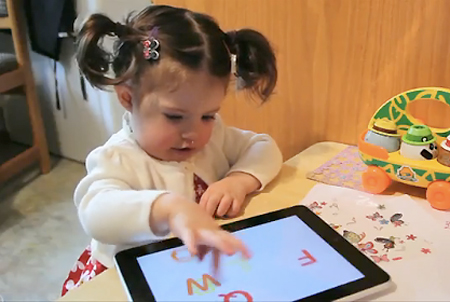 Electronic tablets like the iPad are a revolutionary educational tool and are becoming part of childhood, but should be watched carefully so that overuse doesn't lead to learning or behavioral problems, experts say.
"It's a topic that really emerged in the last two years. You can't pull it from their hands," Warren Buckleitner, editor of Children's Technology Review, said this week at a New York panel titled "Baby Brains and Video Games."
According to a late 2011 survey of 2,200 parents and children in Britain and the United States, 15 percent of kids between three and eight had used their parents' iPad. Nine percent had their own iPad, while 20 percent had their own iPod.
The same study, by the marketing agency Kids Industries, found 77 percent of parents believed that using tablets was beneficial for their children and the same number thought the gadgets helped develop creativity.
Amid warnings from some researchers that tablets can cause developmental difficulties and problems including autism or attention deficit disorder, experts at the forum recommended not rushing to judgment.
"Technology maybe fosters some things and dampens others," Rosemarie Truglio, from the children's TV producers Sesame Workshop, said. "It's definitely about balance."
Lisa Guernsey, director of the Early Education Initiative at the New American Foundation, said that critics blaming devices like the iPad for child developmental problems should differentiate "between a cause and an association."
Still, Guernsey, author of "Screen Time: How Electronic Media -- From Baby Videos to Educational Software -- Affects Your Young Child," urged parents to establish limits on use of electronic devices.
"Can they focus on a conversation, not look a screen for 30 minutes?" she asked.
Truglio noted that "researchers have proven they need adult-child interaction," in addition to the electronic helper. "Interactive doesn't mean educational," she said.
Annie Murphy Paul, author of "How the Nine Months Before Birth Shape the Rest of Our Lives," said there's no need to panic.
"Your brain is changing all the time, each time you learn something new," she said.
But Paul said she strictly controls her own offspring's access to such devices and remains concerned "about the value" for small children.
For Buckleitner, it's all a question of balance. Don't let the iPad become an electronic babysitter. But it can be "a shelf of toys. It could be a lot things," she said. "Trust your gut."
Related Stories

Praise or not to praise your kid?
Process praise beats person praise: why praising a child's effort — not their 'greatness' — builds resilience, and why praise for everything backfires.

Kindness Can Be Taught to Kids — Start as Young as Three
Kindness isn't just a trait kids are born with — research suggests it's a teachable skill, and age three is exactly the right time to start.

Should Children Sleep With Their Parents? What Sleep Science Says
Co-sleeping is normal across much of the world, but the safety evidence is nuanced. Room-sharing vs bed-sharing, SIDS risk, and what research supports.