Baboons can tell real words from fake ones, study finds

Learning to read may depend less on speech than on a brain's ability to spot regular patterns in letters \u2014 and that ability appears to be neither uniquely human nor uniquely linguistic, according to a study published in the journal Science in April 2012.
Researchers led by Jonathan Grainger at the Laboratoire de Psychologie Cognitive (CNRS/Aix-Marseille University) trained six Guinea baboons on a touchscreen task: four-letter sequences flashed on screen, and the animals learned to tap an oval shape for correctly spelled English words and a cross for nonwords, earning a piece of cereal for each right answer.
Within a few days \u2014 and after several thousand trials \u2014 the baboons could reliably distinguish words like "bank" from near-misses like "jank." More strikingly, after memorizing the spelling of several dozen words, they answered correctly for words they had never seen before.
That rules out simple shape memorization. Instead, the researchers concluded, the baboons had learned the frequent letter combinations of English and could detect anomalies \u2014 letters out of their usual place.
The finding challenges the long-held assumption that spelling skill grows out of spoken-language ability (children do learn spelling through sound). It suggests that reading rests, at least in part, on an older capacity: perceiving and memorizing regular patterns in a visual object \u2014 a capacity that most likely predated the advent of speech in human evolution.
This item was updated during our 2026 editorial audit and rewritten to replace the original press-release copy.
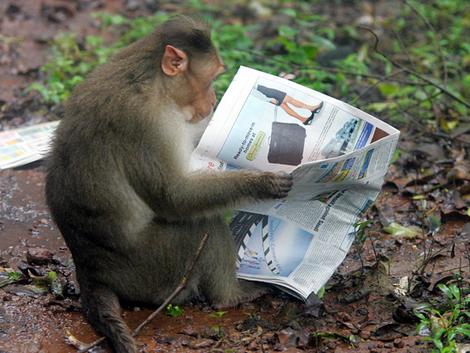 Learning to read is not just to do with speech, but also with the ability to recognize and memorize regular patterns among the letters that make up words, according to a new study on baboons. New results show that monkeys identify specific combinations of letters in words and detect anomalies -- a capacity that certainly existed before speech.
How do humans learn to distinguish between correctly and incorrectly spelt words? What mechanisms allow them to recognize, in just a few hundred milliseconds, that "animal" is a word but "azimal" is not? It was long thought that this capacity stemmed from spoken language because children learn spelling based on the oral language skills that they have already acquired, for example putting "m" and "a" together to make the sound "ma," "d" and "a" to make "da," etc. Understanding of spelling thus seems closely related to speech.
However, a team of researchers at the Laboratoire de Psychologie Cognitive (Cognitive Psychology Laboratory, CNRS/Aix-Marseille University) in Marseille has now challenged that theory through a study carried out on baboons. Their experiment consisted in showing the monkeys words made up of four letters on a touch screen.
The baboons were taught to press an oval shape if the word was spelt correctly or a cross if it was not, and were rewarded with a piece of cereal for each right answer. In just a few days -- and after several thousands tries -- the baboons learned to distinguish English words like "bank" from similar nonwords like "jank." More surprisingly still, after memorizing the spelling of several dozen words, the baboons gave right answers for words that they had never seen before. This suggests that they did not memorize the overall shape of the words, although they certainly would have the ability to do so. According to the researchers, the monkeys can detect and memorize regular patterns in the organization of words: they are able to learn frequent letter combinations in English words, and thus detect anomalies, i.e. letters not in their usual place.
As far as humans are concerned, these results suggest that reading is based, at least in part, on our capacity to perceive and memorize regular patterns in the components (letters) of an object (the written word). This ability, neither specifically human nor specifically linguistic, most certainly predated the advent of spoken language in the history of human evolution.[youtube]http://www.youtube.com/watch?v=LbCvHGaejRE[/youtube]
Related Stories

Your brain on fiction: what neuroscience finds in a novel
Brain scans show novels light up more than the language centers — fiction trains empathy, simulates experience, and rewires how we understand others.

Elementary School Abolishes Homework
Gaithersburg Elementary scrapped worksheets in 2012 and assigned only 30 minutes of nightly reading — and test scores held up.

How did successful people spend their time when they were young?
A popular Quora thread asked what Steve Jobs, Elon Musk, Bill Gates and others did between ages 10 and 22. The answers share a striking pattern.