What India's test-prep machine understood about reading before America did
US seniors posted their worst-ever reading scores; India's foundational reading is recovering. India treats reading as a skill. America treats it as taste.
In brief: America's high-school seniors just posted their worst reading scores in the history of the national assessment, while India's foundational reading is quietly recovering from its pandemic lows. The difference is not money or culture. It is a framing choice: India's exam machine treats reading as a skill you train, with drills, timing, and deliberate practice. America's schools increasingly treat it as a taste you acquire, through exposure and encouragement. Both can fail. Right now, only one side's data is pointing up.
Two reports, one year apart, opposite directions
Start with the numbers, because the argument needs them.
In September 2025, America's National Assessment of Educational Progress released its first update on high-school seniors since before COVID. The results were, in the acting commissioner's word, "sobering." Twelfth-grade reading scores were lower than in all previous assessments, and 10 points below where they stood when NAEP first measured 12th-grade reading in 1992. Nearly a third of seniors, 32 percent, scored below the NAEP Basic level, up from 20 percent in 1992. Only 35 percent reached Proficient. The decline was concentrated where it hurts most: scores fell at every percentile except the 90th. The strongest readers held steady. Everyone else slid. (District Administration, EdChoice)
Four months earlier, on the other side of the world, India's Annual Status of Education Report (ASER) 2024, compiled by the NGO Pratham across hundreds of rural districts, told the opposite story. Children reading a Class II-level text in Class V rose from 42.8 percent in 2022 to 48.8 percent in 2024; in Class III, from 20.5 to 27.1 percent. Government schools, the ones everyone writes off, recovered fully to their pre-pandemic reading levels. Analysts credit the grind of the NIPUN Bharat foundational-literacy mission and the slow, unglamorous repair of classroom practice. (ForumIAS, Insights on India)
One country is relearning to read from the bottom up. The other is losing it from the bottom down.
What the Indian machine actually does to reading
India's test-prep industry is now a multi-billion-dollar apparatus. IMARC Group puts the coaching-institutes market at roughly $7.2 billion in 2025; Redseer's consulting estimates project the broader test-preparation market toward $23–26 billion by FY30, with JEE and NEET together accounting for nearly 70 percent of undergraduate entrance preparation. The odds are feral, roughly 1 percent for an IIT seat and 3 percent for a preferred government medical seat, per Redseer. (The Hindu BusinessLine)
Say what you like about this machine, and plenty should be said, it settled a philosophical question early and never looked back: reading is a performance skill, and performance skills are built by reps.
Walk through the method and it is almost embarrassingly unmysterious. Vocabulary is drilled like multiplication tables, often fifty words a day with roots and usage sentences. Reading comprehension is trained as a timed event: passages under the clock, questions answered by eliminating wrong options, not by feeling the right one. The CAT exam's verbal ability and reading comprehension section, the SSC and banking exams' English papers, the CLAT's passage-heavy papers, all reward the same moves: find the structure of the passage first, answer second, never re-read the whole thing, manage your minutes like money. Slow readers do not "develop a love of reading" and then get fast. They get fast on purpose, thousands of passages deep, and the love, where it comes, arrives later, as a side effect of competence.
Nobody in Kota ever said "just read what you enjoy and the scores will follow." The machine would consider that a dereliction. You want the score, you do the reps. That is the whole religion.
America's missing drill sergeant
Now look at the American decline again through this lens. The NAEP numbers have a shape: the top 10 percent of readers are fine, everyone else is slipping, and the bottom is at historic lows. That is exactly the shape you would expect from a system that asks children to acquire reading by exposure rather than training.
Exposure works beautifully for the top of the distribution. A bright kid in a house full of books, a school with a good library, a teacher who assigns interesting novels, that child builds reading the way a swimmer in a pool builds swimming: just being in the water does most of the work. But the child with no pool, no coach, and nobody timing laps does not become a swimmer by being told that swimming is wonderful. The bottom percentiles of American reading are the children for whom exposure alone was never enough, and the system's answer has largely been more exposure: more books, more encouragement, more "find your passion."
India's machine, whatever its cruelties, never made that error. It assumes the child cannot read the passage, and it drills. The ASER recovery did not come from inspiring speeches either; it came from the least glamorous lever in education policy, structured foundational-literacy practice, repeated daily, measured by whether a child can actually read the sentence in front of them.
The quotable version: India treats reading as a skill you train. America treats it as a taste you acquire. Taste is a fine thing to have. It is a terrible thing to depend on.
The honest limits of this argument
This is where the article has to be honest, because the thesis is flattering to India and flattery needs a leash.
First, India's recovery starts from a low floor. Even after the ASER 2024 gains, more than half of Class V children, 55.2 percent, cannot read a Class II-level text. Three-quarters of Class III cannot. The machine has not solved reading for India; it has started repairing it. Recovery is not victory.
Second, the test-prep machine is a brutal instrument. A year of coaching, hostel, and food in a hub city commonly runs ₹3–5 lakh, drop years multiply the cost, and the success odds quoted above mean the machine's reading drills mostly serve the already-advantaged. (The Core) Treating reading as a trainable skill is a good insight; rationing the training by parental income is not.
Third, America's problem is not that its schools never heard of phonics or practice. Plenty of American educators have been making the training argument for years, and the decline has causes beyond pedagogy: chronic absenteeism (nearly a third of seniors missed three or more school days in the month before the 2024 assessment), the pandemic's long tail, phones in every pocket. Drills alone would not have held the line.
But the core holds: whatever else is true, one country is acting as if reading must be built, and its numbers are rising. The other acts as if it must be caught, and its numbers are falling.
What a parent can actually take from this
The practical lesson is almost boring, which is probably why it works. Reading improves like any other skill: daily, timed, slightly-too-hard practice, with immediate correction. Vocabulary learned in context, not from lists alone. Comprehension checked after every passage, not after the chapter. Speed built deliberately, because the tests, and life, are timed.
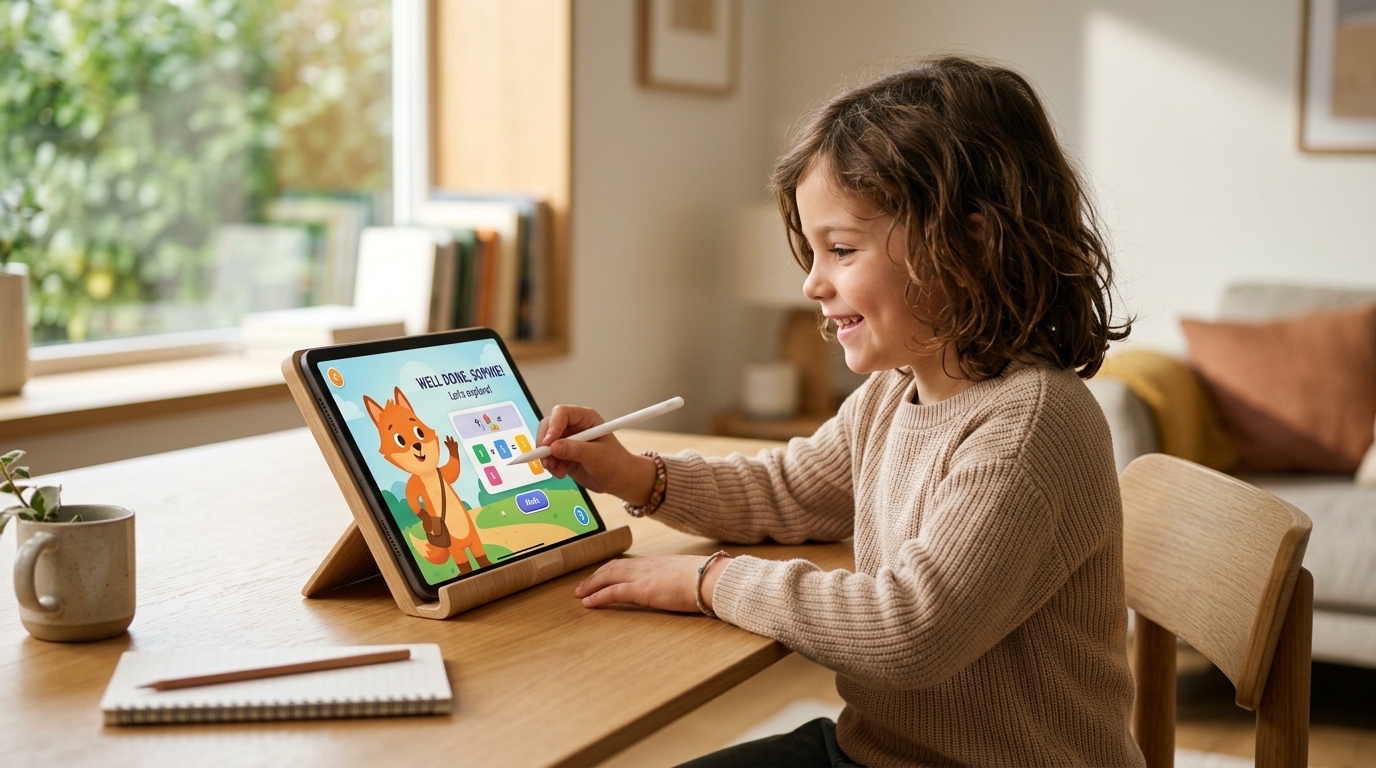
This is also the premise behind the new wave of AI reading tutors aimed at K-10 students: practice-first, passages under the clock, vocabulary and comprehension drilled together. It is the lane FlyingMinds is working in, an AI tutor for K-10 reading and English (with SAT prep layered on), built on the unglamorous theory that a child becomes a reader one corrected passage at a time. The brand does not matter much; the mechanism does. Any parent, on any continent, can steal the mechanism for free: twenty minutes a day, a passage, a timer, and questions you check together.
India's test-prep machine understood this before America did. It understood it the way a factory understands physics, without romance, and sometimes without mercy. The romance can come later. The reps cannot wait.
Frequently asked questions
Is India's test-prep system actually good for reading? It is good at producing readers at the top and at drilling the mechanics into anyone who can afford to stay in the system. It is not good at equity, childhood, or mercy. The lesson to take is the method (deliberate, timed, corrected practice), not the machine.
How bad is America's reading decline, really? For 12th graders, 2024 was the worst reading result in NAEP's history: scores lower than every previous assessment, 10 points below 1992, with 32 percent below basic. The decline predates COVID and is concentrated in the bottom percentiles; the top 10 percent held steady.
Is India's foundational reading actually improving? Per ASER 2024, yes, from pandemic lows: Class V children reading a Class II text rose from 42.8 to 48.8 percent between 2022 and 2024, with government schools recovering to pre-pandemic levels. But more than half of Class V still cannot read at that level, so the base is low.
What can a parent do this week? Twenty minutes a day: one passage, a timer, vocabulary in context, and comprehension questions checked immediately. Treat reading like a skill session, not a mood. That is the whole method, and it costs nothing.