The Tutoring Trap: Why Worksheets and Gamified Apps Are Failing Our Children—and How Adaptive Socratic AI Is Changing the Math
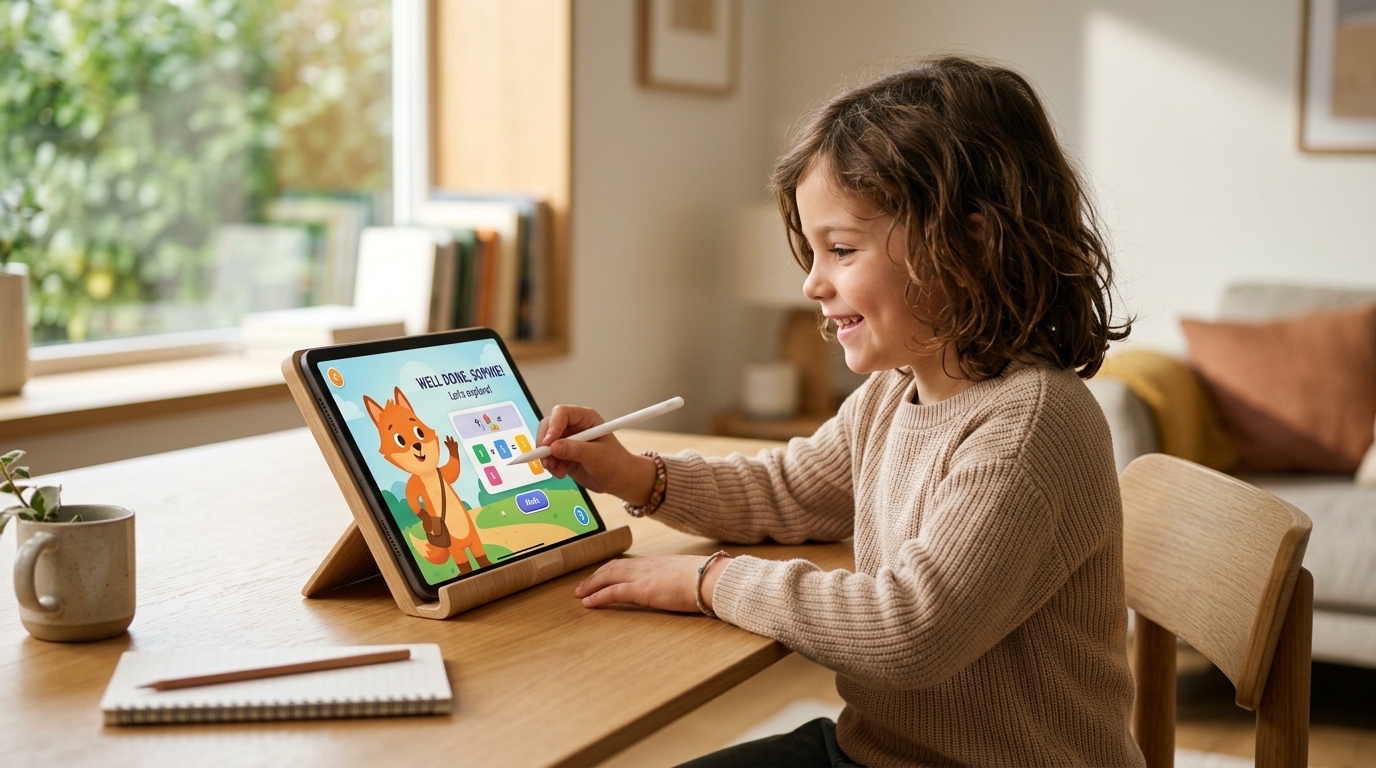
If you walk into the kitchen of almost any ambitious suburban household around six-thirty on a school night, you see the exact same quiet battle unfolding. A ten-year-old sits slumped over the table, either staring blankly at a thick stack of paper math worksheets or tapping frantically on an iPad screen that looks more like a carnival arcade than an educational tool.
Parents today are pouring more money, time, and emotional energy into their kids' schooling than any generation before them. In competitive school districts—whether you are looking at suburban Chicago, North Texas, or the San Francisco Bay Area—after-school enrichment has practically become a second car payment. Families regularly shell out hundreds of dollars a month at strip-mall learning centers, or around $90 an hour for private tutors, desperate to make sure their children don't fall behind in reading comprehension, analytical writing, or gifted placement exams.
Yet when you look at national reading comprehension and critical reasoning benchmarks, the numbers keep sliding. Kids are memorizing steps to pass Friday's quiz, but when handed an unfamiliar text or a multi-step word problem that requires independent reasoning, their confidence evaporates.
The issue isn't that our kids are unmotivated or that parents aren't trying hard enough. The problem is that the two main tools parents have been handed outside the classroom are fundamentally broken.
The Two Traps: Repetitive Drills vs. The Dopamine Slot Machine
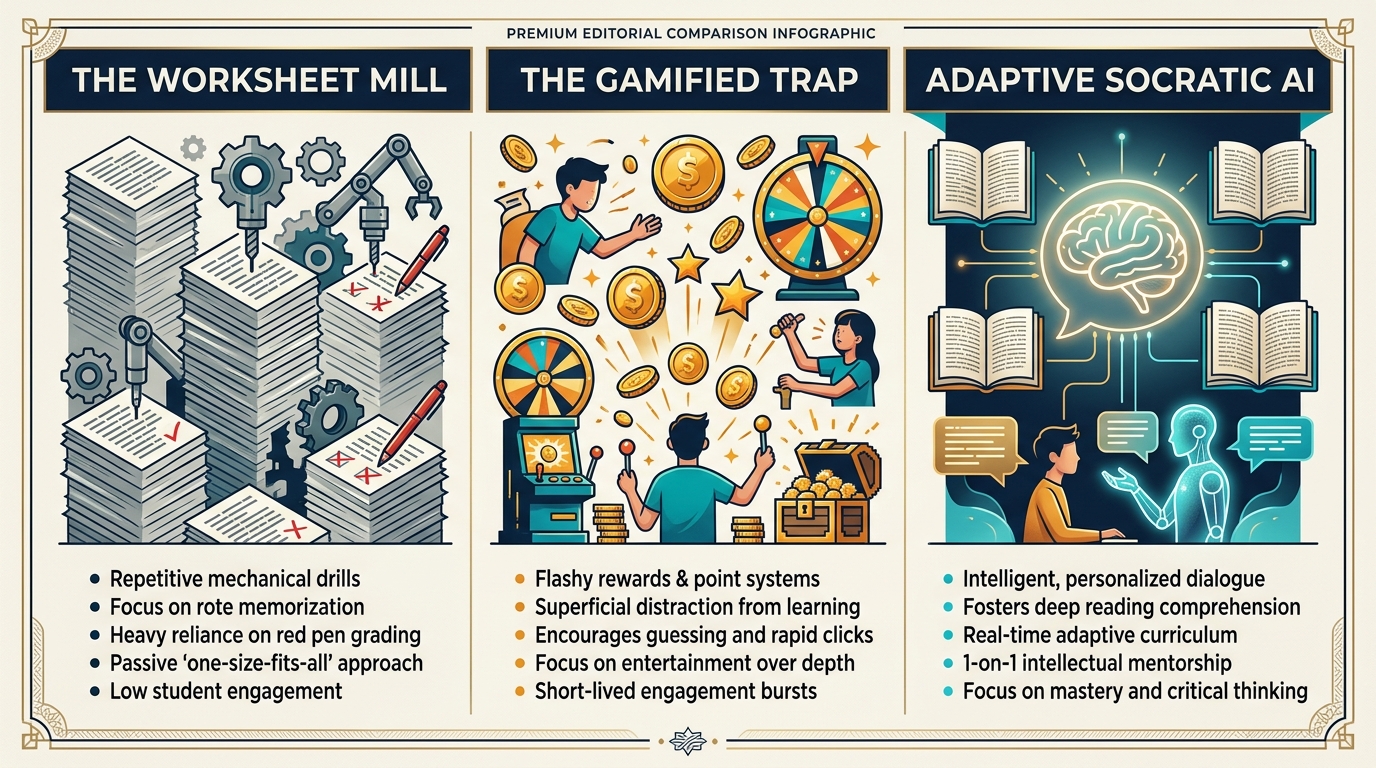
On one side sits the legacy worksheet factory. This model hasn't changed since the 1970s: give a child forty nearly identical arithmetic drills or grammar fill-in-the-blanks every single day. If they make two mistakes, hand them forty more sheets next week.
Repetition can build raw calculation speed in first or second grade, but it hits a wall the moment learning demands higher-order thought. It teaches pattern recognition without conceptual understanding. A student learns exactly where to stick a comma on a pre-printed drill sheet, but struggles to construct a coherent, persuasive paragraph on their own. Worse, it turns learning into pure compliance. By fourth or fifth grade, bright kids come to dread study time because it feels like mindless factory labor.
On the other side of the room sits the modern tablet app. Built as a reaction to paper drill fatigue, these apps turned homework into an animated video game. There are mascots doing backflips, spinning prize wheels, daily streak counters, and digital coin stores to buy virtual hats.
What actually happens when a nine-year-old uses these platforms? Cognitive scientists and observant parents notice the same trick: kids learn to game the system. They rapidly click through four-choice multiple-choice buttons until they hear the cheerful chime, collect their gems, and move on—without reading the passage or thinking through the underlying concept. The moment you hand that same child a printed book chapter or a standard exam without sound effects, their focus dissolves within five minutes.
Why True Mentorship Changes Everything
Back in the 1980s, educational psychologist Benjamin Bloom proved something that every teacher instinctively knows: an average student paired with a dedicated one-on-one tutor using mastery learning outperforms ninety-eight percent of students taught in a standard classroom.
Bloom called it the "Two Sigma" phenomenon. The magic wasn't that the tutor gave better lectures. The difference was the back-and-forth dialogue—the Socratic method.
When a student makes an error in front of a great tutor, the tutor doesn't just circle the mistake in red ink and say "wrong, the answer is B." Nor do they immediately spoon-feed the correct answer. Instead, the tutor pauses and asks an unhurried question:
- "Take another look at the third sentence. What word there tells you how the captain actually felt about leaving?"
- "You subtracted twelve from the left side of the equation. What does the equals sign require you to do on the right side?"
- "If we followed your rule here, what would happen when that word becomes plural?"
That gentle conversational friction forces the child to pause, re-examine their own assumptions, and discover the error for themselves. It builds real cognitive stamina. Once a child figures out an answer through their own reasoning, the concept locks in permanently.
The problem, of course, was always economics. Having an exceptional educator sit beside your child three evenings a week has historically been an expensive luxury reserved for families who can comfortably spend several thousand dollars a month on private academic coaches.
The Socratic Companion: Where Thought Actually Happens
This is the exact challenge that platforms like FlyingMinds set out to solve.
Instead of building another multiple-choice quiz engine or a digital sticker book, FlyingMinds developed an adaptive Socratic learning companion named Fred. Fred doesn't just grade answers; he talks with the child, listening to how they explain their thinking and guiding them when they get stuck.
The approach addresses three crucial areas where traditional schooling and drill centers struggle most:
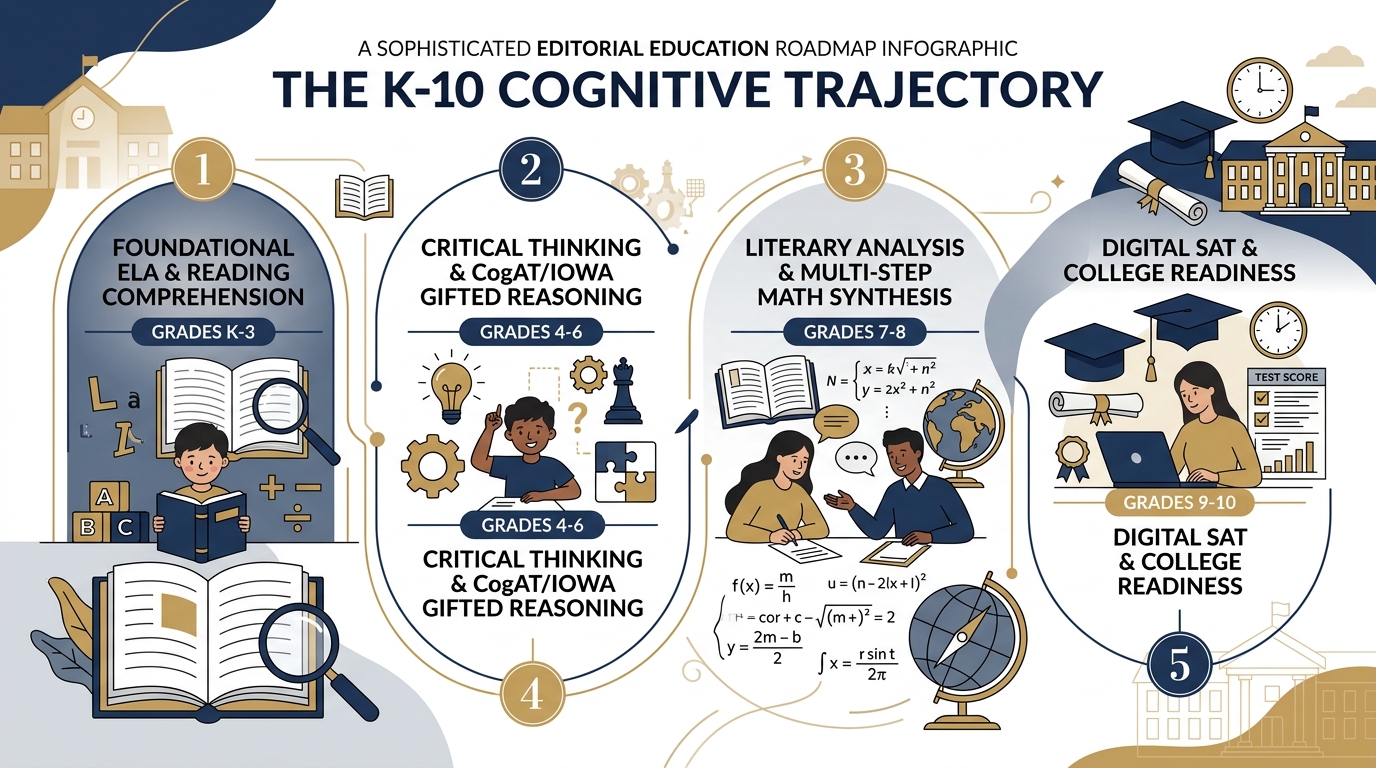
Deep Reading Comprehension and Writing. Most educational software sticks to basic math because grading numbers is simple. But the biggest hurdle for modern students is reading comprehension—deciphering tone, identifying rhetorical arguments, and building structured written responses. An adaptive companion walks through dense texts alongside the student, asking probing questions that teach them how to unpack complex passages rather than just skimming for keywords.
Cognitive and Gifted Reasoning. In top school systems, admission to advanced and gifted tracks hinges on assessments like the CogAT, OLSAT, or Iowa tests. These exams don't test memorized trivia; they test spatial puzzles, non-verbal logic, and relational analogies. When kids learn how to systematically break down these logic patterns without anxiety, it builds problem-solving confidence that carries across every subject.
Standardized Test Stamina. As testing from middle school through the digital SAT shifts to computer-adaptive formats, learning how to pace oneself through multi-step prompts without rushing is essential. Regular practice with responsive, conversational feedback helps students develop intuitive familiarity with adaptive exams, so test day feels like second nature rather than an ordeal.
Without the real-estate and administrative overhead of physical storefronts, the company prices its subscription at around $29 a month — less than a single half-hour session at a commercial franchise.
Raising Thinkers, Not Test Bubblers
Every parent wants to see their child succeed in school. But true academic confidence doesn't come from finishing fifty drill sheets before dinner, nor does it come from collecting virtual coins on a screen.
It comes from the moment a child wrestles with a hard problem, thinks it through out loud, catches their own mistake, and realizes: I can figure this out.
That is what great education has always looked like. And with adaptive Socratic tools now available to any family with an internet connection, that level of thoughtful, individualized mentorship is finally within reach for every child.
Disclosure: FlyingMinds is operated by the family behind Thoughtful India; it is cited above as one example of the approach described in this essay.
Related Stories
What India's test-prep machine understood about reading before America did
US seniors posted their worst-ever reading scores; India's foundational reading is recovering. India treats reading as a skill. America treats it as taste.
Are You Raising a Precocious Child?
Gifted children think differently — and that comes with emotional challenges: sensitivity, teasing, perfectionism, existential worry.

Feeding Young Minds: Resources for Curious Kids
From the TI archives: a parent's 2014 shortlist of magazines, toys, science kits, and free learning sites to keep kids aged 5–12 curious — most of them