The Texas Paradox: Bo French, the 'Perpetual Foreigner' Myth, and the New Reality of Indian-American Power
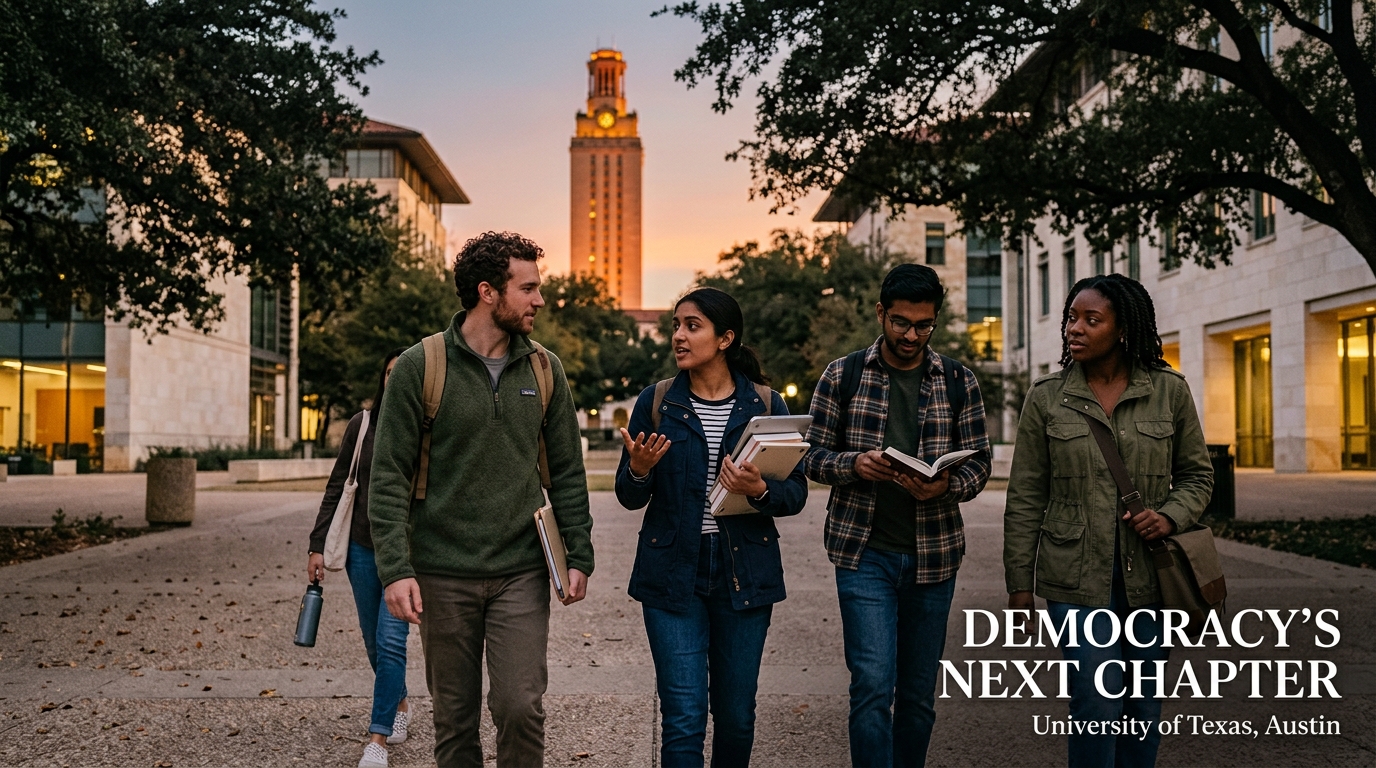
On a sunny Saturday afternoon in Austin, tens of thousands of college kids packed into the bleachers at Darrell K Royal–Texas Memorial Stadium. Among the cheering crowd was a group of young South Asian undergraduates—dressed head-to-toe in burnt orange, singing "The Eyes of Texas," with their hands thrown up in the Longhorn salute.
If you have spent any time in Texas over the last fifteen years, the scene was entirely ordinary. The University of Texas at Austin has long been a magnet for the state's top STEM talent, drawing competitive students from the tech corridors of Plano and Frisco, the medical research complexes in Houston, and energy offices across Dallas.
Yet within a matter of hours, a snapshot of those students became the center of a bitter online controversy. Bo French, the Tarrant County Republican Party Chairman, posted the image to his social channels, framing the sight as evidence of "foreigners displacing Americans" on Texas soil.
The reaction was immediate and unusually bipartisan. Senior conservative leaders, including U.S. Senator John Cornyn, publicly rebuked French, pointing out that xenophobic rhetoric has no place in the party, ignores Texas values, and denies the basic economic engine powering the state.
It would be easy to dismiss the episode as just another piece of political grandstanding designed to harvest internet outrage. But doing so misses the deeper cultural reality it uncovered. The post laid bare a glaring contradiction at the very core of modern Texas: what you might call the Texas Paradox.
Courting the Economy, Questioning the Neighbors
For two decades, Texas civic and political leaders have carried out one of the most aggressive economic development campaigns in American history. Promoted as the "Texas Miracle," the state lured corporate headquarters, semiconductor manufacturing plants, defense contractors, and biotechnology labs away from high-tax states like California and New York.
The pitch was straightforward: no state income tax, light-touch regulation, abundant land, and modern municipal infrastructure.
Major companies arrived in droves. Tesla moved its global headquarters to Austin. Oracle set up along the Colorado River. Samsung broke ground on a massive semiconductor foundry in Taylor, while Texas Instruments committed tens of billions to new chip manufacturing in Sherman.
Here is the crux of the paradox: you cannot recruit a multi-trillion-dollar high-tech economy and expect it to run without knowledge workers.
Semiconductor lithography, enterprise AI platforms, and cancer immunotherapy research do not run on political slogans. They run on graduate degrees in electrical engineering, linear algebra, distributed computing, and organic chemistry. And for decades, the demographic disproportionately doing that heavy technical lifting across Texas has been the Indian-American diaspora.
Between 2010 and 2026, the Indian-American population in Texas more than doubled, growing toward half a million residents. In North Texas suburbs like Frisco and Plano, families bought homes in master-planned communities, funded public school districts through property taxes, supported local hospital networks, and launched tech startups of their own.
The nativist reflex laid bare by politicians like French welcomes the tax revenue of the chip plant, the prestige of the Houston medical center, and the property tax base funding local infrastructure—yet balks at the reality of the brown engineer who designed the circuitry sitting in the front row of the football game.
The Persistent "Perpetual Foreigner" Trope
What made the controversy strike such a nerve was not just partisan friction; it was the assumption behind it. By casually labeling American university students as "foreigners," French revived an enduring American prejudice: the perpetual foreigner myth.
In that worldview, citizenship and belonging are judged purely by ancestry rather than civic commitment. It ignores the six figures paid in local, state, and federal taxes. It ignores military service, volunteer firefighting, and terms served on municipal school boards. An immigrant from Western Europe is automatically treated as a local, while a second-generation American of Indian descent is perpetually seen as an outsider on probation.
This double standard hits home hardest for the young people born and raised here. These are kids who grew up eating breakfast tacos, speaking with subtle Texas drawls, cheering for the Dallas Cowboys, and knowing no home other than the United States. To look up from a college football game and hear a county party chair declare that you are "displacing Americans" is a blunt reminder that for some, full civic belonging still comes with an asterisk.
From Silent Observers to Civic Participants
This controversy is not happening in isolation. It unfolds against a backdrop of prolonged policy friction for legal immigrants:
First, there is the grinding reality of the employment-based green card backlog. Hundreds of thousands of Indian engineers, scientists, and physicians across Texas live under the constant strain of temporary visas—paying full taxes, buying property, and raising American children, yet tethered to rigid employer sponsorship where an unexpected layoff gives them sixty days to uproot their lives.
Second, local suburban politics has grown increasingly fraught. School board and city council meetings in North Texas have seen outbursts where fringe agitators accuse legal homeowners of taking over local institutions.
Yet there is a clear shift underway: the era of the passive model minority is over.
Historically, earlier waves of immigrants often embraced a cautious philosophy: focus on work, provide for the family, avoid political controversies, and let quiet professional success speak for itself.
Today’s community understands that economic contribution without civic engagement leaves you vulnerable. Wealth without political representation offers little protection.
From school boards and municipal councils in Collin and Fort Bend counties to the state legislature in Austin, Indian-Americans are increasingly running for office, organizing voter turnout, and funding campaigns. They are making it clear that politicians cannot quietly solicit campaign contributions in private while remaining silent when nativist attacks surface in public.
Where Texas Goes From Here
Texas has always defined itself by frontier ambition—the idea that what matters is not where your ancestors originated, but what you can build, the cattle you can raise, and the enterprise you can create with your own hands.
If the state wants to remain an economic powerhouse, it has to move past its own contradictions. The young men and women cheering in the bleachers in Austin are not displacing anything. They are the fabric of modern Texas.
They are the engineers writing the next generation of automation models, the researchers running clinical trials in Houston, the entrepreneurs founding local businesses, and the taxpayers supporting public universities. Political commentators can cling to an imagined past, but the students singing under the Texas sun are already busy building its future.
Related Stories

'Living abroad makes you more Indian': inside the NRI identity debate
One NRI said three years in Paris made her 'more Indian than ever' — and the internet pushed back. Inside the diaspora's oldest identity argument.
Indian Americans in US Politics: Rising Influence
Kamala Harris, Nikki Haley, Vivek Ramaswamy — four million Indian Americans punch far above their numbers in US politics, holding structural power nationally.
The 'Dhokla Diplomacy' Debate: Culinary Hegemony, Diasporic Anxiety, and the Unapologetic Rise of Indian Soft Power
An expat debate over vegetarian summit menus reveals a deeper question: why does serving dhokla to foreign leaders make some NRIs cringe — and why shouldn't it?