India's gold paradox: at record prices, almost nobody is selling
Gold trades near ₹1.5 lakh per 10 grams, yet Indian households sold less old gold last quarter than at any point in three years. They are pawning it instead.
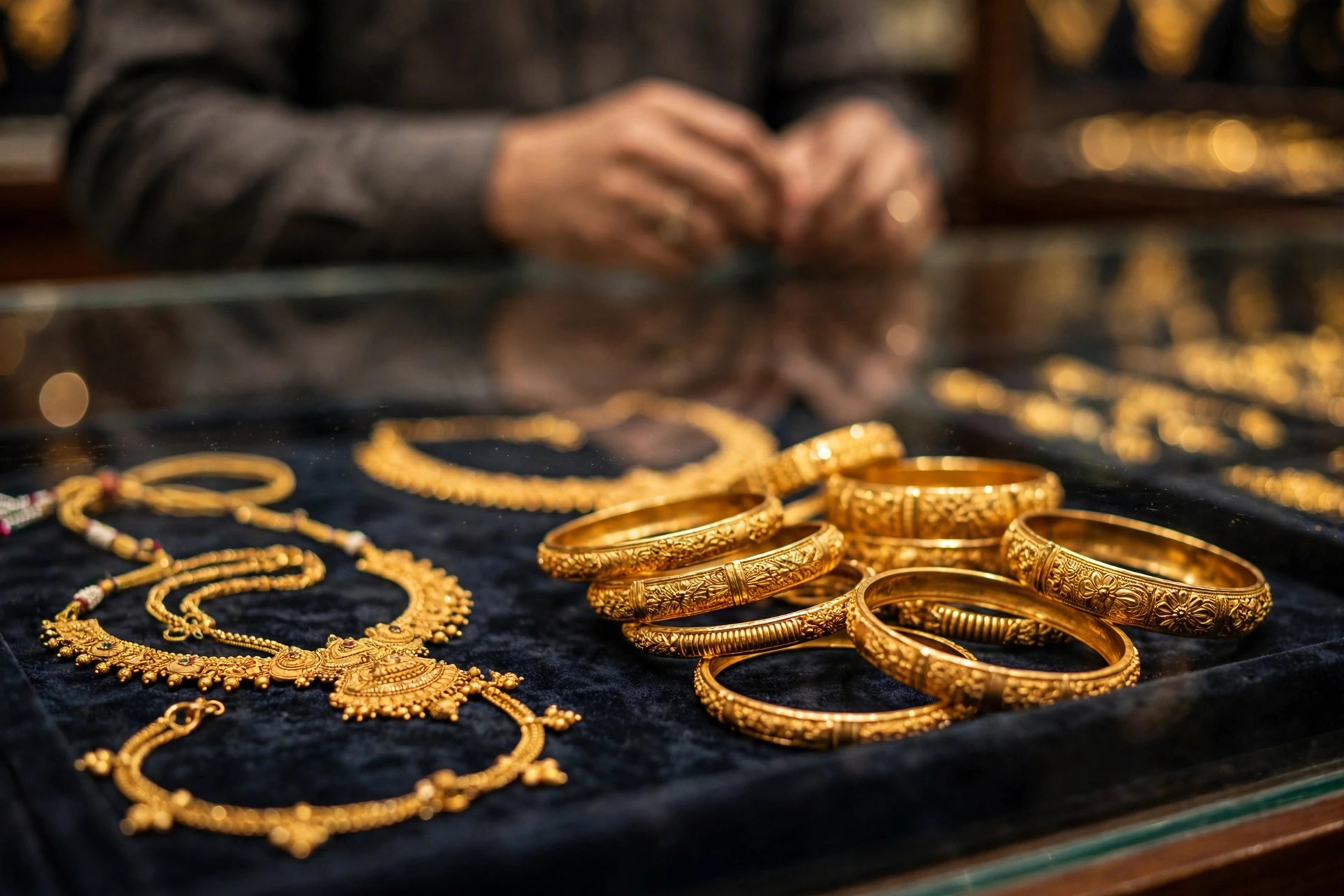
In brief: Gold is changing hands near ₹1.5 lakh per 10 grams, a level that would have sounded absurd two years ago. Textbook economics says households should be selling their old gold into this rally. The World Gold Council's latest India data says the opposite happened: recycling fell to an eleven-quarter low. Families are not selling the metal they worship. They are borrowing against it.
Featured image: Diwali sale signs in an Indian market, where gold jewellery sales peak in the festival season. (Photo: Caitlin Regan, CC BY 2.0, via Wikimedia Commons)
If prices are at records, why isn't anyone selling?
Start with the numbers. On October 7, the all-India reference rate for 24-karat gold was ₹1,50,068 per 10 grams, within touching distance of the ₹1,51,876 peak set on September 23. A year ago the quarterly average was under ₹95,000. In twelve months, the price of the metal sitting in India's household lockers has risen roughly 60 percent.
The World Gold Council's Q2 2026 India report, published at the end of July, captured what that rally did to behaviour. Total Indian gold demand slipped 6 percent by volume to 131.4 tonnes, but the value of what Indians bought hit a record ₹1.98 lakh crore, up about 50 percent from a year earlier. Jewellery volumes fell 15 percent to 75.1 tonnes while bar and coin investment rose 9 percent to 50.3 tonnes. Indians bought less gold and paid far more for it.
And the selling side is where the paradox lives. Recycled gold, which in the Council's definition means gold sold for cash rather than exchanged for other gold, fell 17 percent year-on-year to 19.2 tonnes. That is the lowest quarterly figure in eleven quarters. The report's own explanation is blunt: despite prices running about 60 percent higher than a year earlier, holders showed limited appetite to sell, preferring to monetise their holdings rather than liquidate them. The Council reads that as a bullish signal. Households are holding because they expect prices to go higher still.
There is a cultural fact underneath the data. In India gold is not merely an asset class. It is stridhan, wedding security, the thing a grandmother presses into a granddaughter's hand with instructions attached. Selling it outright carries a weight that a brokerage screen never will. At record prices that weight has, if anything, grown heavier: why sell the family gold at ₹1.5 lakh if you believe it will be ₹1.7 lakh by next Dhanteras?
What households are doing instead: pawning it
Here is the number that explains the quarter. Loans against gold jewellery by non-bank finance companies surged 68.5 percent year-on-year to ₹3.54 lakh crore in July 2026, according to Reserve Bank of India data. Bank credit against gold jewellery stood at ₹5.52 lakh crore. The RBI's June Financial Stability Report noted that gold-backed loans had become the largest segment within non-housing retail borrowing, compounding at 42.4 percent a year since March 2024. One analysis put the growth in retail loans specifically against household jewellery at 80 percent year-on-year.
Put the two datasets side by side and the story writes itself. Households looked at the same price chart the traders saw, needed cash, and chose the instrument that lets them have both: borrow against the necklace, keep the necklace. The World Gold Council's phrasing, "monetise rather than liquidate," is the polite version. The impolite version is that India is pawning its gold at a record pace while telling itself it hasn't sold a gram.
This is not purely distress, and it is not purely savvy. For some families it is rational balance-sheet management: the same bangles now collateralise a far larger loan than they did two years ago, at interest rates far below an unsecured personal loan, with the gold sitting in a vault instead of a locker. For others it is the lender of last resort wearing a respectable suit, as banks have tightened unsecured personal lending. Both things are true at once. The data does not let you pick just one.
Why jewellers are suddenly offering cash for your old gold
There is a second-order effect, and it showed up on high streets this year. Large jewellery chains that historically only accepted old gold as exchange against new purchases have begun offering cash for it. Tanishq rolled out a zero-deduction exchange programme, and Kalyan Jewellers' current exchange terms advertise 0 percent deduction on old gold, subject to purity verification. Mint reported the shift as a reversal of long-standing practice, driven by high prices and higher import duties squeezing the chains' own economics.
Tanishq's jewellery chief told Mint there are roughly 25,000 tonnes of gold sitting in private Indian lockers against annual imports of about 750 tonnes, and that about a third of the company's purchases are now linked to customers bringing in old gold, a share it expects to reach 40 percent. Whether or not you take a retailer's estimate at face value, the direction is clear: the industry has decided the country's real gold mine is not underground. It is in its cupboards.
The policy backdrop matters too. The Council's India head attributed part of the demand softness to higher customs duty and to the Prime Minister's public appeal to limit non-essential gold purchases, and flagged early reports of smuggling picking up after the duty hike. When the official channel gets more expensive, some metal finds unofficial ones. That is a pattern India has seen before.
What this means with Dhanteras a month away
Dhanteras, the day India ritually buys gold, falls on November 6 this year, with Diwali on November 8. The World Gold Council expects the festive and wedding season to support demand in the second half, noting that Indian consumers have historically adapted to high prices by adjusting the quantity or type of gold they buy rather than skipping the purchase. A thinner bangle, a smaller coin, but a purchase nonetheless.
That is the paradox in full. A country that searches endlessly for how to sell its old gold, faced with the best selling opportunity in its history, is instead borrowing against it, exchanging it for new designs, and preparing to buy more of it next month. The metal is worshipped, hoarded, pawned, and repurchased, but almost never truly sold. At ₹1.5 lakh per 10 grams, India has decided its gold is worth more than money. It just needs the money too.
Frequently asked questions
Is it a good time to sell old gold in India? Prices are near all-time highs, around ₹1.5 lakh per 10 grams for 24-karat gold in early October 2026. But the market data suggests most households disagree with selling: recycling hit an eleven-quarter low in Q2 2026 as holders bet on further gains. Any decision should weigh making charges lost on repurchase, capital-gains tax on sale, and whether you need cash or simply want to book profits.
What is the difference between selling gold and taking a gold loan? Selling transfers ownership permanently at the day's rate, minus any deductions. A gold loan pledges the jewellery as collateral while you retain ownership, typically at 55 to 60 percent loan-to-value for banks and NBFCs. The Council's data shows Indians increasingly prefer the loan route, monetising holdings without liquidating them.
Why are Tanishq and Kalyan offering cash for old gold now? Both chains have moved beyond exchange-only policies to cash buybacks with zero deduction subject to purity checks, a reversal Mint attributes to record prices and higher import duties. With an estimated 25,000 tonnes of gold in household lockers, retailers see old gold as cheaper supply than fresh imports.
When is Dhanteras 2026? Dhanteras falls on Friday, November 6, 2026, opening the Diwali season ahead of Lakshmi Puja on November 8. It is traditionally the most auspicious day of the year to buy gold.
Reading the rupee side of this story: India's gold imports are one of the steadiest sources of dollar demand pressing on the currency. See how the rupee's own plumbing is being rebuilt and the tariff fight that made de-risking urgent.


Comments
Loading comments…