Vamkukshi, revisited: what the post-lunch rest actually does to you
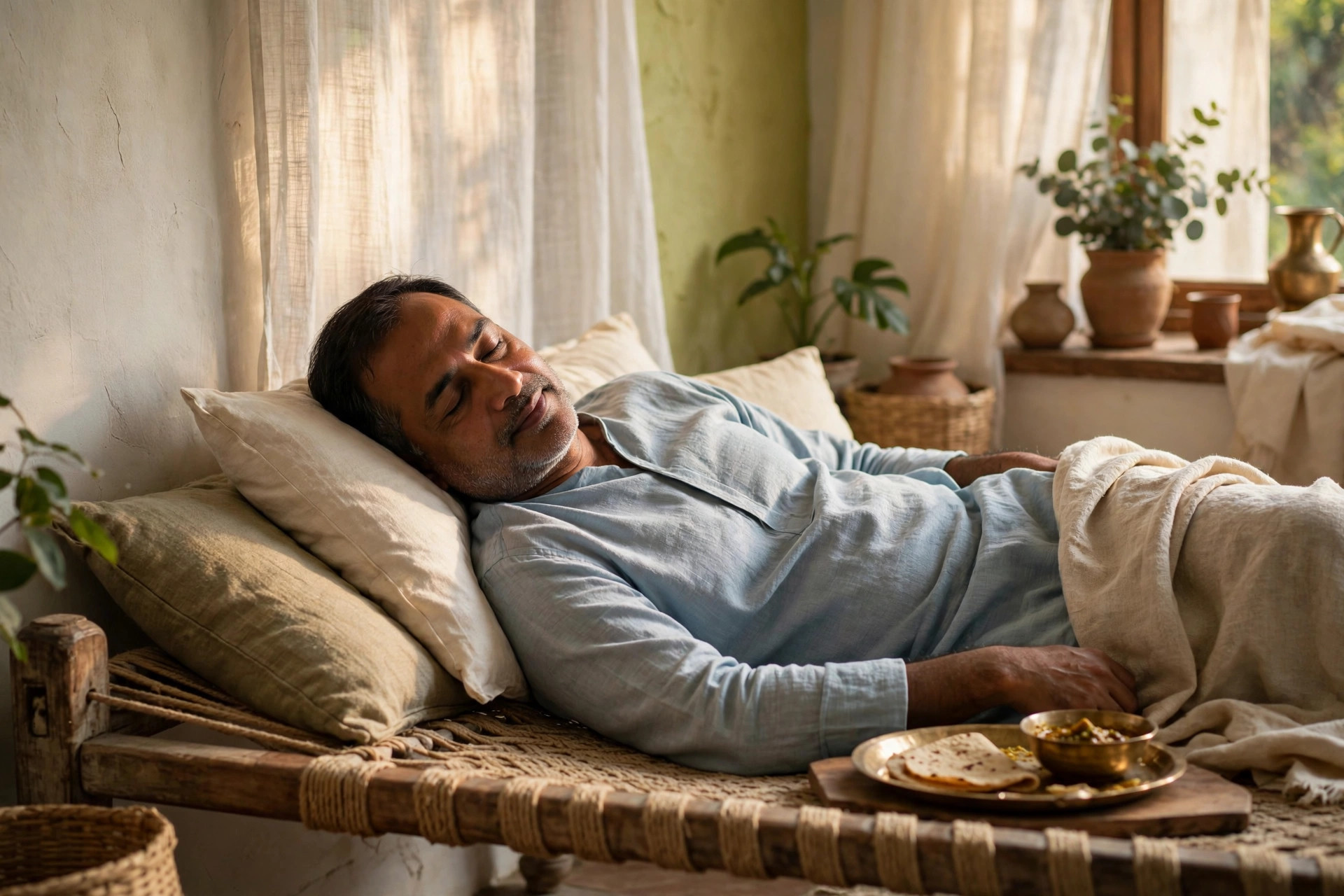
In brief: Vamkukshi is lying on your left side for a short rest after the midday meal. It's the daytime cousin of the left-side sleeping posture we covered in our earlier piece on the science of vamkukshi at night. The honest version is narrower than the internet's: classical Ayurveda mostly warns against daytime sleep, allowing it only in summer and for the very young, old, weak, or ill, so the tradition prescribes rest, not a nap. Modern chronobiology independently found the afternoon dip is real and partly built into the body clock: it happens even without lunch, and a heavy carbohydrate meal makes it worse. The research-backed version is a 10-to-20-minute rest, left side down. Past 30 minutes, you buy grogginess instead of energy.
What is vamkukshi, exactly?
The word breaks cleanly: vama (left) + kukshi (abdomen, flank). It is a posture, not a philosophy: lying on your left side after eating so the stomach, which curves to the left, sits below the esophagus and digests downhill. We laid out the mechanics (gastric geometry, lymphatic drainage, the vena cava) in the nighttime piece. That article is about the night. This one is about 2 p.m.
The daytime form, as the living tradition teaches it: after the midday meal, lie on your left side, curled loosely fetal-style, for roughly 10 to 30 minutes. Nutritionist Rujuta Diwekar, who did more than anyone to put this practice back into urban Indian conversation, frames it simply: 10–30 minutes on your left side between 1 and 3 p.m., or if you're at a desk, head down and senses off for the same window. Her list of don'ts is as instructive as the do's: no naps between 4 and 7 p.m., no stimulants right after lunch, no scrolling through the phone, and never past 30 minutes at a stretch.
That's the popular version. The classical version is stricter, and more interesting.
Did Ayurveda really tell you to nap after lunch?
Mostly, no. This is worth saying plainly, because the Instagram version of Ayurveda has blurred it.
The classical texts treat daytime sleep (divasvapna) with suspicion. Charaka Samhita (Sutra Sthana, chapter 21) prohibits it in every season except summer (grishma), when the nights are shortest and the body's reserves are most depleted. Vagbhata's Ashtanga Hridaya (Sutra Sthana 7/60–61) bars it outright for the obese, the kapha-dominant, and those with kapha disorders. The exceptions read like a triage list: the very young, the very old, the weak, the ill, the exhausted, the traveler. A peer-reviewed review of the Ayurvedic sleep literature summarises it without varnish: "for healthy people sleeping during the day is contraindicated in all seasons because it vitiates kapha dosha."
So what is vamkukshi, then, if not a nap? The distinction the tradition draws is between rest and sleep. Lying down on the left side for a short spell after the midday meal (quiet, eyes closed or half-open, not plunging into deep slumber) is a digestive posture. A 90-minute siesta is something the texts would file under divasvapna, and frown at, unless it's June and you're genuinely depleted.
The modern guidance lands in almost the same place. Coincidence is the wrong word; two different observational traditions noticed the same constraint. But it's worth being precise about what the modern side actually found.
What does modern science say about the afternoon dip?
That the dip is real, and that lunch is only part of the story.
Timothy Monk's 2005 review in Clinics in Sports Medicine put it bluntly: the post-lunch dip in performance "can occur even when the individual has had no lunch and is unaware of the time of day." Its roots are circadian (tied, he argued, to the 12-hour harmonic of the body's internal clock), and it is "certainly exacerbated by a high-carbohydrate lunch." An earlier Monk study (1996) found the dip was an endogenous phenomenon, individually determined, tied to the strength of that 12-hour rhythm. A PMC review of circadian rhythms in attention places the trough between 2 and 4 p.m. for a typical intermediate chronotype.
In other words: you feel sluggish at 2 p.m. partly because you ate, and partly because you're a mammal with a clock.
The food part is measurable. Psychologist Andrew Smith, studying the post-lunch dip at the University of Sussex, found that on a 10-minute vigilance task, people who had skipped lunch scored 14% more "hits" than people who had eaten. The type of food mattered too: a high-protein meal made people more distractible, a starchy meal slowed their responses to peripheral stimuli. Lunch quality, not just lunch quantity, moves the needle.
None of this says "skip lunch." It says the afternoon rest has a biological address, and a big thali makes it worse.
How long should the rest be?
Short. This is where the science is most settled, and most aligned with the tradition's instinct for brevity.
The Sleep Foundation's review of the napping literature: 10-to-30-minute power naps are refreshing; naps under 20 minutes improve alertness immediately with little or no grogginess; naps longer than 30 minutes raise the odds of sleep inertia: the dazed, sluggish feeling of waking from deep sleep. The other safe harbor is a full 90-minute cycle. The risky zone starts past 30 minutes: long enough for a nap to stop being "power," short enough to wake up into sleep inertia — the dazed, sluggish feeling the Sleep Foundation describes after longer naps.
The famous NASA study is worth citing with its caveats attached. In the early 1990s, NASA Ames researchers gave 21 long-haul pilots a planned 40-minute cockpit rest on trans-Pacific routes; the 12 pilots in the rest group slept an average of 25.8 minutes (the "26-minute nap"), and a 1995 summary paper reported alertness up to 54% higher and performance 34% better than the no-rest group. The study is documented in the technical memorandum itself (NASA Ames), with a careful reading of the numbers here. Small study, specific population (sleep-deprived pilots, not office workers), percentages from the summary rather than the original technical memorandum. Direction: clear. Prescription for your Tuesday: suggestive, not settled.
Diwekar's 10-to-30-minute window and her hard stop at 30 minutes sit comfortably inside this evidence. Her 90-minute allowance for "the very young, the very old, and the very sick" even rhymes with the classical exception list. Different centuries, same edges.
The desk-worker's version
Put the two traditions together and the practical shape is simple:
- Eat a lunch that doesn't ambush you. The Sussex work says a heavy, starchy lunch worsens the dip. This is the part that matters most. The rest is garnish, not the meal.
- Don't sprint back to the screen. A short, unhurried pause after eating is the oldest part of the tradition: calmness after meals, no sudden exertion.
- Rest left-side-down, 10 to 20 minutes, between 1 and 3 p.m. On a couch, a mat, or, Diwekar's office concession, head down at the desk, senses off. Set an alarm. Thirty minutes is the ceiling.
- Not after 4 p.m. Late naps borrow from the night: the Sleep Foundation notes naps are unlikely to interfere with nighttime sleep only when taken in the early or mid-afternoon, and Diwekar's don'ts ban the 4–7 p.m. window.
One more honest note: if the afternoon slump is crushing rather than mild (if you need the nap daily to function), that's a question for a doctor, not a tradition. Excessive daytime sleepiness has causes (sleep deprivation, apnea, medications) that no posture fixes.
The afternoon is half the story. The night is the other half, and the nighttime half of this practice, with the full mechanics of why the left side matters, is in our earlier piece on the science of vamkukshi. For readers rebuilding the whole day-night rhythm, Swastik's Ayurveda sleep guide is a solid next read: food first, routine second, herbs last, which is the same hierarchy this tradition has always insisted on.
FAQ
Is vamkukshi just a fancy word for an afternoon nap? No, and the distinction is the point. Vamkukshi is a short left-side rest after the midday meal (10–30 minutes), prescribed as a digestive posture. Classical Ayurveda mostly prohibits actual daytime sleep (divasvapna) except in summer and for the very young, old, weak, or ill.
What does the science say is the ideal nap length? 10 to 20 minutes for immediate alertness with minimal grogginess; up to 30 is fine. Past 30 minutes you risk sleep inertia; 90 minutes (a full sleep cycle) is the other safe option.
Does the post-lunch dip happen even if I skip lunch? Yes. Monk's research found the dip is partly circadian, occurring even without food. Lunch, especially a heavy carbohydrate one, makes it worse; it doesn't create it.
This article is for general information, not medical advice. Persistent excessive daytime sleepiness warrants a clinician, not a posture.
Sources: Charaka Samhita Sutra Sthana 21 and Ashtanga Hridaya Sutra Sthana 7 as summarised in the JETIR review of Nidra in Ayurveda; Rujuta Diwekar's vamakukshi guidance via Zoom TV and IndiaWest; Timothy H. Monk, "The post-lunch dip in performance" (PubMed 15892914) and Monk et al., "Circadian determinants of the postlunch dip in performance" (PubMed 8877121); Andrew Smith's Sussex research via New Scientist; the NASA cockpit-rest study as documented in this careful reading; the Sleep Foundation's power-nap guide; circadian attention review (PMC6430172).
Related Stories

Dinacharya for desk workers: Ayurveda's ancient routine meets your 3pm slump
Ayurveda's dinacharya schedules the day around sunrise, midday meals, and same-time sleep. Modern sleep and sitting trials keep landing in the same places.
The 3 AM wake-up: what sleep science and Ayurveda each say about the small hours
Waking at 3 AM is one of the most reported sleep complaints. The honest version: lighter second-half sleep, cortisol's pre-dawn rise, and the usual evening suspects. Ayurveda marked this hour two thousand years earlier.

Constipated? Isabgol, senna, laxatives — part of life?
Isabgol or senna for constipation? An honest, trial-backed comparison of psyllium husk and stimulant laxatives, Ayurvedic context included.