Retro Reel by Sreepathy, Volume 21: Munich (2005)

Retro Reel is a column about movies — not the latest box-office releases, but recommendations of good movies of different genres, offered with a sense of the retrospective. Sreepathy is an unabashed movie buff who lives in Naperville, Illinois.
What is Munich about?
Revenge tastes sweetest — till we realize that we are inevitably diabetic…
As individuals, as groups, or as nations, the urge to respond with force to an act of evil is very real and natural. Let's not be naïve, or goody-goody, by denying it — force is effective. After all, a good citizen can stop a robbery or a rape if he is armed. Groups have brought down oppressive regimes through violent means. And nations did defy and ultimately rid the world of someone like Hitler through bloodshed and barbarity. Force is unfortunately necessary, somewhat inevitable, and quite effective… as a fix… in the short run…
The blunder lies in mistaking its effectiveness as a long-term solution to human problems. We know the recent story of teenager Trayvon Martin, whose tragedy was thanks to a vigilante who was armed not just with a gun, but with a deadly mix of prejudice and proactivity. We also know the stories of several groups — whether the Naxals of India or some disgruntled members of a religion — that resort to violence as the only way to solve their social issues. And we also know how a powerful nation tried — rather tragically — to deliver democracy to another through the barrels of its tanks and from the wings of its B-52 bombers.
How does Spielberg tell the story?
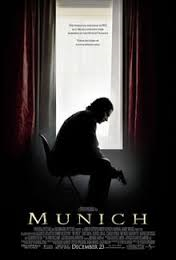
The narrative of Steven Spielberg's Munich (2005) is inspired by how the nation of Israel responded to the devastating real events in which the terrorist group Black September massacred eleven Israeli athletes during the 1972 Olympics in Munich, Germany.
In a tit-for-tat decision, the country's Prime Minister, Golda Meir, officially okayed a black-box-style covert operation (codenamed "Wrath of God") for the assassination of eleven identified Palestinians responsible for the massacre. Avner (played by Eric Bana), a low-key Mossad man, heads a five-member team that goes through Europe, hunting down the perpetrators in a methodical but mercenary fashion.
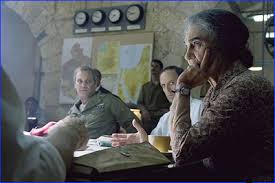
The movie's script plays out initially like a chilling, above-average example of the "espionage-thriller" genre — tactical, taut, tense. Any above-average storyteller could have brought a closure to it as a superb thriller.

But then, we are talking about a movie by Spielberg, not just another above-average director. In his hands, the narrative heads in a direction — and into a line of questioning — that not only makes the movie incisively thoughtful and bold, but genre-defying as well. Himself Jewish, Spielberg was severely castigated by sections of his own community as having "betrayed the Jewish cause" in making the movie. Ironically, neither was he spared by many Palestinians who accused him of somehow endorsing the vengeful vendetta of the Israeli government. Both criticisms are invalid and are largely emotional reactions. In opening up and exploring the moral, ethical, and psychological dilemmas thrown up by the perpetual loop of violence unleashed by both sides, Spielberg stands right in the center, not taking sides. Just asking honest questions, for which he has no answers. But neither has anyone else till now.
What is the moral quagmire at the heart of Munich?
By the time Avner and his mercenary team are about halfway through the targeted assassinations, they realize that their reliance on the murky world of paid informants to locate their targets may have been producing compromised information, thanks to the involvement of intelligence agencies of half a dozen other countries. Serious misgivings and doubts arise — trust becomes a casualty, and they aren't sure who is on their side. Also, by this time, their retributions are being answered by counter-reprisals of a bigger and more brutal nature from the other side.

Moral and ethical questions begin to haunt the team even as blood-lust draws them away from their list of specific targets, and the body-count of collateral innocents begins to pile up on both sides.
There is a brief but very interesting exchange, between Avner and one of his team members, that defines the moral quagmire of Munich. Carl (played by Ciarán Hinds), the calm thinker in the group, is the one who brings up these issues, while Steve (Daniel Craig) is emotional and unquestioningly believes in action. Avner is more like Steve initially, but begins to understand the issues. In a conversation, Carl tells Avner, "I knew guys like you in the army. You do any terrifying thing you're asked to do, but you have to do it running. You think you can outrun your fears, your doubts. The only thing that really scares you guys is stillness…" The stillness that's required for thinking.
Is Munich just a revenge thriller?
Munich (R-rated) is visually intense, brutal, and gory. But gore is not used gratuitously; it serves very specific purposes. Spielberg depicts violence in the initial scenes to whip you up and bring you to a state where revenge seems like the obvious and right choice. In the second half, the depiction of violence does exactly the opposite — it makes you despise it and see its senseless nature. Whereas a routine thriller of this nature would have ended with a high-strung, breathtaking climax, Munich calms down to a climax-less end. And you are left with more questions than answers; more confusion than clarity. In matters like these, sometimes less clarity and more confusion are the first steps towards an eventual solution…
Having said that, action has an appeal where thinking has little allure. Our tendency is to look at people who "act" as decisive and bold, and to downplay others who "think" as wavering and weak. But beware of that action-orientation, because it tends to come up with seemingly convincing but ultimately bizarre solutions to serious problems. For instance, there are many who believe — like pro-gun-rights organizations — that more guns in society lead to fewer gun-crimes. The presumption is, if good people have easy access to guns, they can check the bad ones who anyway have guns. In other words, more violence to reduce violence. In addition to being proved wrong by scientific studies, that solution glosses over the psychological impact of a violent mindset that it will instill in the citizenry in general — a sense of constant fear and doubt leading to a loss of trust in others. Similar is the suggestion that good nations should wage "good wars" to defeat the evil emanating from bad ones. If "good wars" were good, we wouldn't have good soldiers coming back home with post-traumatic-stress-disorder twisting their psyche out of shape. Unfortunately, in the way it influences, violence doesn't differentiate between the bad man and the good. For it to be effective, you should use violence. But the truth is, beyond its limited effectiveness, violence begins to use you.
Mark Twain famously said, "Anger is an acid that can do more harm to the vessel in which it is stored than to anything on which it is poured."
Revenge is not very different from that acid…
PS: 'Munich' is available in the Naperville Public Library.
Related Stories
Retro Reel by Sreepathy, Volume 22: The Ox-Bow Incident
Sreepathy's Retro Reel recommends The Ox-Bow Incident (1943) — William Wellman's stark western about mob justice and Henry Fonda's man-in-the-minority.
Retro Reel by Sreepathy, Volume 19
Retro Reel Vol 19: a true 1996 Hyderabad story — a gun at a cinema ticket window, then 'based on a true story' flashes on screen. Guess the film!

Retro Reel by Sreepathy, Volume 18
Sreepathy's Retro Reel on Argo (2012): Ben Affleck's dramatization of the Canadian Caper, and what it says about American commitment and meddling.