Retro Reel by Sreepathy, Volume 22: The Ox-Bow Incident

Retro Reel is a column about movies — not the latest box-office releases. There will be aspects of review, but the column is intended more as a recommendation of good movies of different genres, with the sense of a retrospective — hence the "Retro" in the name. In a day and age when movies are projected digitally, the word "reel" may seem retrograde and outdated. Yet no other word captures the imagery of a movie as "Reel." Sreepathy is an unabashed movie buff who loves a well-told onscreen story. He has a list of about 450 must-watch movies, and Retro Reel is an attempt to share with friends of a similar bent of mind some of the best movie-watching experiences he has had. He lives in Naperville with his wife and two sons.
The Ox-Bow Incident (1943)
When the mob takes the law into its own hands…
Slice and dice it any way you want, but majority is just a number. Its voice has volume, but it may not necessarily be valid. It has might, but it may not be right. It's not always wrong, but history is littered with examples when the majority got it awfully wrong. Though Hitler never won a majority in a free German election, he managed to win its support for some of his nastiest policies before World War II. Left to the majority, slavery would probably not have been abolished in the US in the 19th century; and segregation would have continued well beyond the 1950s and 60s. More recently, well past the aftermath of 9/11, nationwide polls showed a majority of Americans supporting the waging of preemptive wars against other "enemy" nations… How many times have we heard the justification "that's-what-most-people-do" for a disastrous course of action? How often have we rolled our eyes at the winners of popular TV singing competitions decided by a majority? And yet, we leave crucial decisions in the hands of the majority — not because it gets it right, but because sometimes it is the best of bad options on the table. A flawed system is still better than no system.
There are some messages that don't come with expiry dates. They are not defined by their contexts, nor are they delimited by their times. One such message, symbolized by the ubiquitous octagonal "Stop" sign at every intersection, is: "The law is there for a reason." A society is held together by its invisible threads that inevitably end up being a tangled skein at times. But unless there is an imminent existential threat, there are only bad reasons for anyone to cut those threads, or to uproot the "Stop" sign and groan that "the system doesn't work." Worse still, when denizens of the law — who are entrusted to protect it — begin to dilute the message themselves, the alarm bells should ring louder. If that message was valid in the story of The Ox-Bow Incident (1943) set in Nevada of 1885, it is as valid in present-day India where khap panchayats still rule the roost, and worse, where we hear about elected lawmakers in the capital indulging in attempts to dispense vigilante-style justice on the streets — all in the name of the aam aadmi.
What happens in the story?
Set in the Old West of late 19th century Nevada countryside, the story opens with a couple of drifters riding into a dusty little town wracked by a spate of cattle robberies. They get into the local watering hole, talk rough and rowdy, and pick a fight with the town's well-known hothead. All of a sudden, news reaches the pub that a local farmer, Larry Kincaid, has been robbed of his cattle and shot through the head. Word quickly spreads around the small town, and soon a motley mob forms, ready to get to the bottom of finding and fixing the killers of good old Kincaid, who is known to be an honest man about town.
With emotions running high, and worried that something rash may happen, saner voices of the town — including that of the local judge — appeal to the posse to round up the presumed killers and bring them back into town for a trial. An out-of-town sheriff only adds to this volatile mix of anger and urgency. And the posse, with no patience for the law and its slow processes, is led by an unthinking retired Army Major, abetted by a bunch that includes an over-eager, bloodthirsty acting-sheriff, the town's hothead, a gleeful wastrel looking forward to the prospect of hanging the killers, and a gruff-sounding woman who is only too happy to join the boys. The town's wise man and its African-American preacher join the posse to see if they can inject a semblance of sanity into it. The two drifters from out of town reluctantly join the posse too, for their own furtive reasons.
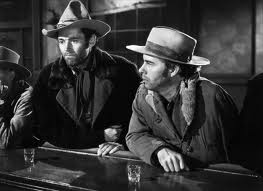
This hurriedly assembled coterie goes out in search of the killers and by nighttime reaches Ox-Bow, where they accost a camp of three men who are in possession of Kincaid's cattle and his gun. Upon being questioned, the men vehemently protest their innocence but are unable to convince the group about how they got the cattle and the gun. By now, the group headed by the Major has concluded that these men are indeed the killers of Larry Kincaid and should be hanged. The wise man and the preacher impress upon the posse to give the alleged killers the right to a fair trial, since their involvement in the crime is inconclusive. Rumblings begin to surface within the group, and a few other members put up a bit of resistance against the group's fatal conclusion. The Major puts the decision to vote and finds that except for a small minority, the group is okay with the decision. The hanging is put off by a few hours for daylight to break…
Why is this film worth watching?
The Ox-Bow Incident is all about a brilliant ensemble cast that performs so convincingly that in every scene you feel one with the group. Having said that, the character of Gil Carter (one of the two drifters), played by Henry Fonda, is a standout. Fonda yet again plays the "man-in-the-minority" very authentically — a throwback to his role in 12 Angry Men (Retro Reel, Volume 16). But Ox-Bow's Fonda is rough and realistic, much in tune with the movie's palpable tone of realism — quite unlike the idealistic one in 12 Angry Men. Both roles are similar in their orientation, yet they appeal to you in distinctly different ways.
Made on a shoestring budget, director William Wellman's The Ox-Bow Incident, with its brilliant narrative, should have been an all-time celebrated Hollywood classic — but its most ardent fan-following has been largely limited to movie buffs and cineastes. The outstanding aspect of the movie is that even though most of its characters and context are cut from rough cloth, it far outstrips their coarseness by achieving a level of sophistication in dealing with its pivotal idea. With a 75-minute running time, it may be short on footage but is long on its message. Shot beautifully in black-and-white, the movie's stark sets complement the starkness of its story. By touching upon the foibles and fortitude of its characters' humanity, the movie's story tortures and touches you in alternating successions. Elevating the anecdotal flow beyond its rough-hewn characters, the movie's writing provides food for thought — sample one of its memorable lines: "And what is anybody's conscience except a little piece of the conscience of all men that ever lived?"
The next time you pass a "Stop" sign, remember this: it may seem pointless; it may slow you down; it may be a pain in the neck; but it stands for something.
P.S. "The Ox-Bow Incident" is available at the Naperville Public Library.
Editor's note: the original image shortcodes and dead attachment links have been replaced with local images; review text preserved.
Related Stories
Retro Reel by Sreepathy, Volume 21: Munich (2005)
Retro Reel on Spielberg's Munich (2005): a chilling espionage thriller that becomes a genre-defying meditation on the moral cost of revenge.

Retro Reel by Sreepathy, Volume 18
Sreepathy's Retro Reel on Argo (2012): Ben Affleck's dramatization of the Canadian Caper, and what it says about American commitment and meddling.
Retro Reel by Sreepathy, Volume 24: A Few Good Men
Sreepathy's Retro Reel Vol. 24 on A Few Good Men (1992): Jack Nicholson's magnetic villainy, Aaron Sorkin's crackling dialogue, and why 'You can't handle