Dinacharya for desk workers: Ayurveda's ancient routine meets your 3pm slump

In brief: Ayurveda's dinacharya schedules the day around an early wake, morning light and movement, the largest meal at midday, and sleep at the same hour nightly. Modern trials keep landing in the same places: morning light improves sleep, regular sleep beats longer sleep, five-minute walks blunt glucose spikes, and the 3pm slump is circadian.
What does dinacharya actually prescribe?
Start with the source, because this article will keep two ledgers and you should know which one you are reading. Dinacharya is laid out in the Ashtanga Hridayam, Sutrasthana Chapter 2, the Dinacharya Adhyaya, the chapter on daily regimen. It is addressed to the healthy person, not the patient: the stated aim is protecting the health of the healthy. The sequence runs: waking in brahma muhurta (roughly 96 minutes before sunrise), elimination, tooth-cleaning, oil gargle, daily oil massage (abhyanga), exercise, bath, and then the day's eating and sleeping timed to the body's clock.
The details matter because they are specific. Exercise, vyayama, is to be done to "half one's strength," lighter in summer and the rains, fuller in cold seasons. Abhyanga is described as necessary for keeping vata, the dosha of movement and nerves, in balance. The largest meal belongs at midday, when digestive fire is taught to be strongest under the Pitta period of roughly 10am to 2pm, and the evening meal stays light so digestion finishes before sleep. Night sleep is to be timely; daytime sleep is discouraged. That is the classical teaching, and it is worth saying plainly: this is regimen literature, not trial evidence. Two recent narrative reviews in peer-reviewed Ayurveda journals map these elements onto modern circadian science, and they keep the same separation this article does. Do not let anyone sell you the texts as clinical trials. They are something else: a very old, very specific scheduling system for a human day.
What does morning light actually do to your sleep?
Here the trials start agreeing with the texts, and the first agreement is about mornings. A 2023 pilot in the Journal of Sleep Research put 12 office workers under 1,000-lux morning light for 90 minutes against ordinary 300-lux office light, five workdays. The bright-light group reached sleep efficiency of 83.82 percent against 80.35, fell asleep earlier and faster, and woke less groggy. Small study, young adults, but run in an office, which is exactly the reader this article is for. A 2026 Manchester study with 89 adults wearing light sensors over 500-plus days found the same direction in real life: brighter, steadier daytime light went with earlier bedtimes and better sleep.
Brahma muhurta, stripped of mystique, is a rule that gets you outside into morning light before the day starts. The classical texts did not know about melanopic light and circadian phase. They built a schedule that behaves as if they did.
Why do you always crash at 3pm?
The mid-afternoon alertness dip is circadian. Timothy Monk's research showed it occurs even in people who skip lunch and persists under time-isolation; Harvard sleep chief Charles Czeisler calls the early-to-mid afternoon "a great time for a nap." Eating amplifies the slump but does not cause it. Recent work suggests post-meal drowsiness is neurologically distinct from sleep deprivation, with the hypothalamic orexin system, which sustains wakefulness and senses metabolic signals like glucose, as a candidate mechanism.
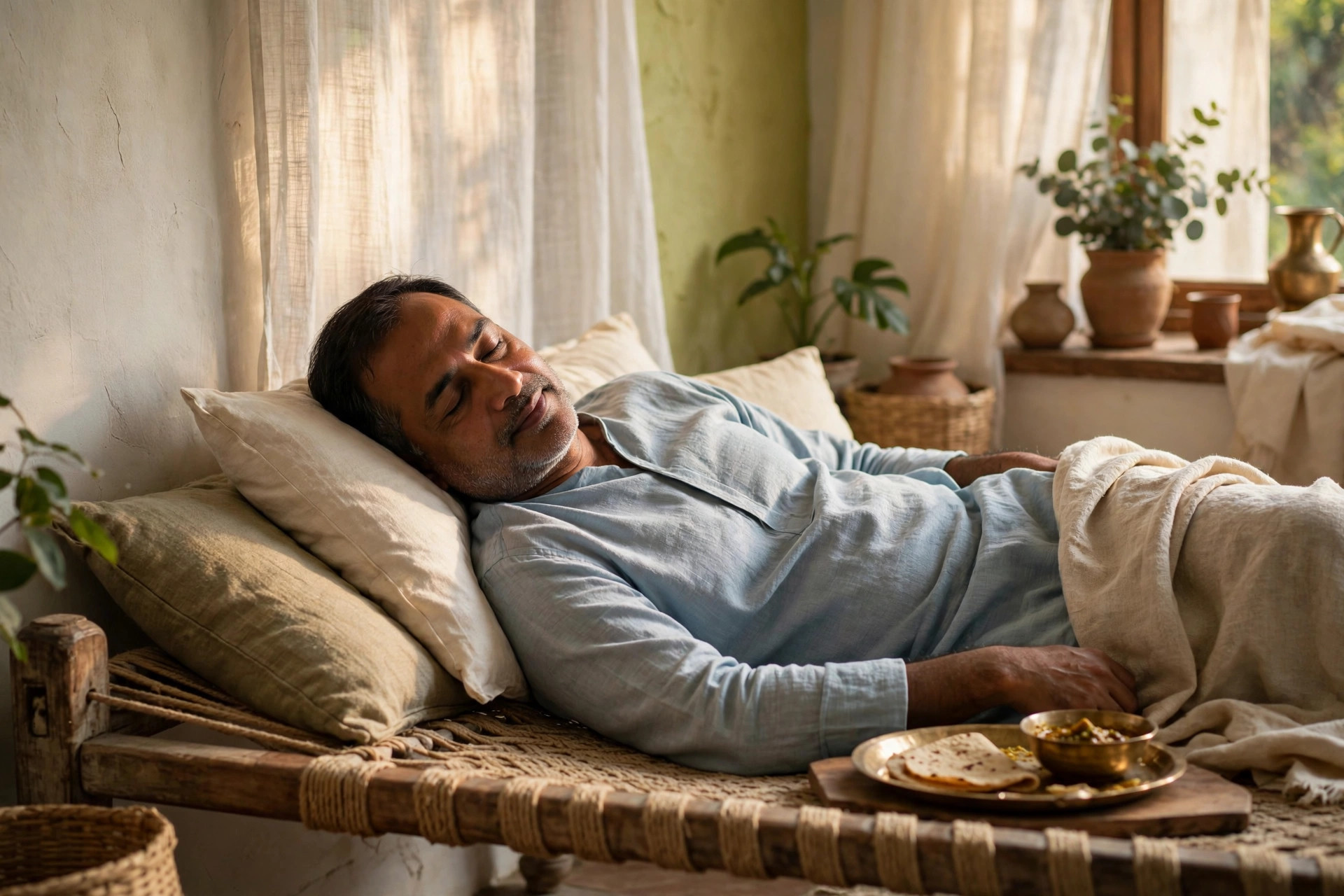
Dinacharya's answer to the slump was rest without sleep. The classical texts mostly prohibit daytime sleeping, and as our earlier piece on the science of vamkukshi showed, the honest traditional position is rest, not a nap. The modern version is unglamorous: when the dip arrives, do the cognitively light thing. Schedule the inbox for 3pm, not the negotiation.
Can five minutes of walking every half hour undo eight hours of sitting?
This is the finding that should change how offices run. In the 2023 "Take a BREAK" trial at Columbia, published in Medicine and Science in Sports and Exercise, 11 adults spent five eight-hour lab days doing either uninterrupted sitting or light walking breaks of one or five minutes every 30 or 60 minutes, with standardized meals. The five-minute walk every 30 minutes was the only regimen that significantly lowered both blood sugar and blood pressure: post-meal glucose spikes fell 58 percent versus sitting all day, and systolic pressure fell 4.3 mmHg. A 2026 real-world follow-up of more than 11,000 people in the British Journal of Sports Medicine found the break groups reporting less fatigue, better mood, and improved productivity after two weeks. Researcher Keith Diaz put it memorably: "At the end of the day, I didn't feel run down. I didn't have the brain drain. I didn't have the brain fog."
Read the caveats before the enthusiasm: eleven people, one lab day each, measuring post-meal spikes, not diabetes outcomes. But the direction is consistent with a 2022 meta-analysis of seven studies, where light walking breaks cut postprandial glucose by about 17 percent versus prolonged sitting.
Now place the classical dose principle beside it. Vyayama to half one's strength, season-adjusted, is a traditional way of saying: dose the movement to the person and the day, not to the ego. The five-minute walk is the desk-worker's ardha shakti.
One honest correction while we are here: standing desks are not the fix. A Cochrane review found the evidence for sit-stand desks low to very low quality, and a University of Sydney study of more than 83,000 people found prolonged standing did not lower heart-disease or stroke risk. Move more; standing still is just sitting vertically.
Big lunch, light dinner: what the trials actually say
The classical teaching is that the largest meal belongs at midday and the evening meal stays light. The modern evidence on meal timing is genuinely mixed, and this article will not pretend otherwise. A 2024 Annals of Internal Medicine trial of an 8-to-10-hour eating window in metabolic syndrome found about 3 to 4 percent weight loss and a small A1C improvement, but the A1C edge was 0.1 percentage points and fasting glucose and insulin did not differ from the control group. An isocaloric trial the same year found no weight or glucose benefit from timing alone, concluding the effects seen in earlier studies likely track reduced calorie intake, not the clock.
The honest modern analog of the classical rule is not metabolic magic. It is behavioral: a consistent, earlier eating window curbs late-night grazing, which is where most desk-worker calories actually leak. The texts prescribed the schedule; the trials confirm the mechanism is mostly the schedule working as intended.
Is a regular bedtime better than more sleep?
The strongest modern finding in this whole article is about regularity. Windred and colleagues analyzed 60,977 UK Biobank adults in Sleep in 2023 and found that the most sleep-regular fifth had markedly lower mortality than the least regular fifth, a hazard ratio of 0.70 even in the fully adjusted model. The authors suggested that asking people to keep more similar sleep times between days "may ultimately be a more feasible strategy" than adding sleep hours. It is observational, in an older cohort, so it proves nothing causal. But it rhymes precisely with dinacharya's insistence on timely, same-hour sleep.
On the specific hour: a 2021 study of 88,026 UK Biobank adults found sleep onset between 10:00 and 10:59pm carried the lowest cardiovascular risk, with both earlier and later onsets worse. Study author David Plans was careful: "While we cannot conclude causation from our study, the results suggest that early or late bedtimes may be more likely to disrupt the body clock, with adverse consequences for cardiovascular health." The classical texts do not name 10pm; that number comes from modern observational data. What the texts name is the principle: sleep on time, every night, and let the morning light do the resetting.
What to steal from the routine this week
None of this requires believing in doshas. It requires a schedule, which is the whole point the texts were making. The desk-worker version, with each item traceable to something above:
Morning: get outside into daylight within an hour of waking, ten to thirty minutes. The texts called it brahma muhurta; the trials call it phase-setting.
Workday: five minutes of light walking every half hour, or every hour if the calendar will not allow half. The texts dosed exercise to half one's strength; this is the same idea in office units.
Midday: make lunch the main meal and keep dinner light and early. The mechanism is mostly behavioral, and that is fine.
Evening: dim the lights, skip the blue-light glasses. A 2023 Cochrane review of 17 trials found the evidence for the glasses inconclusive and uncertain for eye strain or sleep, and one researcher noted screen blue light is about a thousandth of daylight. The free fix, morning light plus dim evenings, has the better evidence.
Night: the same bedtime, within half an hour, seven days a week. Regularity beat duration in the largest study cited here.
For readers who want the full classical sequence this is adapted from, Swastik's guide to the full classical dinacharya walks through it element by element, in the traditional framing this article kept separate from the trial data.
The 3pm slump is not a character flaw. It is a circadian appointment, and an ancient scheduling system had already put it on the calendar.
Frequently asked questions
Is dinacharya scientifically proven? No, and beware anyone who says so. Dinacharya is classical regimen literature: a detailed, internally consistent scheduling system for daily life. Modern trials support several of its specific prescriptions, morning light, movement breaks, sleep regularity, meal timing, but those trials test the prescriptions, not the system, and not the dosha theory behind it. The two ledgers stay separate.
Do blue-light glasses help with sleep or eye strain? Probably not. A 2023 Cochrane review of 17 randomized trials with 619 participants found the evidence inconclusive and uncertain for reducing eye strain or improving sleep. Screen blue light is roughly a thousandth of natural daylight, so the glasses filter a small fraction of a small exposure.
What time should I wake up? The classical texts prescribe roughly 96 minutes before sunrise. Practically, the evidence supports two things more than any specific hour: wake at a consistent time, and get daylight soon after. Consistency plus morning light beats any particular alarm setting.
Will a standing desk fix eight hours of sitting? No. Standing more does not carry the metabolic benefits of moving more, and large observational studies found no cardiovascular benefit from prolonged standing. The evidence favors frequent light walking breaks over any static posture, seated or standing.
This article is for general information, not medical advice. Persistent sleep problems, excessive daytime sleepiness, or metabolic conditions warrant a clinician, not a routine.
Reading the rest angle of this story: the classical texts distinguish rest from sleep after lunch, and the distinction matters. See our piece on the science of vamkukshi.
Related Stories
The 3 AM wake-up: what sleep science and Ayurveda each say about the small hours
Waking at 3 AM is one of the most reported sleep complaints. The honest version: lighter second-half sleep, cortisol's pre-dawn rise, and the usual evening suspects. Ayurveda marked this hour two thousand years earlier.
Vamkukshi, revisited: what the post-lunch rest actually does to you
Ayurveda's post-lunch rest is having a moment. The honest version: the texts prescribe rest, not a nap — and science agrees the afternoon dip is real and short.

Constipated? Isabgol, senna, laxatives — part of life?
Isabgol or senna for constipation? An honest, trial-backed comparison of psyllium husk and stimulant laxatives, Ayurvedic context included.