Naperville-area schools let teachers decide on AI as New York and Los Angeles pause
New York and Los Angeles have paused most student use of AI this school year. Naperville 203 and Indian Prairie 204 leave much of it to the classroom teacher. The 203 board meets tonight.
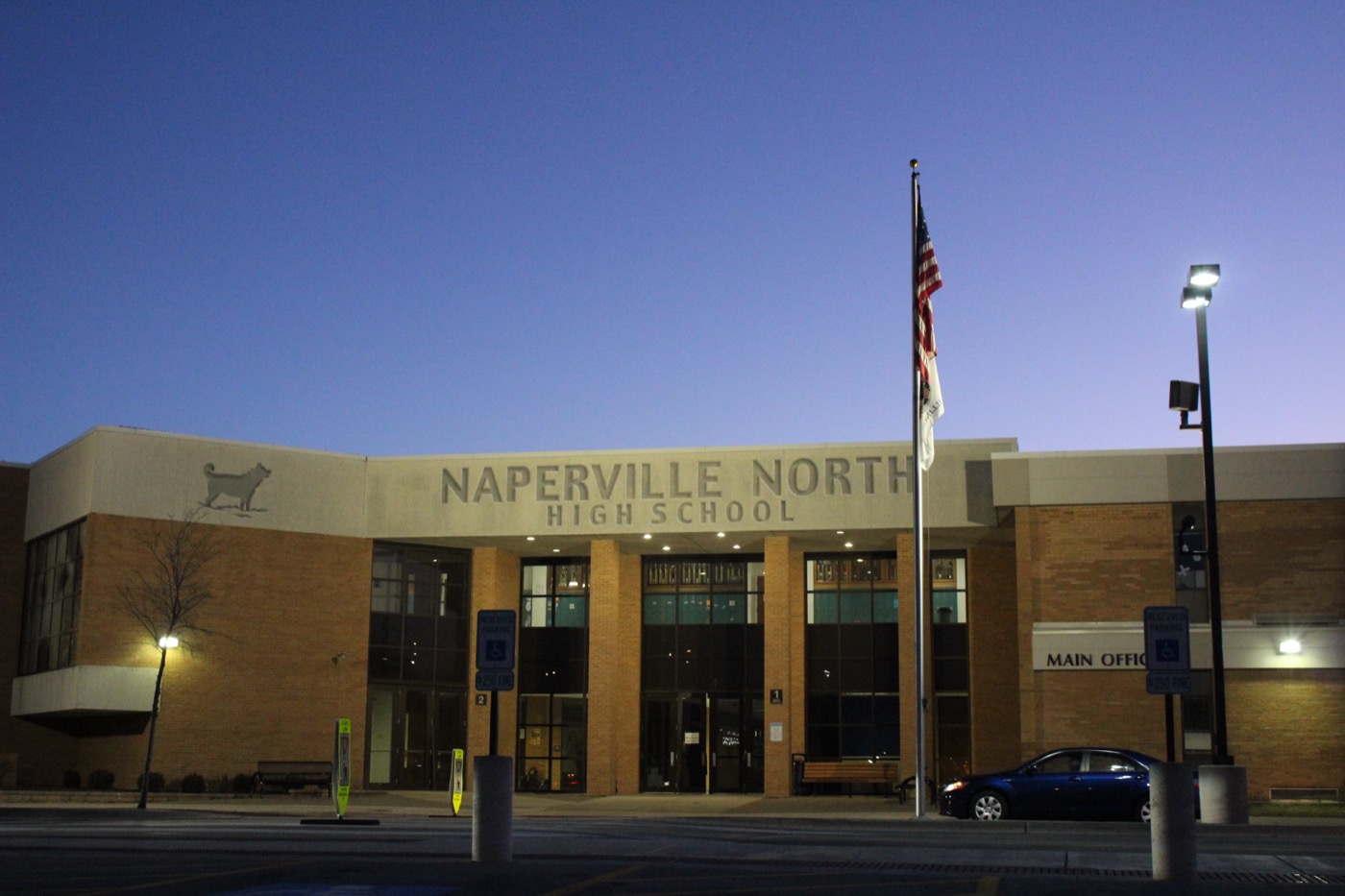
Top photo: The main entrance of Naperville North High School in Naperville, Illinois, at dusk on January 10, 2012. In 2023 the school's district, Naperville 203, opened ChatGPT to students from eighth grade up. Photo by Peter Ohaver, CC BY-SA 3.0, via Wikimedia Commons.
The country's two largest school districts have switched off most student-facing artificial intelligence for this school year. New York City barred it from its youngest 2-K classes through eighth grade. In Los Angeles the block covers every grade, on district devices only.
Naperville's two districts have not paused. Naperville 203 and Indian Prairie 204 teach AI literacy and leave much of the decision to the classroom teacher, assignment by assignment. Neither district's published AI guidance describes a pause.
Naperville 203 serves more than 16,000 students, the district says, and Indian Prairie 204 serves roughly 26,000 in Aurora, Bolingbrook, Plainfield and Naperville, according to its website. The 203 board meets tonight. Its meeting calendar had not linked an agenda as of Monday morning. It was not clear whether AI would come up.
Mayor Zohran Mamdani and Chancellor Kamar Samuels announced New York's one-year moratorium on Wednesday, September 2, GovTech reported. It covers nearly 600,000 students. "Children need teachers and human connection in order to learn and grow," Mamdani said.
The city carved out exceptions for students with disabilities, multilingual learners and career programs such as computer science. Up to 50,000 high school students may join five supervised pilots. Every high schooler will have access to two 45-minute AI literacy modules a year. Companion chatbots are banned at all grades.
Los Angeles Unified acted without a board vote. Senior administrators paused student use of generative AI on district devices for 2026-27 on their own authority, Howard Blume of the Los Angeles Times reported in a story Education Week published on September 3. Board members learned of it at a committee meeting.
If students cannot use generative AI, "then we should publicize that," said Nick Melvoin, a board member. He added that he was "of two minds" because the step did not come from the board. The rule covers only district-owned devices in a system of roughly 378,000 students, by Tech Policy Press's count.
District 203 acted in 2023. On September 11 that year, its board let students in grades eight through 12 use ChatGPT on district devices, The North Star, Naperville North's student newspaper, reported.
Access was switched on by default, so parents who objected had to return an opt-out form. Superintendent Dan Bridges tied the cutoff to OpenAI's minimum age of 13.
The district's current generative AI page puts "Privacy and Safety First" at the top of its beliefs. Using AI in place of original work is "only permitted when specifically authorized by staff," the page says. AI use also falls under Board Policy 6:235, which families receive in the annual update.
The district's AI page does not say whether students still have ChatGPT on district devices, or whether the 2023 opt-out still applies. It does not mention ChatGPT at all.
Administrators presented a refreshed digital learning plan at an August 3 work session, NCTV17 reported. "We want technology used when it adds value to the learning experience," said Matt Langes, the district's director of innovation and learning.
Jayne Willard, assistant superintendent for curriculum and instruction, said students must be ready "for a digital world that has constantly changed." Board member Holly Blastic stressed the basics. "We still need to handwrite," she said.
Elementary screen time is expected to fall under the plan. iPads for children from early childhood through second grade stay at school. In grades three to five, devices go home up to two days a week.
District 204 publishes an AI in 204 page, an AI Playbook and a family guide. Student use "is not automatic," the guide says. On significant assignments, the district page explains, teachers may mark the work Independent, Supported or Collaborative.
The AI Playbook spells out the labels. Independent work is done without AI. Supported work starts with the student's own draft, which AI may help revise. On Collaborative tasks, students may use AI for back-and-forth inquiry, idea generation or perspective-taking. The district's pages do not say how often teachers use the labels.
The playbook also sets grade bands. Elementary students do not use AI in classroom work, the playbook says, and AI is "not a general expectation" in middle school. High schoolers may use it when a teacher directs. The page mentions "limited, guided piloting" for grades six to eight "next school year" without saying which year.
When AI is allowed, the guide sets four rules. Students follow teacher directions and check AI answers against reliable sources. They may use AI to brainstorm, outline or clarify. AI may not do the work for them. They never share names, addresses or passwords with a chatbot.
The guide names no approved tool. Its home activities run from a "20 Questions" game for young children to practice tests for high schoolers.
In fall 2025 the district blocked ChatGPT at school and moved students to Google's Gemini for Education, The Echo, Neuqua Valley High School's student newspaper, reported. Rodney Mack, the district's chief technology officer, said the switch was driven by student safety and data privacy.
A spring Parent University session on the playbook had four panelists, according to a notice on Brooks Elementary's website. One was Jenn Brown, a senior program manager at Google for Education. The others were a fifth-grade teacher who is a Teach Plus Illinois fellow, a Digital Promise research director and a Neuqua Valley graduate who works at an AI start-up.
The state's role is advisory. On July 9 the Illinois State Board of Education released a 400-page framework, Chalkbeat Chicago reported. It binds no district. Its drafters disclosed that ChatGPT, Claude and Gemini helped with early versions.
State Superintendent Tony Sanders said the job is to help schools "navigate new technologies in a way that strengthens instruction." Districts choose. The framework says schools need a "locally determined purpose" for AI. Lawmakers ordered it in Public Act 104-0399, the state board says.
Ask your child's teacher which rule applies to the next big assignment. In 204, the words to use are Independent, Supported and Collaborative.
In 203, ask the school whether ChatGPT is still on by default from eighth grade, and how to opt out if you want to. Read Policy 6:235 when the annual update arrives.
Remind your child never to type a full name or address into a chatbot, as 204's guide advises.
To comment at tonight's 203 meeting, submit through the district's Let's Talk portal by 3 p.m., the board calendar says. Choose the Board of Education Public Comment tab. The board meets at 7 p.m. at the District Administrative Center, 203 West Hillside Road.