Homeland Security proposes ending the H-1B renewal shortcut, with comments due November 13
A proposed rule would remove the instruction that immigration officers defer to a worker's last approval when reviewing an H-1B extension. Indian-born workers held 72 percent of approved H-1B petitions in fiscal 2023.
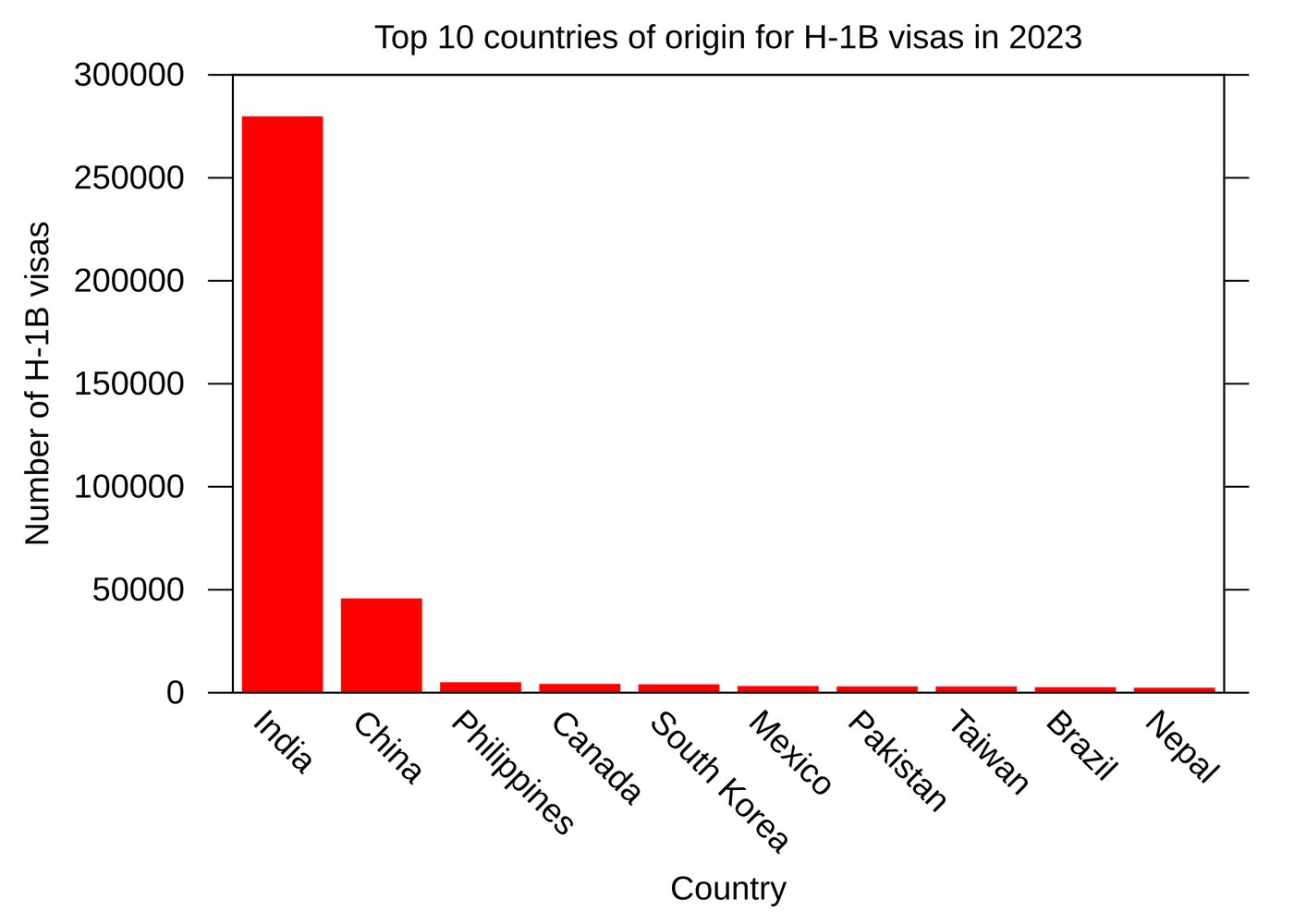
Top image: The ten most common countries of birth among beneficiaries of H-1B petitions approved in fiscal year 2023, charted from U.S. Citizenship and Immigration Services data (Table 4a of its report to Congress). India accounts for the tallest bar. Chart by Kelob2678, CC0, via Wikimedia Commons.
When an employer asks to extend the stay of an H-1B worker, a professional on the visa for specialty occupations, federal regulations tell officers to lean on the last approval if nothing material has changed. A proposed rule would delete that instruction.
The Department of Homeland Security (DHS) published the proposal in the Federal Register on Wednesday, October 14, signed by Secretary Markwayne Mullin. Comments close November 13.
The change would reach every worker category renewed on Form I-129, a list that includes H-1B, L-1, O-1 and TN visas. Indian workers hold most H-1Bs. Indian-born workers accounted for 72 percent of the 386,318 H-1B petitions approved in fiscal year 2023, according to that year's report to Congress from U.S. Citizenship and Immigration Services (USCIS). Roughly seven in ten were for continuing employment.
USCIS calls the practice "deference." It began as an agency memo in April 2004, the proposal recounts, and was rescinded in October 2017. Officers got it back in April 2021.
A December 2024 rule wrote it into the regulation now slated for removal, 8 CFR 214.1(c)(5). The proposal gives no date for a final version.
DHS argues in the proposal that deference shifts the burden of proof from the employer to the agency. That arrangement, the department wrote, is "in tension with" the immigration statute.
It also cites USCIS site visits, conceding that other factors may have played a part. From fiscal 2022 through 2025, USCIS found non-compliance or fraud at 22.39 percent of H-1B extension sites it visited. No deference applied in fiscal 2018 through 2020, when the rate was 16.77 percent.
By the department's estimate, ending deference would generate 6,044 additional requests for evidence a year. Those are letters asking an employer for more documents. The estimate applies a 2.9-percentage-point rise in the request rate to the 208,429 petitions a year, on average, that were eligible for deference from fiscal 2022 through 2025.
Across those four years, the median decision time averaged 76 days for petitions that drew a request. Those without one took 12.
The proposal acknowledges the change could "increase stress for workers who may have to wait significantly longer." It prices the extra paperwork for employers at $133,987 a year. That works out to $22.17 per request.
In October 2017, the last time USCIS dropped deference, Cyrus Mehta warned on his firm's blog that unnecessary requests for evidence would "cause havoc in the lives of foreign nationals." Mehta practises immigration law in New York. He singled out workers in their 10th or 12th H-1B year, still waiting for green cards. They faced USCIS "suddenly pulling out the rug from under their feet," Mehta wrote.
Amended petitions can also fall under deference, depending on the change, the proposal notes. IT services companies file an amended petition each time a worker moves to a project at a new location, according to a February 2020 brief by the National Foundation for American Policy. One worker can generate several a year.
"Each of these approvals does not represent a unique individual," Vic Goel said in the brief. He was then managing partner of the law firm Goel & Anderson.
Denials did climb after 2017. The brief found that the H-1B denial rate for continuing employment, mostly for existing employees, rose from 5 percent in fiscal 2017 to 12 percent in fiscal 2018. It stayed there in 2019.
The 2017 memo had "likely been responsible for many of the denials," the brief said, citing attorneys. DHS wrote that historical denial rates "did not statistically differ" with and without deference.
A separate final rule, published the same day and already in force, ends automatic extensions for certain work permits. Before October 30, 2025, people in those categories who filed on time to renew could keep working for up to 540 days while USCIS decided. Renewals filed since then generally get none.
The categories that lost it include H-4 spouses of H-1B workers who hold work permits and L-2 spouses of L-1 workers, according to the October 2025 interim rule. The final rule made no exception for them.
A Congressional Research Service report dated October 14 counts this year's H-1B actions. They range from a weighted lottery, begun in February 2026, to a proposed end of the 60-day grace period.
By the department's own figures, a request for evidence adds 64 days to the median decision. The rule expects 6,044 more of those requests each year.
The law firm Duane Morris advised employers in an October 15 alert to prepare extensions "as full filings that document eligibility anew." It also suggested premium processing.
The practical step for a family facing an H-1B renewal next year is to ask the employer to file early. Expect a thicker file and a longer wait. A timely same-employer filing generally allows up to 240 days of work past expiry, the firm noted.
Anyone can comment at regulations.gov under docket USCIS-2026-0529. DHS says the most useful comments point to a specific part of the rule, explain any suggested change and include supporting data. Comments are posted publicly, personal details included.
Families who have answered a request for evidence can respond directly to the $22.17 estimate. The system accepts comments until midnight Eastern time on Friday, November 13.