Why French students are marching, and what Paris's unrest means for Indians
A month of lycée blockades over missing teachers and crumbling schools spilled into nationwide marches on October 17. What students want, what the government has said, what comes next, and what Indian students and travellers in France should check now.
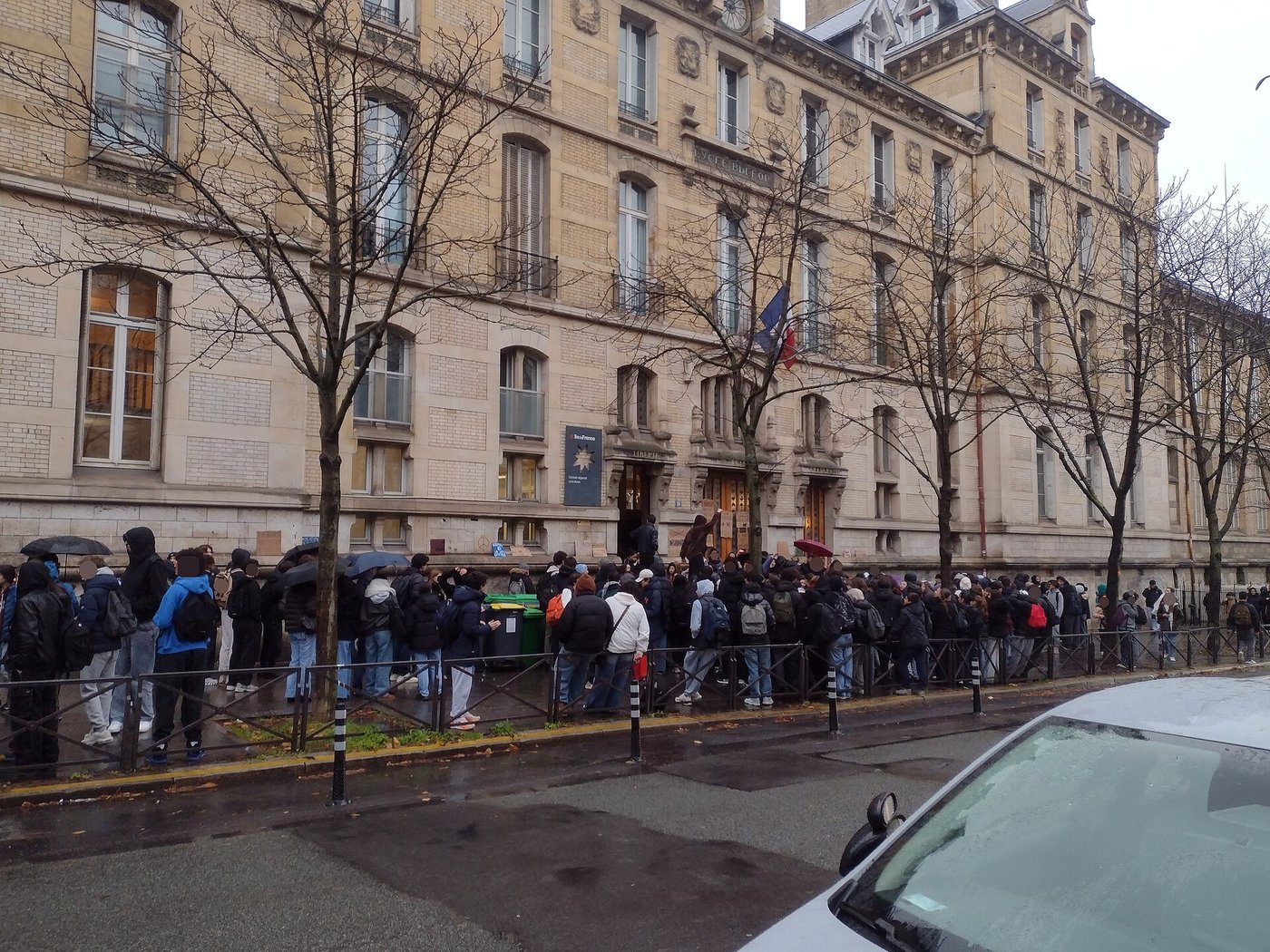
Featured image: Students gather outside the Lycée Buffon in Paris's 15th arrondissement during a school blockade on December 5, 2024, in an earlier wave of lycée protests. The photographer blurred the faces. Photo by Wyslijp16, CC BY 4.0, via Wikimedia Commons.
The movement began with a teachers' strike on September 17 at the Lycée Saint-Exupéry in Créteil, a suburb south-east of Paris. Staff were short. The next morning its pupils blockaded the gates, TheJournal.ie reported, drawing on Le Monde. Within two weeks hundreds of secondary schools and dozens of universities had joined.
On Saturday, October 17, the school protest became something larger. The Interior Ministry counted 550,000 people in the streets across France, 110,000 of them in Paris, while the CGT union put the national figure at 800,000, according to Reuters' live coverage on Monday. Most marched peacefully, Al Jazeera reported. A minority looted shops and set public buildings on fire.
France hosts about 10,000 Indian students, according to the Ministry of External Affairs' India-France bilateral brief of June 2026, and 625,330 Indian visitors arrived in 2024, Atout France reported, citing Oxford Economics. Monday brought curfews in Paris, Lille and Nice.
The students' grievances are specific. In lycées, the public high schools for pupils aged 15 to 18, they complain of too few teachers, buildings in disrepair and timetables they call exhausting, Al Jazeera reported. Their unions also object to how Parcoursup ranks applicants. That is the national platform that sorts school leavers into university places.
On October 5, student and youth unions published a joint list of emergency measures, L'Etudiant reported. It called for 250,000 extra university places, a renovation plan for buildings and an end to algorithmic selection on Parcoursup. Five groups signed. They were the Union étudiante, the lycée union USL, UNEF, FAGE and Solidaires. The Union étudiante and the USL would keep centralised national platforms for applications, L'Etudiant reported, but without selection.
School staff also worry about pay, Al Jazeera reported. Prime Minister Sébastien Lecornu's draft 2027 budget seeks savings of 54 billion euros and freezes the index that sets civil servants' basic pay, AFP reported when the plan was presented on September 17. Teachers are civil servants.
The October 17 day of action drew in unions and the yellow vests, the movement against inequality and fuel taxes that first took to the streets in 2018, France 24 reported. Students marched with them. Sophie Binet, the CGT's leader, said beforehand that Saturday's demands, including those on the cost of living, matched those of young people, AFP reported. Climate activists and farmers were also called. It was not clear how many did.
The main Paris march passed without major incident, Reuters reported, citing the police prefecture. Around the Place de la République, groups looted shops and dug up cobblestones, according to The Associated Press. The prefecture recorded 855 arrests in Paris that day. It called the figure a record.
Damage spread well beyond Paris. In Limoges, fire gutted the 19th-century town hall and brought down its roof, AP reported, and the prefect, Maurice Barate, blamed "a wild horde," France 24 reported. The tourist office in Lyon was set on fire. In Saint-Étienne a 17-year-old lost a hand, and in Mulhouse a 17-year-old girl lost an eye.
A demonstrator died after a cardiorespiratory arrest in Paris, the prefecture said on October 18, according to Reuters. The Paris prosecutor is investigating, AP reported. The Interior Ministry said that nearly 1,000 police officers and gendarmes were injured, seven of them seriously.
Gérald Darmanin, the justice minister, said on Monday that more than 2,330 people had been taken into custody over the weekend, 70 percent of them adults, AFP reported. AP put the arrests at 2,400 or more. Serge Papin, a government minister, said at least 3,000 shops had been damaged, according to Reuters.
President Emmanuel Macron addressed the nation on Sunday evening. "Tonight, we all feel anger and shame," he said, adding that "nothing justifies" the violence, France 24 reported. He separated marchers with "legitimate demands" from "those who destroyed, smashed, and looted." Those who looted would have to pay for the damage, he said, according to AP.
The interior minister, Laurent Nuñez, offered to resign. "Je suis responsable de tout ce qui se passe," he said, meaning he was responsible for everything that happens, according to Reuters. The Élysée turned him down. Nuñez acknowledged a "lack of anticipation," AFP reported, after about 60,000 police and gendarmes had been deployed on Saturday.
On Monday, after a crisis meeting, Lecornu asked for local curfews, and prefects and mayors set them. Paris now has a curfew from 11 p.m. to 6 a.m. in a zone between République and Les Halles, according to Reuters. It applies to adults and minors. "Il n'est pas question de mettre tout Paris sous couvre-feu," Lecornu said, ruling out a citywide order. Lille and three other towns in the Nord have an 8 p.m. to 6 a.m. curfew for two days.
Nice has set a curfew for minors from 10 p.m. Marseille banned all gatherings on Monday afternoon. The government also promised full short-time-work pay for businesses forced to close, Reuters reported.
On schooling, the education minister, Édouard Geffray, has already given ground. On October 1 he withdrew planned registration fees for vocational BTS courses and preparatory classes, LCP reported. They would have cost 178 and 270 euros. He said 3,000 unassigned replacement teachers would join more than 500 short-staffed lycées within days, Public Sénat reported.
Geffray defended his response before the Senate's culture committee in mid-October. He pointed to an online platform for students' demands. "C'est plus démocratique que les mortiers," he said, meaning more democratic than mortars, according to Public Sénat. The government's first proposals for lycées are due at the end of October, TheJournal.ie reported.
More dates are set. Yellow-vest groups have called a second day of action for Saturday, October 24, Reuters reported. Five union federations have called a national day of strikes and demonstrations over pay and public services for November 5, according to the CGT's public-sector branch. They are the CFDT, CGT, FO, UNSA and FSU. The call is dated October 5.
The two governments have a larger goal. When Prime Minister Narendra Modi was guest of honour at the Bastille Day parade on July 14, 2023, the two governments set a goal of 30,000 Indian students in France by 2030, Campus France says. That is triple today's figure. Indian enrolments rose 17 percent in 2024-25, the French Embassy in India said, Business Today reported. About 119,000 people of Indian origin live in mainland France, according to the MEA brief.
For Indian students and travellers in France, the practical steps are plain. As of October 19, the Embassy of India in Paris had posted no protest advisory on its website. Its consular services are at 20-22 rue Albéric Magnard, 75116 Paris, in the 16th arrondissement. Check the Paris police prefecture's site, prefecturedepolice.interieur.gouv.fr, for curfew zones and banned gatherings. The République curfew runs from 11 p.m.
Britain's Foreign Office warned on October 19 that local curfews may be introduced at short notice. Before setting out, check RATP for the metro, SNCF Connect for trains and Île-de-France Mobilités for regional transport. The next called day of action is Saturday, October 24.


Comments
Loading comments…