Fires behind a Paris café table, and France's long terrasse tradition
A Reuters clip of a couple at a café table near the Arc de Triomphe, with fires burning behind them, went around the world this week. The Paris terrasse has sat beside unrest before, in 1968, in 2015 and in the yellow-vest years.
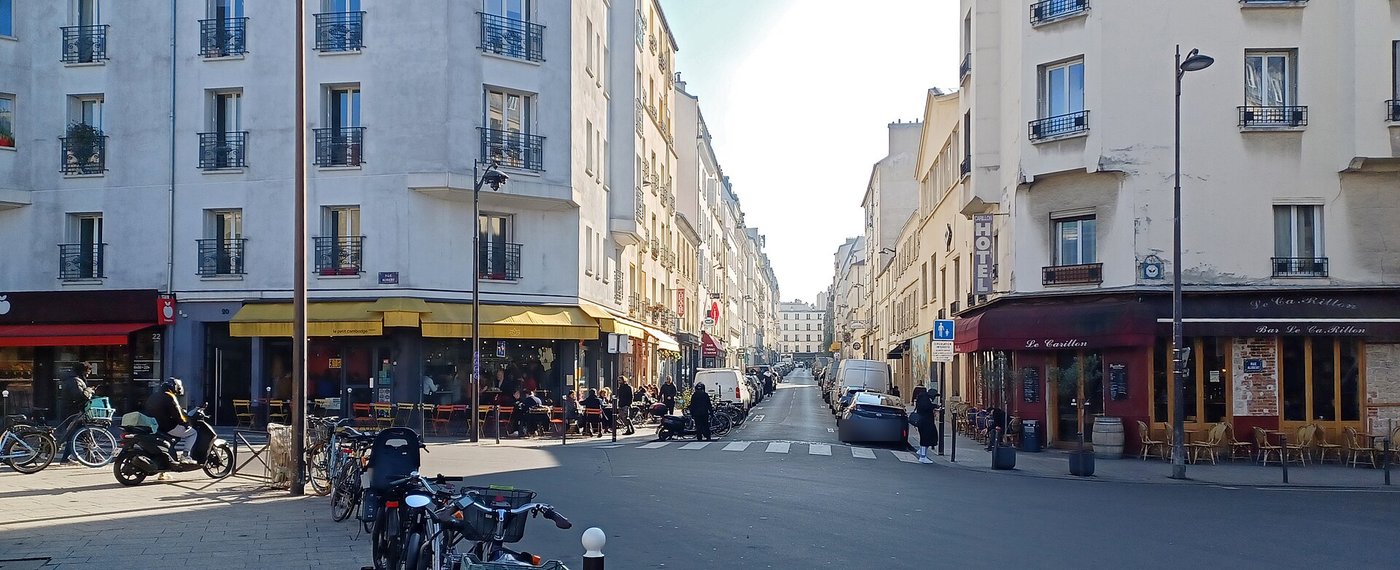
Featured image: The terraces of Le Petit Cambodge (left, yellow awnings) and Le Carillon (right, burgundy awnings) at the corner of Rue Alibert and Rue Bichat in Paris's 10th arrondissement, two of the sites attacked on November 13, 2015, in ordinary daytime use in a photograph published in February 2023. Photo by Steigi1900, cropped by Lämpel, CC0, via Wikimedia Commons. A licence plate has been blurred.
Reuters filmed the clip on Saturday, October 17, near the Arc de Triomphe, the Free Press Journal reported. Nationwide protests over schools and living costs had turned violent in parts of Paris that day. A man and a woman sit at a café terrace with drinks and cigarettes. Behind them, objects burn in the street.
By Monday the footage had spread across news sites from Wellington to Mumbai. The Free Press Journal described flames consuming objects in the street behind the pair. New Zealand's Stuff headlined the couple as "blasé."
The Daily Jagran added a caveat. The footage, its report said, "does not establish what the couple knew about the fire."
Reactions came quickly. "This is why I love the French," Piers Morgan, the British broadcaster, wrote on X, Mediaite reported. Mediaite itself likened the scene to the "This is fine" dog meme. In France, the news channel CNEWS ran the clip under the label Insolite, meaning unusual.
The Interior Ministry said nearly 1,000 police officers and gendarmes were injured, and a demonstrator died after a cardiorespiratory arrest in Paris, France 24 and Reuters reported. Curfews followed on Monday.
Café terraces have sat beside French unrest before. Nicholas Cox described May 3, 1968, in a 2018 history for Bonjour Paris. In the Latin Quarter, police went after people "even those just sitting at café terraces," he wrote. Within days, a Le Monde report described barricades on the Boulevard Saint-Michel.
Maurice Brinton, a British eyewitness, published his account of those weeks in a Solidarity pamphlet in June 1968. On the afternoon of May 13, he stood in a dense crowd at the Place de la République. "Several people faint and have to be carried into neighbouring cafes," he wrote.
Half a century later, a famous restaurant became a target. On March 16, 2019, yellow-vest protesters on the Champs-Élysées ransacked Fouquet's, a brasserie founded in 1899, and "torched the restaurant's famous red awning," Reuters reported. It reopened on July 13 of that year. Its general manager, Géraldine Dobey, said the restaurant was known "beyond the borders of France."
On December 1, 2018, rioters had sprayed graffiti on the Arc de Triomphe and smashed a statue of Marianne inside it, AP reported. That day 133 people were injured and 412 arrested.
In November 2015 the terrace itself came under attack. On the night of November 13, gunmen opened fire on Le Carillon and Le Petit Cambodge, on Rue Bichat and Rue Alibert, and on La Belle Équipe on Rue de Charonne, according to a Wikipedia account of the attacks. In all, 130 people were killed that night. Within days restaurateurs, brewers and café owners called on Parisians to go back to their bistros on the evening of Tuesday, November 17, franceinfo reported. The call went out as "Tous au bistrot."
"On est là pour créer de la vie," Florent Gauthier told franceinfo. He managed La Fine Moustache, a bar in the 19th arrondissement. He meant it was there to create life. The slogan "Je suis en terrasse" spread online, echoing "Je suis Charlie," Reuters reported that week. "We can't just stop living," Marie-Thérèse Vasseur, 65, told the agency.
The same Reuters report quoted Luc Le Vaillant, a columnist at Libération. "Tomorrow, we will kiss each other like the abominable perverts we are," he wrote.
Writers and scholars have long treated the café as public space. Ray Oldenburg, the American sociologist, coined the term "third place" in his 1989 book The Great Good Place, and he listed the French café of the Revolution among his examples. The historian W. Scott Haine traced cafés as places of working-class sociability in The World of the Paris Café, covering 1789 to 1914. Johns Hopkins published it in 1996.
Jürgen Habermas, the German philosopher who died in March at 96, wrote about coffee houses as early sites of public debate. He also saw limits. The ideal, he cautioned, was never "actually realised in earnest in the coffee-houses." Ioannes Chountis de Fabbri quoted that line in Engelsberg Ideas after his death. Ernest Hemingway opened A Moveable Feast with a chapter titled "A Good Café on the Place St.-Michel."
On May 19, 2021, French terraces reopened after more than six months of Covid closures, with tables limited to six people and outdoor seating to half capacity, AP reported. Emmanuel Macron sat at a café terrace that day. There was "no reason why we can't continue moving forward," he said, according to AP.
Alain Fontaine, owner of the bistro Le Mesturet, had led a campaign three years earlier to seek UNESCO intangible heritage status for Paris bistros and their terraces, The Local reported in June 2018. The dossier was due that September. The group's statement recalled that after 2015, "Parisians crowded onto the terraces." It was not clear what became of the bid.
The cafés themselves are fewer. Insee, France's statistics agency, counted 34,600 bar-café businesses in 2021, against about 40,000 in the early 2010s, The Local reported in 2025. In the 1960s there were an estimated 200,000.


Comments
Loading comments…