The Small Skills We Give Away
Isaac Asimov wrote a short story in 1958 in which a man who could multiply became a genius. Is it possible that soon normal human skills will be extraordinary?
Swaraj — We the People. A Monday column by Suchitra Sharma on freedom, purpose and who decides where your life goes in the age of AI.
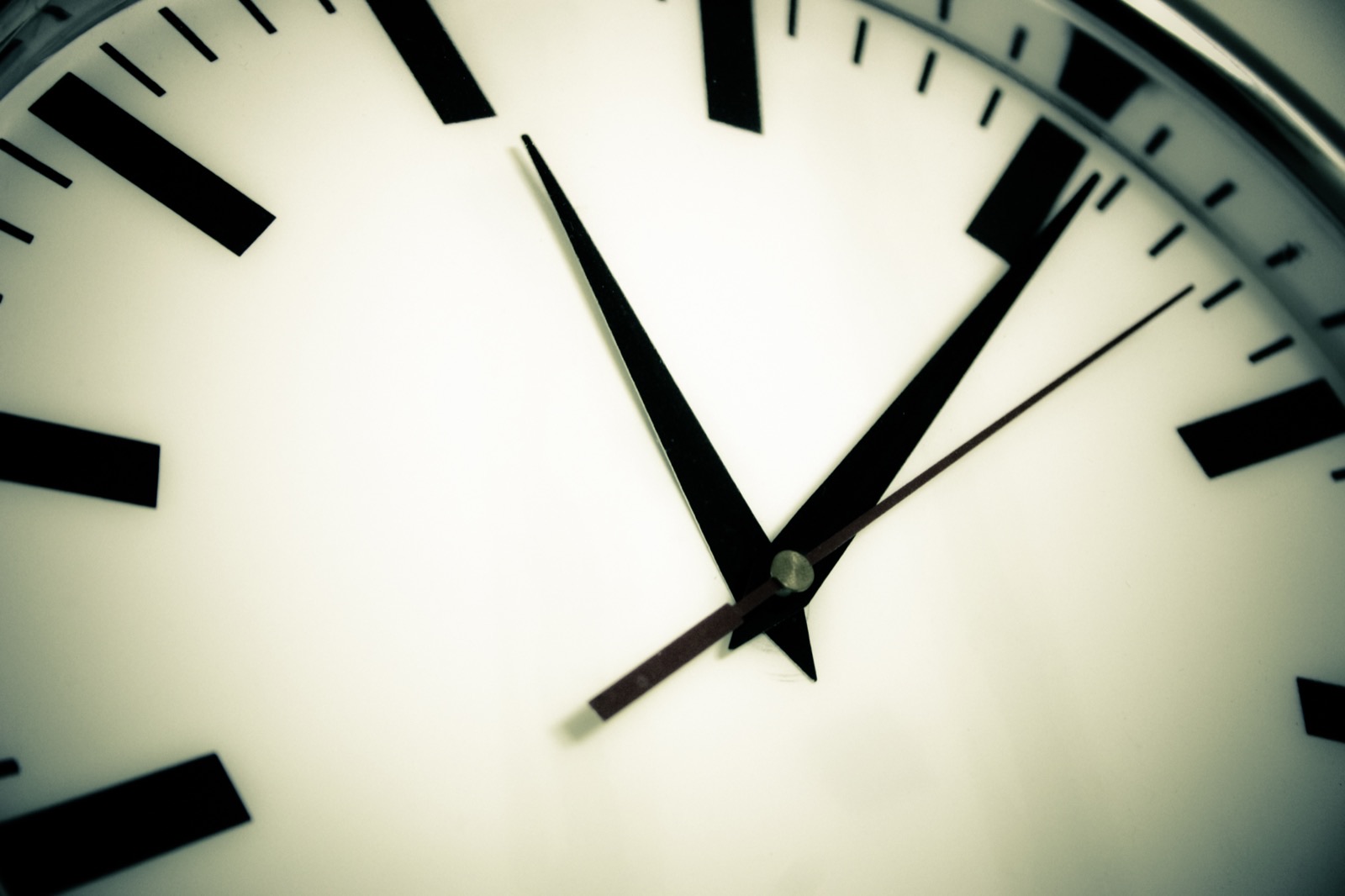
Top photo: An analog clock, photographed by Markus Spiske on June 9, 2014. CC BY 2.0, via Wikimedia Commons.
The man in Asimov's story was Myron Aub, an aging technician who spent his spare time studying old computers. In "The Feeling of Power," people have become so dependent on machines that they have forgotten how to do even simple arithmetic. Computers perform every calculation, including those needed to guide weapons in a war.
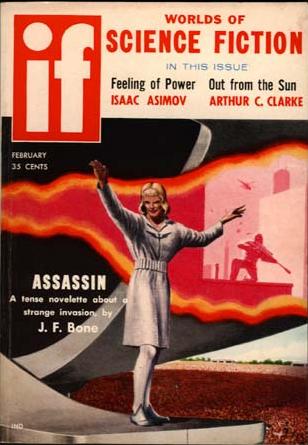 The February 1958 issue of If, which carried "The Feeling of Power." Cover art by Mel Hunter for Quinn Publishing. Public domain (copyright not renewed), via Wikimedia Commons.
While studying how older computers worked, Aub discovers that he can multiply numbers using a stylus and paper. A senior programmer hears about his discovery and brings him before a general and a congressman.
The general gives him the number 17 and the congressman chooses 23. Aub writes down 391. The congressman checks the answer on his pocket computer and finds that it is correct.
Neither official can quite believe what he has witnessed.
What happens next is disturbing. The officials realize that if people can calculate without computers, they could use human operators to guide missiles and save the cost of expensive electronic equipment. Aub had discovered multiplication because he enjoyed figuring things out, and he is horrified when he learns what the government intends to do with it. He eventually takes his own life.
I wonder how readers reacted to this story in 1958, when almost every schoolchild knew how to multiply. The idea that a person could become famous for something so ordinary must have seemed ridiculous.
But I am beginning to wonder whether Asimov was as far-fetched as he appeared.
Last Monday, I wrote about Jon Stewart's doubts about AI's promise of universal high income and E.M. Forster's story "The Machine Stops". Forster wrote his story in 1909, imagining a future in which a giant Machine provides everything people need. They live underground, rarely meet one another and depend on the Machine for food, shelter, communication and almost every part of daily life.
Over time, people forget how to do things for themselves, and eventually nobody understands the Machine on which everyone depends.
We are reading The Machine Stops in my seventh-grade class, and during one of our discussions, I asked the students if they could name simple things that people once knew how to do but were now forgetting because technology had made them unnecessary.
Aarna Gaurishankar, one of my seventh-grade students, mentioned that some students in her class couldn't read an analog clock.
I hadn't thought of that example, but it made sense.
A clock face is a small sum. Twelve hours, sixty minutes and two hands turning at different speeds have to be read together, in your head. A phone shows the time in digits, so a child can go a long way without ever needing the dial.
Does it matter if children cannot read an analog clock? Perhaps it doesn't matter very much when almost every device around us displays the time. But Aarna's observation made me think about other skills we might be losing without noticing.
Take cooking, for example.
Many of us have stopped cooking because we think a cart full of ingredients costs more than a Chipotle bowl. When you go to the grocery store and buy chicken, rice, beans, tomatoes, lettuce and cheese, the bill seems much higher than the price of a ready-made meal.
Chipotle has made affordability part of its appeal. In 2025, the average price of a chicken bowl was $10.68, according to Restaurant Business.
But how much would the same kind of meal cost if we made it at home?
I decided to look at the numbers.
According to the Bureau of Labor Statistics, in September 2026 a pound of boneless chicken breast cost an average of $4.20 in the United States. Rice cost $1.12 a pound, dried beans $1.67, tomatoes $1.99, romaine lettuce $3.31 and cheddar cheese $6.13.
Suppose we buy a pound of chicken and a pound of tomatoes, use half a pound each of beans and lettuce, add a cup of uncooked rice and finish with a quarter-pound of cheese. The ingredients used would cost about $10.67. Add another $1.50 for onion, lime, oil and spices, and the total comes to a little over $12.
That is enough for four modest bowls at roughly $3 each.
Of course, this is the cost of the ingredients used, and the amount paid at the grocery checkout may be higher because we cannot always buy everything in the exact quantity we need. Cooking also takes time, and that time has value.
Still, the calculation is worth doing. We may decide that the convenience of eating out is worth the extra money, but at least we know what we are paying for.
And there is something else we gain when we cook.
We learn to estimate quantities, adjust recipes, recognize ingredients and figure out what to do when something goes wrong. We also learn how much food we need and how far our money can go.
These may seem like ordinary household skills, but they give us more control over our daily lives.
The same is true of reading a map, calculating a bill, sewing a button or fixing something that has stopped working. We may not need to do these things every day, but knowing how gives us another option when we do.
I have no desire to return to a time when every household task required hours of manual labor. Machines have made life easier in countless ways, and artificial intelligence may do the same for many kinds of intellectual work. It can already explain difficult subjects, help people learn new skills and make information available to almost anyone who wants it.
Yet I wonder what happens when we begin relying on machines for tasks that also help us develop our own abilities.
A calculator is useful, but it helps to know enough arithmetic to recognize an unreasonable answer. A navigation app can take us almost anywhere, but understanding directions is still valuable. And a student can ask AI to write an essay, but what has the student learned if they cannot explain the ideas in it?
This question reminds me of Gandhi's idea of swaraj, the word from which this column takes its name.
In Hind Swaraj, written in 1909, Gandhi explained that freedom required people to learn how to govern themselves. "It is Swaraj when we learn to rule ourselves," he wrote. He followed it with another sentence: "It is therefore in the palm of our hands."
Gandhi was writing at a time when India was struggling for political independence, but his understanding of freedom also had a place in ordinary life. He believed that people should develop the knowledge and judgment needed to take responsibility for themselves.
He brought this thinking into education.
In 1937, Gandhi proposed a system of basic education that later became known as Nai Talim. He wanted children to learn through useful work, with their minds and hands working together. A child learning to spin, weave or make something would also learn mathematics, science and other subjects through the work itself.
"Of course the pupil learns mathematics whilst he is learning his handicraft," Gandhi wrote in Harijan in 1937.
Think about a child who is learning to sew. The child has to measure cloth, calculate how much is needed, work out where to cut and correct mistakes. Mathematics becomes part of doing something useful, and the child begins to understand why it matters.
I find this approach to education particularly relevant today, when AI can complete many of the tasks we ask students to do.
A student can now get a summary of a book within seconds, ask AI to solve a difficult equation or produce an essay on almost any subject. These tools can be enormously helpful, especially when a child needs additional explanations or wants to explore something beyond the classroom.
But I worry about students becoming accustomed to receiving answers before they have tried to work things out themselves.
When children struggle with a mathematical problem or try to find the right words for an essay, they are learning through that effort. They make mistakes, reconsider their ideas and gradually develop confidence in their own thinking.
As a teacher, I want my students to have access to every useful tool available to them. I also want them to know the satisfaction of understanding something well enough to explain it without assistance.
When a student hands in a beautifully written essay, I still want to know what the student thinks about the subject. Can they explain their argument? Can they defend it when someone disagrees? Have they understood what they have written?
These questions become more important when machines can produce convincing answers so easily.
There is a wonderful moment at the end of Asimov's story.
Jehan Shuman, the programmer who recognized Aub's discovery, has been experimenting with arithmetic himself. He works out that nine times seven is 63 and realizes that he no longer needs a computer to tell him the answer.
"The computer is in my own head," he thinks.
He experiences what Asimov called the feeling of power.
The ability to calculate had always been available to human beings, but generations of dependence on computers had made them forget it.
I think a free people is one that can still do small things for itself, and that every skill we keep is a vote for self-rule.
Perhaps we should think about this the next time a child asks us how to read a clock, or when we are tempted to let a machine solve a problem before trying it ourselves.
We have good reasons to use technology, and there will be many more reasons as it improves. I hope we also continue to teach children how to understand the world around them and how to do ordinary things with their own minds and hands.
It would be strange if one day a child who could read a clock, cook a meal or multiply two numbers without a machine were regarded as unusually gifted.
But then, that was precisely the world Asimov imagined nearly 70 years ago.



Comments
Loading comments…