Jensen Huang's admitted affair and the espionage questions now facing Nvidia
He built Nvidia into an AI empire by taking risks, cultivating relationships and demanding loyalty. Now an admitted affair and an alleged Chinese intelligence operation have raised questions about the man at its center.
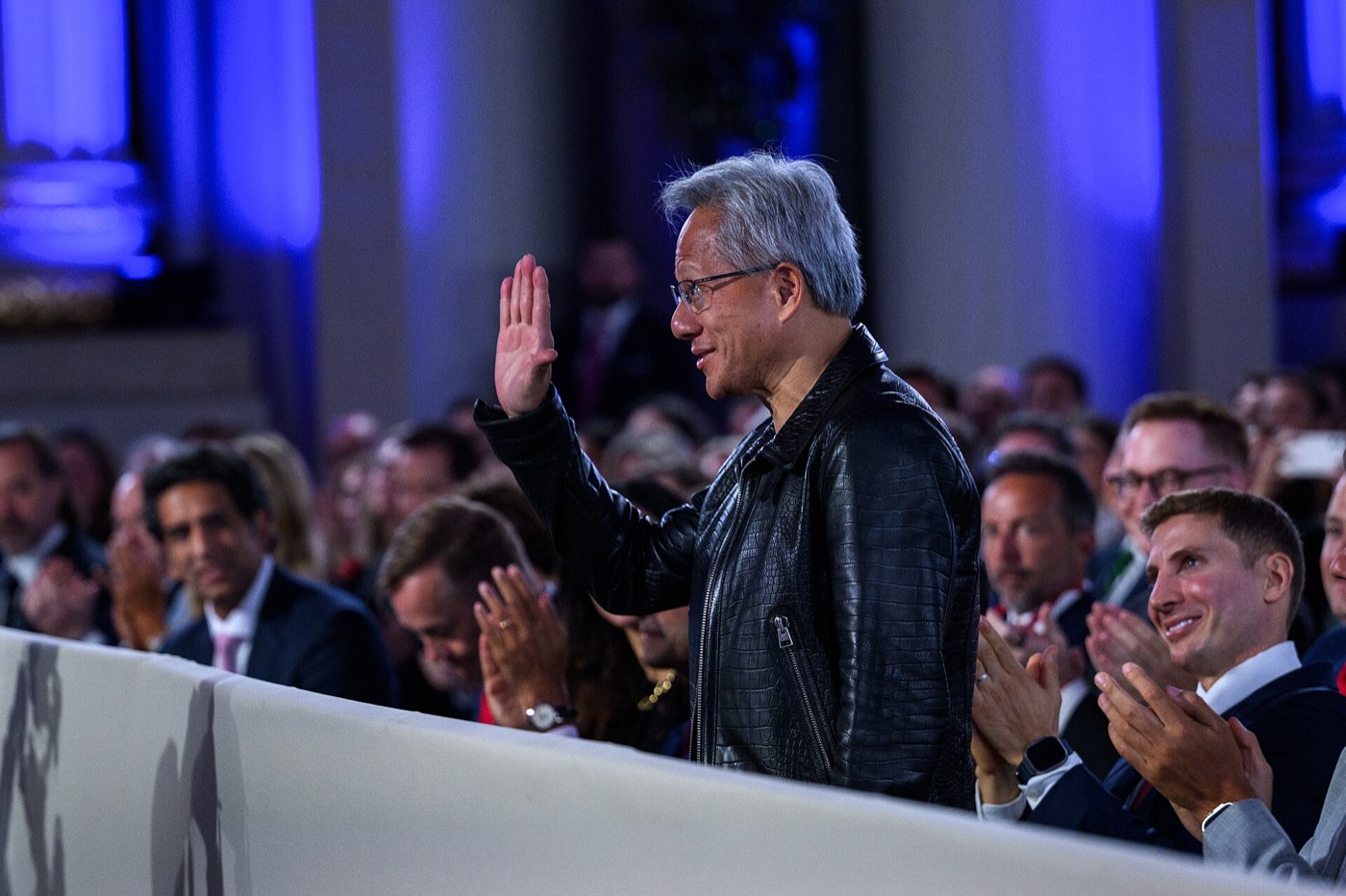
Top image: Nvidia's chief executive, Jensen Huang, is recognized by President Donald Trump at the White House AI Summit at the Andrew W. Mellon Auditorium in Washington on July 23, 2025. Official White House photo by Joyce N. Boghosian, public domain, via Wikimedia Commons.
Read our companion profile, Jensen Huang, the man behind the leather jacket, and the price of trust.
On May 22, 2025, during the Computex trade show, Jensen Huang hosted a dinner at a restaurant in Taipei. Among his guests was a woman in a pink dress.
At one point, Huang put his arm around her. She kissed him on the cheek. Later, they left in the same car.
Taiwanese broadcaster CTI filmed the encounter through the restaurant's windows, AFP reported. It looked like an ordinary evening among technology executives.
The woman was Alice Huang, a Chinese businesswoman and former executive of Megaspeed, a Singapore-based customer of Nvidia that runs data centers. She is no relation to Jensen Huang.
Seventeen months later, the footage took on a different meaning.
On November 8, 2026, Jensen Huang, the founder and chief executive of Nvidia, acknowledged that he had been unfaithful to his wife. In a letter to employees, he wrote: "I was unfaithful to my wife."
His actions, he said, had hurt her and their children. "There is no excuse for what I did," he wrote. "I am deeply sorry."
His apology came after reports that American intelligence officials suspected Alice Huang of working for China's Ministry of State Security. According to The New York Times, she had been recruited to gather information about Nvidia's chief executive and potentially to influence the company's approach to selling advanced AI chips to China.
Jensen Huang's letter did not identify the woman involved in the affair. The connection to Alice Huang came from subsequent news reporting.
Nvidia's board announced an independent investigation into reports that its chief executive had been the target of a foreign intelligence effort. It expressed confidence in Huang and said it had no reason to believe company secrets or national security had been compromised.
The story threatened something beyond Huang's marriage. For thirty-three years, he had been the public face of a company that grew from a struggling Silicon Valley startup into one of the world's most valuable businesses.
Now the same man who had built Nvidia through instinct, personal relationships and an extraordinary willingness to take risks was being questioned about his judgment.
Jensen Huang was born in Taiwan in 1963. His father worked in the oil industry, and the family moved to Thailand when he was young.
In 1973, his parents sent Jensen and his older brother to the United States, where they initially stayed with relatives. Their aunt and uncle enrolled them at the Oneida Baptist Institute in Kentucky, apparently believing it was an ordinary boarding school.
It was an austere religious institution that served troubled children. Jensen was nine years old.
He was too young for the institute's regular classes, so he attended a nearby school while living in its dormitory. His chores included cleaning bathrooms used by about a hundred teenage boys.
Huang has described those years as difficult but formative. He was far from his parents, learning English and finding his place in an unfamiliar country.
When his family eventually reunited in Oregon, he excelled at school, skipped grades and became a nationally ranked table-tennis player. He graduated from high school at sixteen.
At Oregon State University, he met Lori Mills, his lab partner in electrical engineering. Huang has said there were 250 students in the class and three women. Jensen was seventeen and Lori was nineteen. He later recalled that he tried to win her attention by offering to help with homework.
They began studying together, started dating and eventually married.
The two became engineers in Silicon Valley. They had two children, Madison and Spencer, and Lori later stepped away from her engineering career to raise the family.
Over the years, Lori became part of the Jensen Huang story. Huang has credited his wife and daughter with choosing his clothes, including the black leather jackets that became his trademark. He has frequently spoken of his family, of his wife's intelligence and of his reliance on her.
His public identity was unusually consistent: the immigrant boy who worked hard, the engineer who married his college sweetheart, the founder who never abandoned his company.
There was another part to the story. He had once washed dishes at Denny's, the American diner chain.
Years later, he would return to one of its restaurants to begin building Nvidia.
In 1993, Huang and two engineers he knew, Chris Malachowsky and Curtis Priem, met at a Denny's in San Jose to plan a company. They believed the emerging market for computer graphics would create enormous demand for specialized chips.
They founded Nvidia in April 1993.
Huang became chief executive. Malachowsky concentrated on engineering, and Priem helped design the graphics architecture.
Their first major bet nearly destroyed the company.
Nvidia's NV1 graphics chip relied on an approach to rendering three-dimensional images that differed from the triangle-based standard the industry was adopting. When Microsoft backed triangles, Nvidia found itself on the wrong side of the market.
Sales disappointed. Money ran short. The company laid off about half its staff and struggled to survive.
A contract with the Japanese video-game company Sega offered one possible escape, but Huang realized Nvidia's technology was wrong for the console Sega was developing.
He traveled to Japan and told Sega executive Shoichiro Irimajiri that Nvidia could not deliver the chip as planned.
Then he made an extraordinary request. He asked Sega to turn the $5 million it still owed under the contract into an investment in Nvidia.
Huang warned that the money would most likely be lost. Irimajiri agreed to help anyway.
The decision gave Nvidia several months to start again.
The company abandoned its original graphics approach, built a new chip around the industry standard and launched the RIVA 128 in 1997. It became Nvidia's first major commercial success.
The episode shaped Huang's approach to business. He had survived by admitting failure, changing direction and persuading another executive to trust him, as he recalled in a 2023 commencement speech at National Taiwan University.
Nvidia went public in 1999. That year it introduced the GeForce 256, which it marketed as the world's first graphics processing unit, or GPU.
The larger transformation came in 2006, when Nvidia introduced CUDA, software that allowed developers to use its graphics chips for computations beyond graphics.
For years, the investment brought little financial reward. Scientists used Nvidia's technology for research, simulation and other complex problems.
Then artificial intelligence caught up.
In 2012, the AlexNet breakthrough, trained on two Nvidia graphics cards, demonstrated the extraordinary usefulness of GPUs for training neural networks. Demand for computing power accelerated, and Nvidia found itself supplying the technology on which much of modern AI would depend.
In the quarter ending July 26, 2026, Nvidia reported revenue of $96.2 billion, up 106 percent from a year earlier. Its data-center business supplied $89.0 billion of it.
Huang had spent three decades preparing for a market that few people had imagined.
Yet the structure of Nvidia remained remarkably personal.
Two books, Tae Kim's The Nvidia Way and Stephen Witt's The Thinking Machine, describe a chief executive who runs his company differently from most large corporations.
Huang has maintained dozens of direct reports, resisted elaborate management hierarchies and demanded a constant flow of information. Employees send short "Top 5 Things" emails about their most important work. Problems are discussed openly, sometimes in uncomfortable detail.
He is known for fierce criticism, impatience and an almost relentless emphasis on speed.
His management style extends beyond Nvidia.
Huang cultivates relationships with customers and partners personally. He attends dinners, visits factories, meets engineers and keeps in touch with executives across Asia, Europe and the United States.
These relationships helped Nvidia succeed in an industry where access, trust and technical knowledge count for a great deal.
They also created an unusual concentration of influence.
For a company supplying some of the world's most strategically important technology, much of the business still revolves around one man.
And by 2026, Huang's relationships were no longer merely commercial. Nvidia had become central to the technological struggle between the United States and China.
Washington wanted to prevent China from acquiring the most advanced American AI chips. Beijing wanted access to the computing power necessary to develop its own systems.
Huang opposed sweeping restrictions that, he argued, would encourage Chinese companies to build competing technology and weaken American leadership. In May 2025 he called American export controls on AI chips to China a failure.
He spent considerable time making that case in Washington. In March 2026 he was named to President Donald Trump's Council of Advisors on Science and Technology, and in May he traveled with the president to China.
For Huang, China represented an enormous business opportunity. For American national-security officials, advanced AI chips were technology that could strengthen a strategic rival.
The conflict placed Nvidia's chief executive in a politically sensitive position.
It also made the people around him more important.
Alice Huang, also known as Huang Le, had worked in Chinese finance before entering the AI infrastructure business.
According to a Reuters profile published on November 10, she held senior positions at Shanghai Hexi Investment Management and had worked for HSBC's private bank in Hong Kong and for CITIC Securities. An earlier professional profile also described work in television journalism, although parts of that history remain difficult to corroborate.
In March 2023, she became the controlling shareholder of Megaspeed International, a Singapore-based cloud-computing company, according to C4ADS, a Washington research group that reviewed corporate records.
Megaspeed operated in a lucrative part of the AI business. Companies desperate for computing power could rent Nvidia systems in data centers outside China, without purchasing the chips themselves.
The difference is legal as much as technical. American export controls primarily restrict the transfer of advanced hardware to designated destinations and users, and renting computing services from facilities in other countries raises a different set of questions.
Megaspeed expanded at extraordinary speed.
Its assets grew from $33 million in 2023 to $3 billion in 2024, according to business filings cited by Reuters. Revenue rose to $294 million, and the company reported an after-tax loss of $20 million.
The company became an official Nvidia cloud partner. Shipping records showed that its Indonesian subsidiary imported Nvidia hardware, including advanced H100 processors, between 2024 and 2026.
Those shipments were not themselves proof of wrongdoing. But since 2025, American authorities have been examining whether Megaspeed helped Chinese customers get around restrictions on advanced chips.
Megaspeed has denied violating the rules. Its website calls the reports "misleading information and incorrect insinuations."
Alice Huang's formal connection to the company also became more complicated. Its shares were transferred to another Singapore company, SwiftData, in late 2023. C4ADS could not establish who ultimately controls SwiftData, but it assessed that she may have retained influence, noting appearances in which she was identified as Megaspeed's chair.
Meanwhile, she had developed access to Jensen Huang.
Both attended a Gigabyte party during the 2024 Computex show in Taipei, and a LinkedIn photograph showed them seated side by side, Reuters reported.
The May 2025 restaurant footage, which resurfaced after the scandal broke, showed a degree of familiarity that went beyond a routine handshake between a supplier and a customer.
But footage establishes only what cameras record. It cannot establish what the two discussed or what information, if any, changed hands.
That distinction would become central to the investigation.
On October 29, 2026, The New York Times reported that American intelligence officials had concluded Alice Huang was a Chinese intelligence asset.
On November 6, the newspaper reported further details from an intelligence memorandum circulated among senior Trump administration officials earlier that year. According to people briefed on the findings, China's Ministry of State Security had recruited her to gather intelligence on Jensen Huang.
The Financial Times reported that the assessment also described a romantic relationship.
The memo has not been made public. Its complete wording, evidence and level of confidence cannot be independently examined.
China rejected the allegations. Guo Jiakun, a Foreign Ministry spokesman, called the reports "baseless and purely slanderous smears" on October 30.
Singapore issued a particularly important correction. After The Wall Street Journal reported that Singaporean officials had investigated Alice Huang's possible intelligence ties, the country's Ministry of Home Affairs said no such investigation of her had been conducted.
It confirmed, however, that investigations into Megaspeed were ongoing.
These are separate questions: suspicion about an individual, possible violations by a company and the question of whether Nvidia's chief executive knowingly disclosed sensitive information.
None should be treated as proof of the others.
Reuters said on November 10 that it could not independently verify the intelligence allegation. It also could not locate Alice Huang to seek comment.
Huang himself initially characterized his interactions with her as ordinary business dealings. "Our relationship, our interactions, have been related to Megaspeed," he told Bloomberg. Nvidia said its regional cloud customers did not get access to its trade secrets or relevant national-security information.
Then came the November 8 apology.
The letter settled one question: Huang acknowledged betraying his wife.
It did not settle the intelligence allegations.
He did not say whether he had known of any suspected espionage. President Trump said on November 9 that Huang had told him he had no idea Alice Huang was a spy, and that he believed him.
Nvidia's board appointed a committee of independent directors, assisted by outside counsel, to investigate.
At the time of writing, no public evidence establishes that Jensen Huang knowingly assisted Chinese intelligence or that Nvidia secrets were compromised.
The revelations arrived during a difficult period for Nvidia's shares.
The stock closed at $178.67 on November 9, down 4.3 percent on a day the Nasdaq rose 2.7 percent. That left it about 25 percent below its record close of $239.24 on October 6. Much of that slide unfolded alongside a broader sell-off in AI and semiconductor stocks, so not all of it can be attributed to the scandal.
But investors now faced a risk that Nvidia's financial statements could not measure.
The company had become inseparable from its founder.
Huang remained its chief strategist, public spokesman, dealmaker and most recognizable figure. No obvious successor commanded the same authority.
His personal judgment had therefore become a matter of corporate governance.
Three Republican committee chairs in the House, John Moolenaar of the select committee on China, Brian Mast of Foreign Affairs and Rick Crawford of Intelligence, asked Huang to appear for a closed-door briefing on November 18. They want to discuss his interactions with Alice Huang and Nvidia's protections against foreign intelligence operations.
A shareholder lawsuit filed on November 9 in federal court in San Jose alleges that investors were misled by the failure to disclose the relationship and associated risks. The allegations have not been adjudicated.
The questions now extend beyond Huang's private conduct.
What did Nvidia's board know? When did it learn of the relationship? Were any company policies breached?
Did government officials share their concerns with Nvidia? And was any sensitive information disclosed?
The most consequential question is still unanswered: did a foreign intelligence service gain access to information or influence through its relationship with one of the world's most powerful technology executives?
An affair does not establish espionage. Nor does the absence of publicly disclosed evidence prove that nothing happened.
The board's investigation is where that question will be tested.
For much of his career, Huang has repeated a warning that became part of Nvidia's culture: the company is always thirty days from going out of business.
It began as a reminder of the company's near-collapse in the 1990s. Success, he wanted employees to understand, was never permanent.
The philosophy helped him build Nvidia.
He learned to recognize danger early, change direction and persuade others to keep faith with him. Sega trusted him when his first technology failed. Investors supported him through years of uncertain spending. Engineers followed him into a market that had not yet arrived.
Now the company faces a different test.
Nvidia is scheduled to report earnings on November 17. The congressional briefing has been requested for the following day. The board's investigation has no announced completion date.
Lori Huang has made no public statement. Alice Huang has not publicly responded to the allegations. Jensen Huang remains chief executive, with the board's expressed support.
The technology that made Nvidia indispensable has not disappeared. Its chips are still central to the world's AI infrastructure. Its customers still need them.
But the company has entered unfamiliar territory.
For three decades, Jensen Huang's greatest strength was his ability to persuade people to trust him.
This time, an apology and a promise of cooperation may not be enough.
The answers will have to come from evidence.
Reported through November 10, 2026. This is a developing story. Allegations regarding Chinese intelligence activity remain unproven in the public record.


Comments
Loading comments…