Jensen Huang, the man behind the leather jacket, and the price of trust
From a lonely childhood in Kentucky to the creation of the world's most valuable chipmaker, Jensen Huang has built his life on determination and personal relationships. An admitted affair and allegations of Chinese espionage have now placed both under scrutiny.
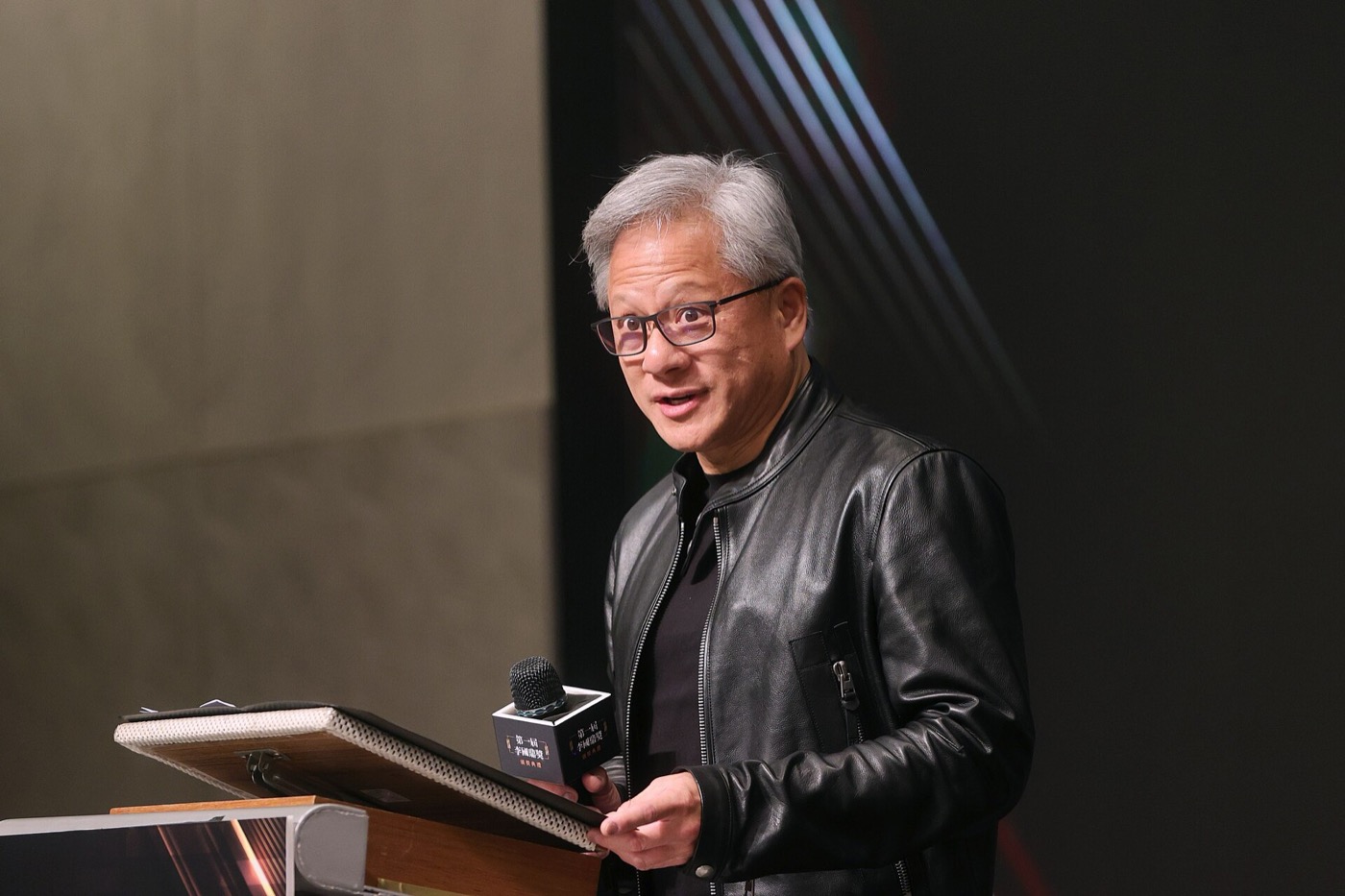
Top image: Jensen Huang, in one of his black leather jackets, speaks at the first K.T. Li Awards ceremony in Taiwan on November 9, 2023. Photo by the Office of the President of Taiwan, CC BY 2.0, via Wikimedia Commons.
This profile accompanies our report, Jensen Huang's admitted affair and the espionage questions now facing Nvidia.
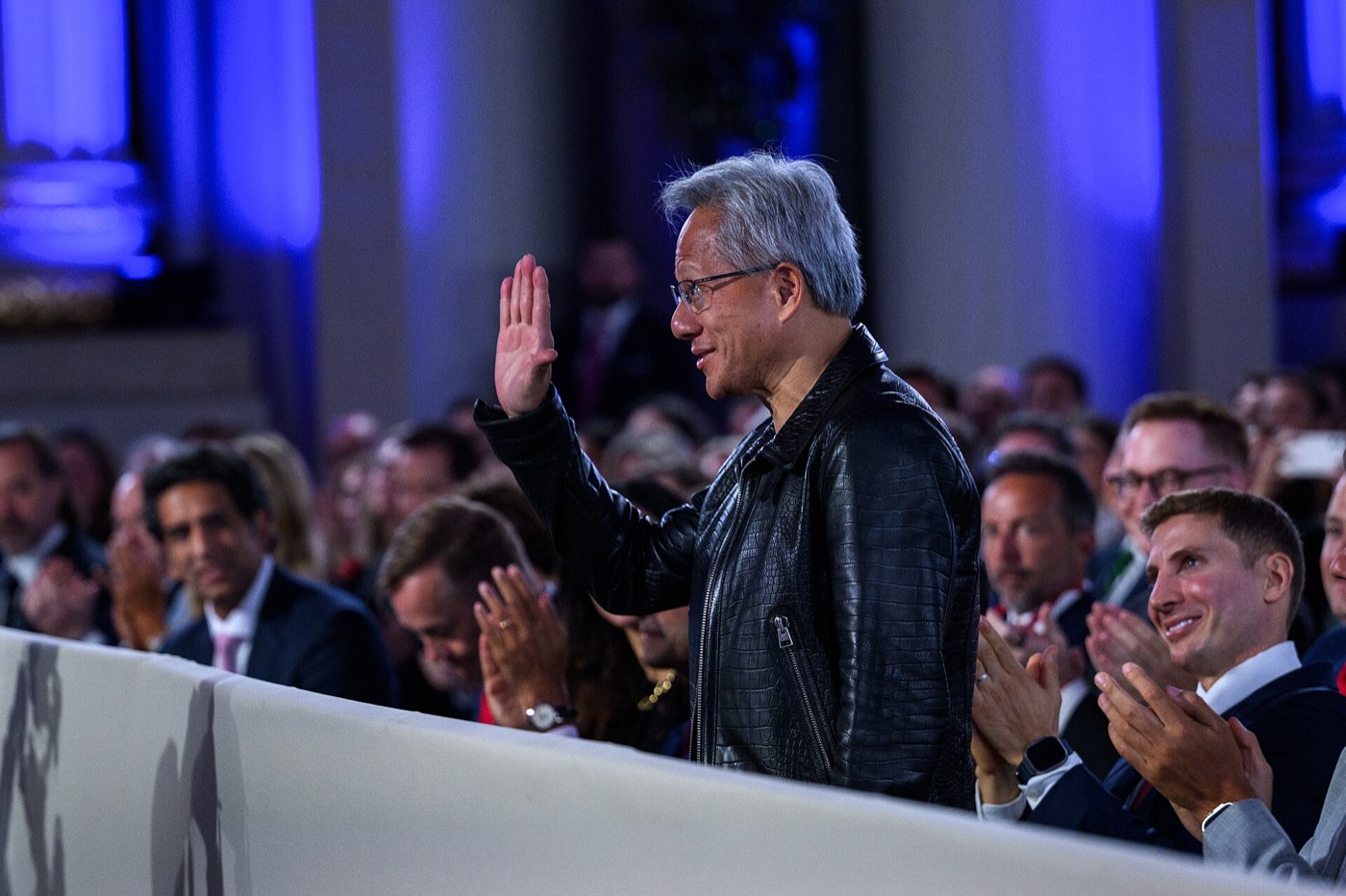
Jensen Huang rarely appears in public without his black leather jacket.
He wears one to technology conferences, product launches and meetings with some of the world's most powerful executives. Over a black shirt and trousers, the jacket has become his uniform, as recognizable as Steve Jobs's black turtleneck.
He has said he owns between thirty and forty of them. Many are Tom Ford designs. The lizard-embossed jacket he wore at Nvidia's 2024 technology conference retailed for $8,990.
The look was not entirely his idea.
"I'm happy that my wife and my daughter dresses me," Huang said in a 2023 interview. He has said he does none of his own shopping and finds it easier to wear essentially the same outfit every day.
Asked about the jackets in another interview, he gave the credit to Lori. "This is what my wife bought for me, and this is what I'm wearing," he said.
Lori Mills met Jensen Huang when they were engineering students at Oregon State University more than forty years ago. They married in 1985, raised two children and built a life together as Nvidia grew from a struggling startup into one of the most valuable companies in the world.
Huang has often credited his wife for her intelligence, support and influence on his life. Their two children now work at Nvidia.
On November 8, 2026, the sixty-three-year-old chief executive admitted that he had been unfaithful to Lori.
In the mid-1990s, Huang traveled to Japan to deliver bad news.
His company, Nvidia, was running out of money. Its first graphics chip had failed, and a contract to develop technology for Sega's next video-game console was falling apart. Huang knew his engineers were pursuing the wrong approach.
He told Sega executive Shoichiro Irimajiri that Nvidia could not deliver what it had promised.
Irimajiri could have walked away. Instead, Sega agreed to turn the $5 million it still owed under the contract into an investment in the struggling company.
The money kept Nvidia alive long enough to develop a new chip.
Thirty years later, Irimajiri, now eighty-six, still remembered the encounter. "I came to like Jensen Huang's character, and bet everything on him," he told Jiji Press in September 2026.
It was one of the most consequential acts of trust in Silicon Valley history.
The company Irimajiri helped save would eventually become the world's leading supplier of artificial-intelligence processors, making Huang one of the richest people in technology.
Now, at sixty-three, Huang finds himself in another crisis. This time, the questions concern his personal conduct, his judgment and a reported intelligence operation involving China.
His apology to Lori, his wife of roughly forty years, followed reports that American intelligence officials believed a Chinese businesswoman close to him had been recruited to gather information for Beijing.
The woman, Alice Huang, had been an executive at Megaspeed, a Singapore-based company that buys Nvidia technology. She is unrelated to Jensen Huang.
Nvidia's board has opened an independent investigation. Its directors say they have no reason to believe company secrets or national security have been compromised.
For a man whose entire career has depended on persuading others to believe in him, the next few months may prove unusually difficult.
Jen-Hsun Huang was born in Taiwan on February 17, 1963. His father worked in the oil industry, and the family moved to Thailand when Jensen was a child.
In 1973, his parents sent Jensen and his older brother to the United States. They stayed initially with relatives in Tacoma, Washington.
Their aunt and uncle enrolled the boys at the Oneida Baptist Institute in Kentucky, believing it to be a prestigious boarding school.
The school was very different from what they had imagined. It was a religious institution that served troubled young people, many of them considerably older than Jensen.
At nine, he was too young for its classes. He lived in the dormitory and attended a nearby elementary school, crossing a footbridge each morning.
In a 2023 profile by Stephen Witt in The New Yorker, Huang described being assigned a seventeen-year-old roommate who showed him where he had been stabbed in fights. The older boy could not read, so Jensen helped teach him. In return, his roommate taught him how to lift weights.
Huang was bullied and spoke English with a heavy accent.
He also cleaned bathrooms at the institute.
The experience became a recurring part of his public story. Huang has spoken about the value of suffering, the importance of resilience and the discipline required to endure difficult circumstances.
After about two years, his parents moved to Oregon and the family reunited.
Jensen was academically gifted. He skipped two grades, played table tennis at a nationally competitive level and graduated from Aloha High School at sixteen.
He also worked at Denny's, washing dishes before becoming a busboy and a waiter.
He would return to that detail often, telling audiences that he had learned to work hard long before becoming a technology executive.
At Oregon State University, Huang studied electrical engineering. There he met Lori Mills, another engineering student.
By Huang's account, she was one of only three women in a class of 250. Huang was seventeen and younger than nearly everyone around him. Lori was nineteen.
They were assigned as laboratory partners.
Huang later recalled that he tried to impress her through his academic abilities. He persuaded her to study with him, and they began dating.
Jensen completed his undergraduate degree in 1984 and later received a master's degree from Stanford University. The couple married in 1985.
Their early married life revolved around engineering careers in Silicon Valley. Huang worked at Advanced Micro Devices and then at LSI Logic, where he became involved in semiconductor design and management.
They had two children, Madison and Spencer.
Although Lori kept a relatively low public profile, she remained a familiar presence in Huang's accounts of his life. He spoke fondly about meeting her in college and about her role in their family.
His black leather jackets, often paired with black shirts, turned into a kind of corporate uniform. Whether unveiling a processor, greeting world leaders or speaking to thousands of engineers, Huang appeared in much the same clothes.
Their family became part of Nvidia's story as well. Madison is a senior director of product marketing, and Spencer is a director of product management specializing in robotics, according to The Information.
Lori is president of the family's charitable foundation, which supports universities and scientific research. Its gifts include $50 million to Oregon State University for the Jen-Hsun Huang and Lori Mills Huang Collaborative Innovation Complex. In 2008, Stanford announced a $30 million pledge from Huang for an engineering center. In 2019, a $2 million gift built Huang Hall, a girls' dormitory at Oneida.
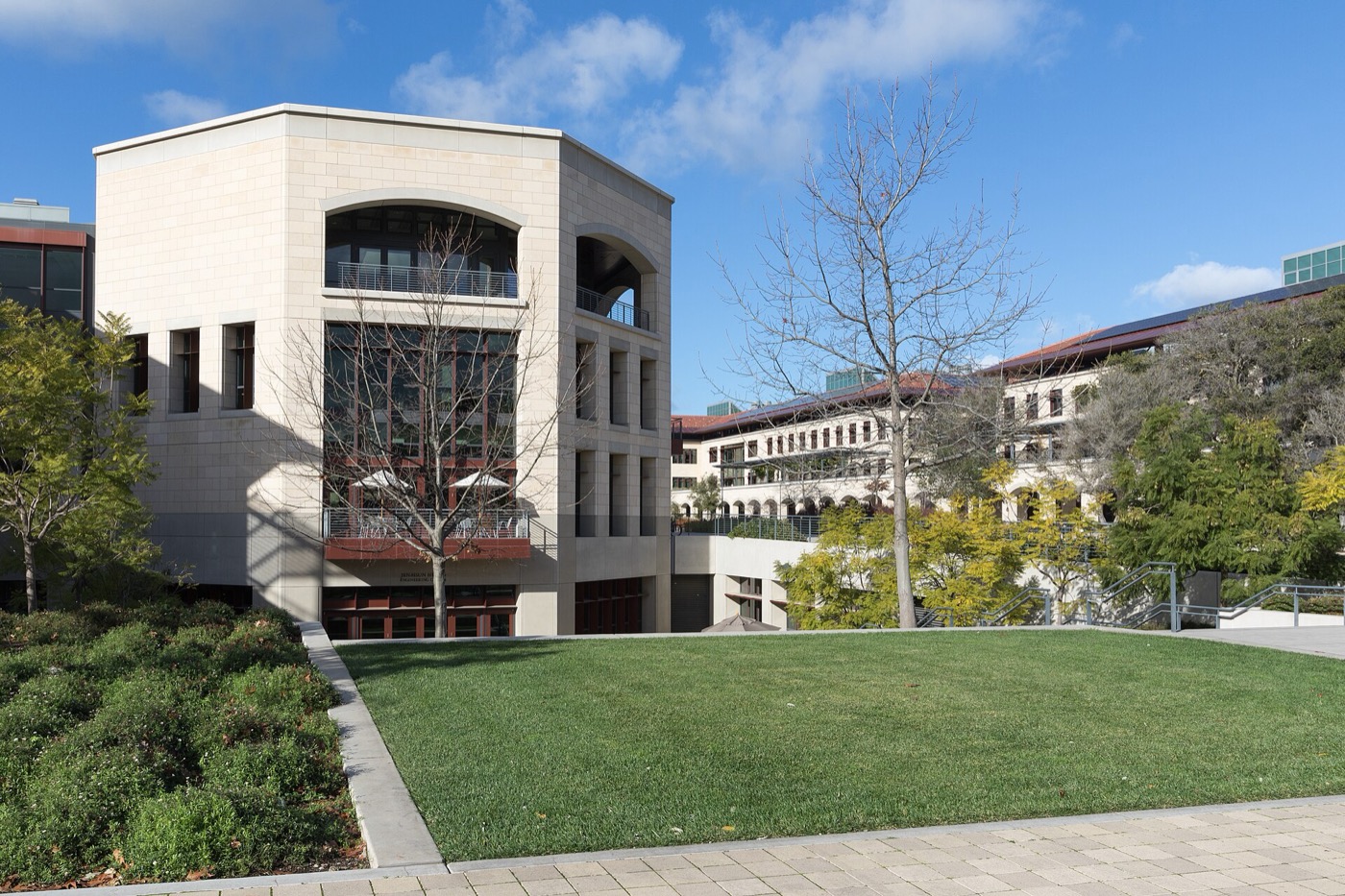
The Jen-Hsun Huang Engineering Center at Stanford University in California, photographed on December 16, 2016. Photo by Frank Schulenburg, CC BY-SA 4.0, via Wikimedia Commons.
For years, the public saw a familiar portrait: a successful immigrant entrepreneur with a long marriage, two grown children and a family closely involved in the company he created.
His private life attracted little scrutiny.
Early in 1993, Huang began planning a new semiconductor company with Chris Malachowsky and Curtis Priem, two engineers from Sun Microsystems.
They met at a Denny's in San Jose.
The personal computer was changing rapidly. Video games were becoming more sophisticated, and the founders believed that ordinary processors would struggle to handle increasingly complex graphics.
They decided to develop specialized chips.
Nvidia was incorporated in April 1993, with Huang as its chief executive. He was thirty.
The three founders brought different strengths. Priem was a graphics architect. Malachowsky had considerable engineering experience. Huang understood both chip design and the commercial side of the semiconductor business.
The company struggled from the beginning.
Nvidia's first product, the NV1, used a graphics approach that conflicted with the emerging industry standard. Microsoft and other developers were moving toward triangles as the basis for three-dimensional graphics. Nvidia had made a different bet.
It was a costly mistake.
Sales disappointed, money ran short and the company cut staff. Its contract with Sega offered some hope, but Huang came to believe that Nvidia's proposed technology would fail there as well.
That was when he went to Japan.
The $5 million from Sega gave Nvidia time to change course. Its engineers redesigned the product around the industry's preferred architecture.
In 1997, Nvidia released the RIVA 128, a successful graphics chip. Two years later, the company went public and introduced the GeForce 256, which it marketed as the first GPU.
The company finally had a profitable direction.
Its founders would take different paths.
Malachowsky remained at Nvidia, continuing his technical work and eventually becoming an Nvidia Fellow. Priem retired in 2003, had sold all his shares by 2006 and gave much of his wealth to philanthropy. "I wish I'd kept a little bit more," he later said.
Huang stayed.
He would spend the next three decades running the company he had founded at thirty.
Nvidia initially built its business around video games, helping computers render increasingly realistic images.
Huang believed the chips had a larger future.
Graphics processors were exceptionally good at performing many calculations simultaneously. That capability, he reasoned, could be valuable beyond gaming.
In 2006, Nvidia introduced CUDA, a software platform that allowed programmers to use GPUs for more general computing tasks.
It was an expensive undertaking, and the commercial return was uncertain.
Scientists began using GPUs for complex simulations and numerical research. Some AI researchers discovered that the same processors were well suited to training neural networks.
In 2012, the success of AlexNet, a neural network that dramatically improved image recognition, demonstrated the potential of GPU-based AI computing.
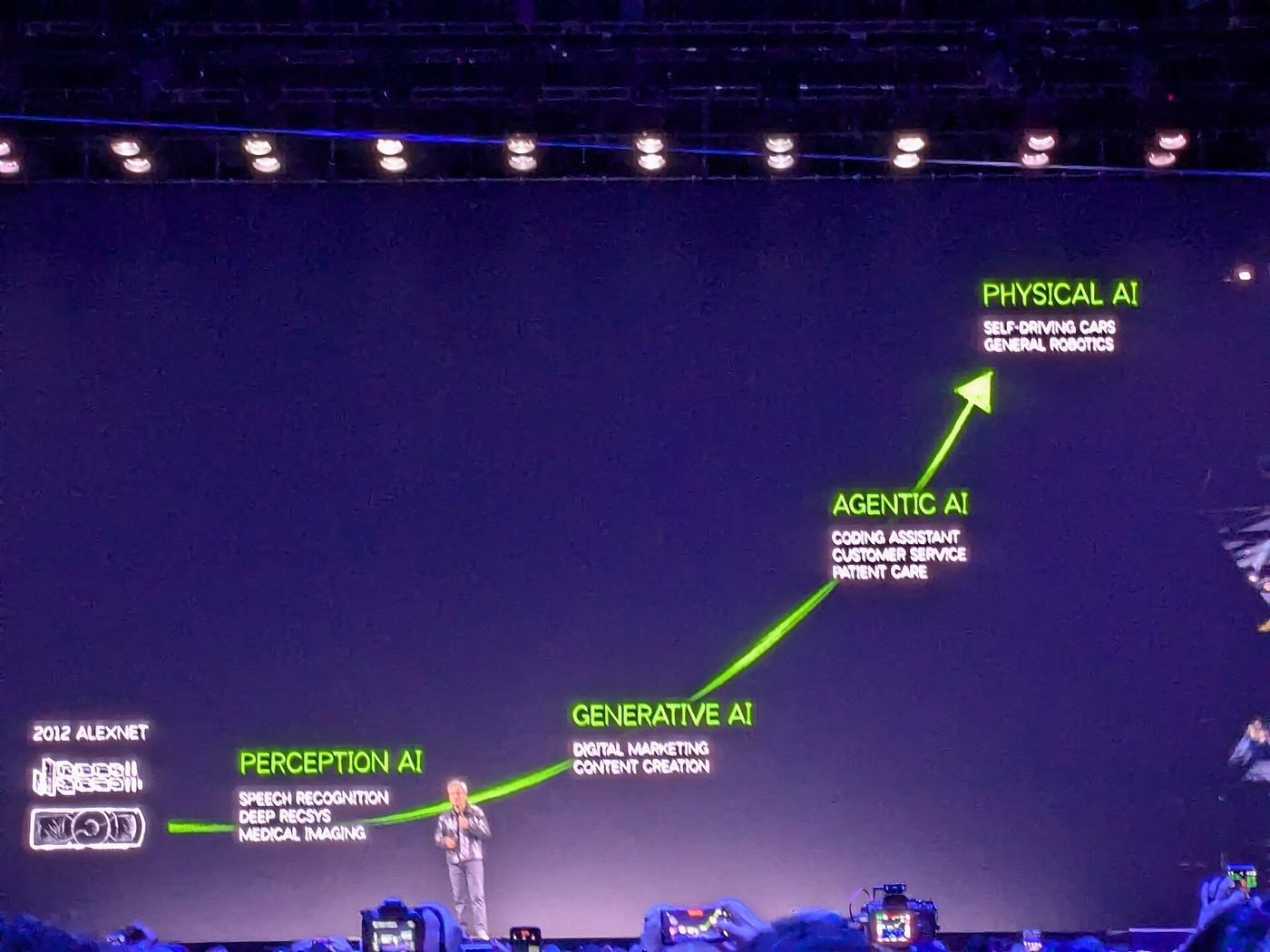
Jensen Huang presents Nvidia's history of AI, starting from "2012 AlexNet," at the company's keynote at CES 2025 in Las Vegas on January 6, 2025. Photo by Pronoia, CC0, via Wikimedia Commons.
Huang began investing more aggressively in artificial intelligence.
The decision required patience. Nvidia spent years developing hardware, software and a network of developers before the market became enormous.
When OpenAI released ChatGPT in November 2022, the demand for advanced AI computing accelerated. Nvidia had already developed much of the infrastructure needed to supply it.
The company's fortunes changed with remarkable speed.
In May 2023, Nvidia reached a market value of $1 trillion. By October 2025, it had crossed $5 trillion. Its fiscal 2026 revenue reached $215.9 billion, an increase of 65 percent over the preceding year.
Huang's personal fortune rose and fell with Nvidia's share price.
He became a celebrity in technology circles, particularly in Taiwan, where the president presented him with the first K.T. Li Award in 2023. He courted governments far beyond Washington, too. In September 2023, he met Prime Minister Narendra Modi in New Delhi.
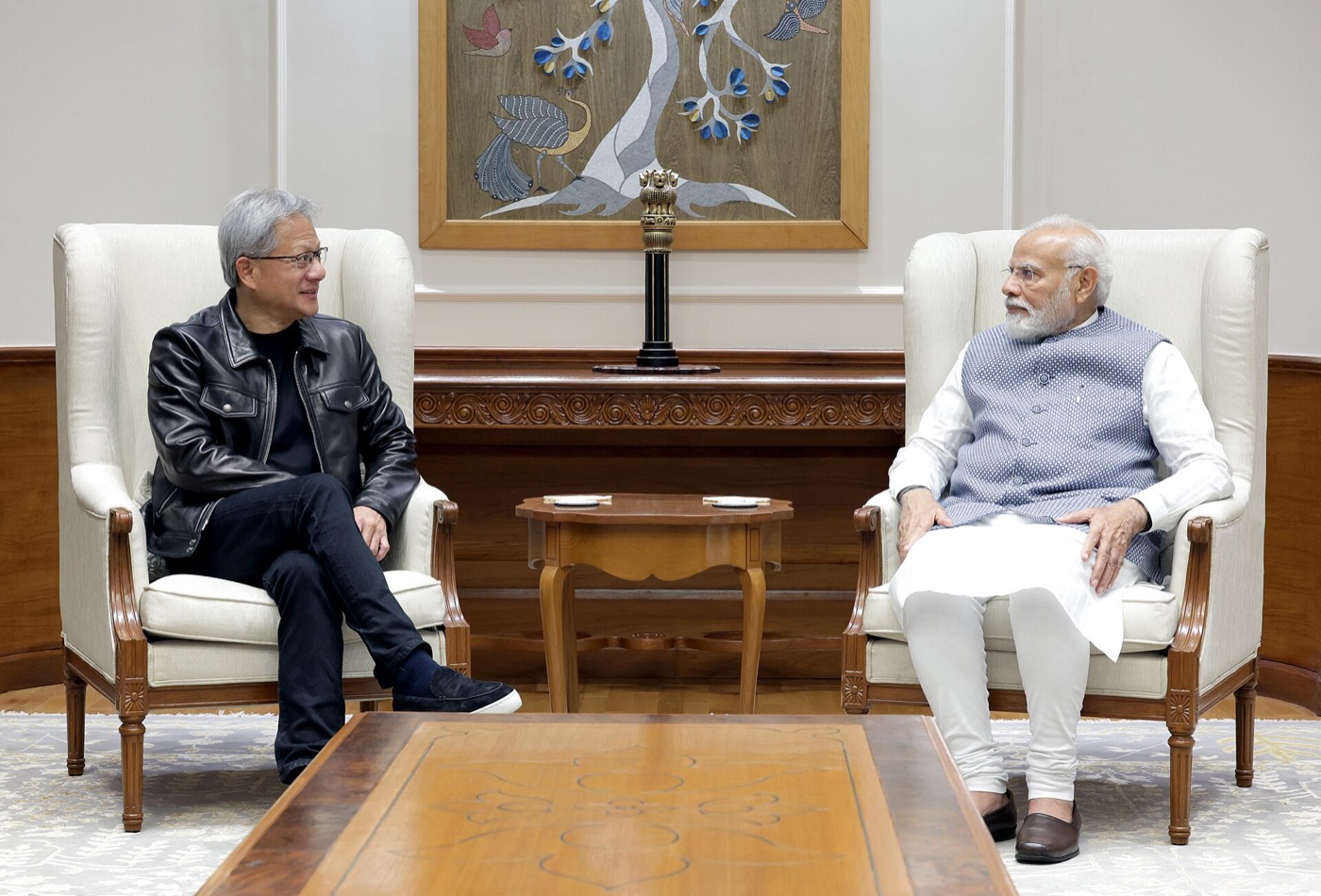
Jensen Huang meets Prime Minister Narendra Modi at the Prime Minister's Office in New Delhi on September 4, 2023. Photo by the Prime Minister's Office, Government Open Data License – India, via Wikimedia Commons.
Yet Nvidia's management structure remained unusually dependent on him.
In two recent books, Tae Kim's The Nvidia Way and Stephen Witt's The Thinking Machine, Huang emerges as a demanding and highly involved chief executive.
He has maintained an unusually large number of direct reports, resisted traditional management hierarchies and required employees to communicate problems directly.
He can be impatient and sharply critical. Employees describe long working hours, public questioning and high expectations.
Huang argues that information should travel quickly through a company and that problems should be discussed openly.
He is equally involved with customers.
He regularly visits technology companies, manufacturers, government officials and business partners. In Taiwan and elsewhere in Asia, he attends dinners and informal gatherings with executives whose companies supply or purchase Nvidia technology.
Personal relationships have been central to his business methods since the Sega rescue.
By 2026, those relationships carried growing geopolitical importance.
Nvidia's advanced processors had become essential to artificial intelligence. They were used to train powerful language models, run data centers and develop new applications for businesses and governments.
Washington increasingly regarded the technology as a national-security concern.
Beginning in 2022, the United States restricted exports of advanced AI chips to China. Successive rules tightened the controls, seeking to keep Chinese companies and military-linked organizations away from the most powerful American processors.
Nvidia responded by developing modified chips intended to comply with American rules.
Huang also argued publicly against broad restrictions, calling the export controls a failure in May 2025.
He maintained that shutting Nvidia out of China would strengthen Chinese chipmakers and encourage the development of a competing technological ecosystem.
His position reflected a substantial commercial interest. China represented a major market for Nvidia, and American restrictions threatened billions of dollars in potential sales.
Huang became increasingly visible in Washington. He met President Donald Trump, joined the President's Council of Advisors on Science and Technology and accompanied Trump on a trip to Beijing in May 2026.
The chief executive of a private company was now participating in discussions with direct consequences for American foreign policy and the global AI industry.
At the same time, American officials were investigating whether intermediaries in Southeast Asia were helping Chinese customers obtain restricted Nvidia technology.
One of the companies attracting attention was Megaspeed.
Alice Huang, also known as Huang Le, had worked in Chinese finance before becoming associated with the rapidly expanding AI computing industry.
For a report published on November 10, Reuters reviewed more than 30 publicly available financial records, corporate filings and company materials.
The records linked her to senior roles at Shanghai Hexi Investment Management, a Chinese investment firm. Company materials also described earlier employment with HSBC's private bank in Hong Kong and with CITIC Securities.
Another profile said she had worked as a television journalist. That part of her career has proved more difficult for reporters to verify.
In March 2023, she became the controlling shareholder of Megaspeed International, a Singapore-based company that supplies cloud-computing services using Nvidia hardware, according to C4ADS, a Washington research group that reviewed corporate records.
Megaspeed grew extraordinarily fast. Its assets rose from $33 million in 2023 to $3 billion in 2024, according to filings cited by Reuters.
Its business model placed it in an increasingly sensitive market.
American export controls restricted shipments of certain advanced Nvidia chips to China. Companies based elsewhere in Asia could buy the hardware and rent computing power to customers, including Chinese businesses.
The arrangement raised questions for American regulators about whether restricted technology could be reached indirectly.
Shipping records showed that Megaspeed's Indonesian subsidiary imported advanced Nvidia processors between 2024 and 2026. The shipments did not themselves establish any violation of American export controls.
Megaspeed has maintained that its business is legitimate and complies with applicable rules.
Alice Huang's shares in the company were transferred to another Singapore entity, SwiftData, in late 2023. Her precise role after that transaction remains uncertain, though C4ADS assessed that she may have retained influence.
By 2024, however, she had met Jensen Huang.
A photograph showed the two sitting together at a Gigabyte party during the Computex trade show in Taipei that year.
In May 2025, video footage showed them greeting each other affectionately at a Taipei restaurant and leaving in the same car.
The footage gained attention only after the intelligence allegations emerged.
On October 29, 2026, The New York Times reported that American officials had concluded Alice Huang was a Chinese intelligence asset.
A subsequent report described an intelligence memorandum alleging that China's Ministry of State Security had recruited her to gather information about Jensen Huang and to influence his views on sales of advanced chips to China.
The Financial Times reported that the classified assessment also described a romantic relationship.
The memorandum itself has not been made public.
American officials have not released the evidence supporting the assessment, and Reuters said it could not independently verify the allegations.
China denied the reports, calling them baseless.
Singapore's government also disputed one part of the reporting. On October 31, its Ministry of Home Affairs denied that it had investigated Alice Huang, as The Wall Street Journal had reported.
Singapore confirmed that investigations into Megaspeed were ongoing.
The distinction is important. The company was already under scrutiny over possible violations of trade rules, but that inquiry did not establish that Alice Huang was a spy.
Nvidia initially characterized Jensen Huang's interactions with her as ordinary business dealings.
The company said its chief executive speaks with thousands of customers every year and that its regional cloud customers did not get access to its trade secrets or relevant national-security information.
Then, on November 8, Huang issued a public apology.
"I was unfaithful to my wife. My actions hurt her and our children."
His statement acknowledged infidelity without identifying the other person.
It also addressed the reported intelligence concerns. "I support the investigation and will cooperate fully," he wrote.
Nvidia announced that independent directors, assisted by outside counsel, would examine the allegations.
The board expressed confidence in Huang and said it had no reason to believe Nvidia secrets or national security had been compromised.
President Trump defended him, saying Huang had told him he was unaware of any alleged espionage.
The controversy quickly moved beyond Nvidia.
Three Republican congressional committee chairs requested a closed-door briefing with Huang on November 18, asking about his interactions with Alice Huang and Nvidia's security procedures.
On November 9, a shareholder filed a proposed class-action lawsuit alleging that Nvidia and Huang had failed to disclose information that could affect investors. The claims have not been adjudicated.
As of November 10, no public evidence establishes that Huang knowingly passed sensitive information to Chinese intelligence. Nor has the intelligence assessment been released for independent examination.
Alice Huang has not publicly responded to the allegations, and Reuters was unable to locate her for comment.
The scandal has exposed an uncomfortable problem for Nvidia.
The company has become one of the most important suppliers of technology in the world, yet its identity remains inseparable from its founder.
Huang is its chief executive, principal strategist and most recognizable spokesman. He has spent decades developing personal relationships with customers, engineers, suppliers and government leaders.
Those relationships helped build the company.
Now investigators must establish whether any of them exposed Nvidia to inappropriate influence or security risks.
There are several questions to resolve. Did Huang know about the suspicions surrounding Alice Huang? What information was shared during their interactions?
Did Nvidia's directors know of the relationship? Were any company safeguards breached?
The intelligence allegations also raise a broader question about the growing influence of technology executives in Washington.
Huang has publicly argued for policies that would allow Nvidia to sell more chips to China. His position is well known and commercially understandable. American officials must decide export policy according to their assessment of national security, economic interests and competition with China.
Whether his personal relationship had any influence on those discussions remains unestablished.
The consequences for Huang's family are more immediate.
Lori, who met him as a college student and shared his life long before Nvidia existed, has made no public statement. "My family bears no responsibility for my choices," Huang wrote. "Please give them privacy."
The family that was so often part of Huang's public story is now at the center of unwanted attention.
Huang has long told Nvidia employees to operate as though the company were thirty days from going out of business.
The warning grew out of Nvidia's early struggles. He wanted engineers to remember that even a successful technology company could be undone by complacency, poor judgment or a sudden change in the market.
That philosophy helped Nvidia survive its failed first chip, the uncertain years of CUDA and the long wait for artificial intelligence to become commercially valuable.
The company he built is now financially formidable. Its processors remain central to the global AI industry, and its customers continue investing enormous sums in computing infrastructure.
Huang faces a different kind of uncertainty.
The November 17 earnings report will give investors another measure of Nvidia's commercial strength. The requested congressional briefing on November 18 will turn attention to questions outside its balance sheet.
The board's independent investigation may eventually clarify what happened, what Huang knew and whether company information was compromised.
Until then, the allegations remain unresolved.
In the 1990s, Shoichiro Irimajiri trusted Jensen Huang after he admitted that Nvidia's technology had failed. That decision helped save the company.
Three decades later, Huang has admitted another failure, this one personal.
He is asking his family, employees, shareholders and the public to trust him again.
This time, the questions extend beyond his word.
This profile is based on published interviews and biographies of Jensen Huang, corporate records, Nvidia's November 8 statements, Reuters reporting, Singapore's official clarification and congressional correspondence. Reporting is current through November 10, 2026. The intelligence allegations remain unproven in the public record.


Comments
Loading comments…