Rubio heads to Mumbai with a say over the Russian oil tariff waiver
Marco Rubio meets S. Jaishankar in Mumbai on Tuesday, four days after a White House order paused a 100 percent tariff threat over Russian oil and gave his office a say in when that pause ends.
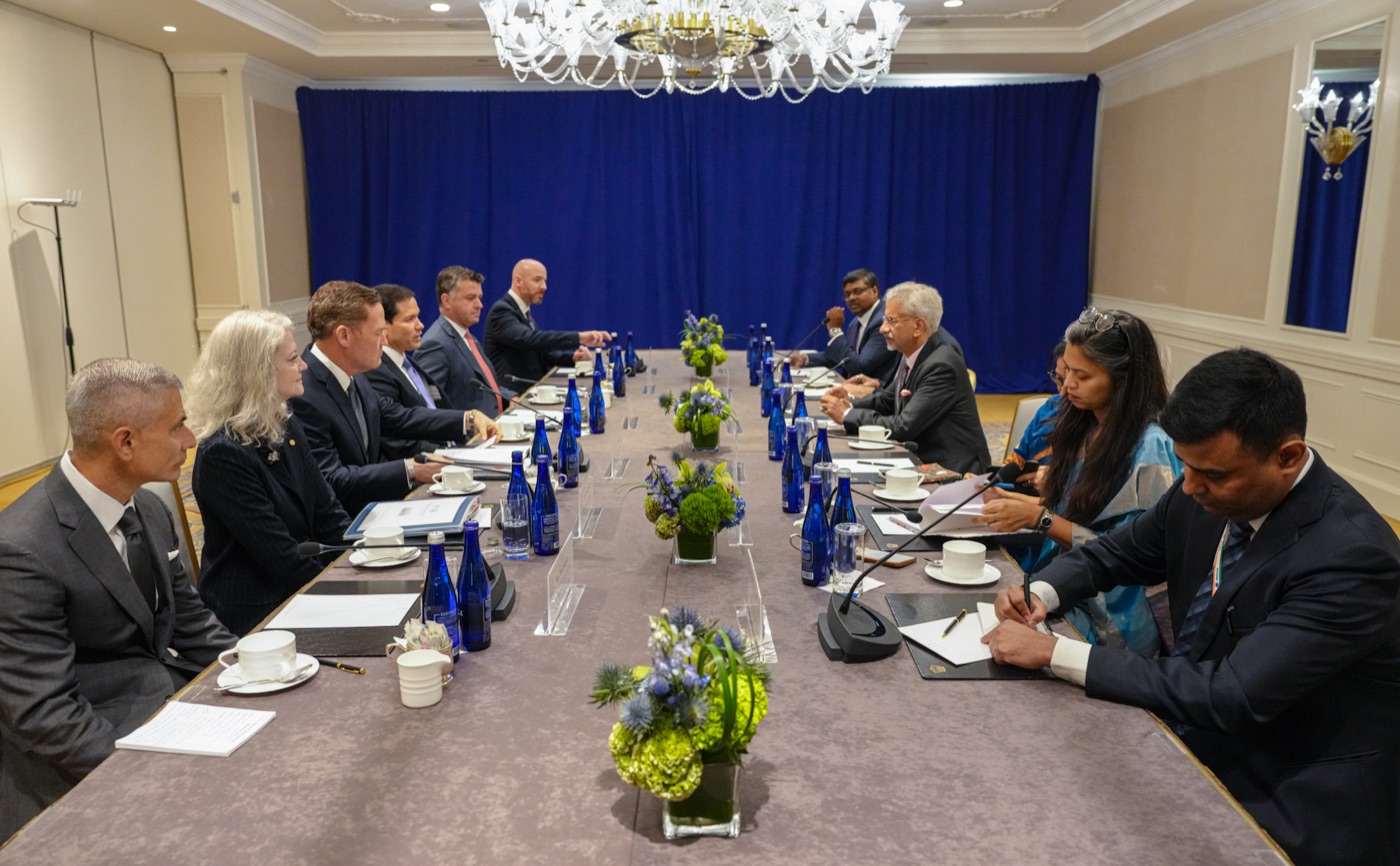
Featured image: Secretary of State Marco Rubio (left side of the table, purple tie) and External Affairs Minister S. Jaishankar (right side, grey hair) meet at the United Nations General Assembly in New York on September 23, 2026. (Official State Department photo by Freddie Everett, public domain, via Wikimedia Commons)
In February, P. Anbu Rose was among the knitwear exporters in Tiruppur who described the cost of steep US duties to The Federal. The town is in Tamil Nadu. It accounts for nearly 90 percent of India's cotton knitwear exports, The Federal reported. The United States took 35 to 40 percent of its shipments.
Some units shut down, Anbu Rose told the outlet, and "a few exporters even gave loans to workers to help them survive." Another exporter, M. Rakul, described goods lying unsold for months. Days earlier, an India–US trade deal had promised to cut those duties from 50 percent to 18 percent.
That deal has been caught between Washington's courts and its sanctions law ever since. On Tuesday, October 20, Secretary of State Marco Rubio meets External Affairs Minister S. Jaishankar in Mumbai, ThePrint reported.
A White House order on Friday paused a threatened 100 percent duty on goods from big Russian oil buyers. It also handed the President's waiver power to the Secretary of State.
Rubio spoke to reporters in Samarkand, Uzbekistan, on Monday. "We're trying to finalise a trade deal with India right now," he said, according to Firstpost and India TV. "We're very close to doing that." He gave no date, and Firstpost noted that the final terms and timeline have not been announced.
Commerce Minister Piyush Goyal said the first phase had been finalised and was in legal drafting, Outlook reported on October 16. Goyal added a condition. India would implement it only once it secured competitive terms, he said.
On February 20 the US Supreme Court ruled that President Donald Trump could not impose such tariffs under an emergency-powers law, The News Minute reported. The deal went into limbo. Since July 24, many Indian goods have carried an extra 10 percent duty that the US Trade Representative imposed under Section 301 over forced-labour import rules. Some products are exempt.
Trump signed the Lindsey O. Graham Sanctioning Russia and Iran Act on September 18, the order says. Under Section 2(b), the order sets a 100 percent duty on goods from the five largest importers of Russian crude and gas if they knowingly make new purchases on or after October 18. The order names no country. India and China are among those buyers, India TV reported.
Section 4(a) of the same order waives that duty at once. Under Section 4(d), the waiver stays in effect until the President or the Secretary of State decides "that further action is appropriate," in consultation with the Treasury and the Trade Representative. No end date is set. Section 5(a)(ii) delegates the waiver power itself to the Secretary of State.
Rubio said India still gets a substantial amount of energy from Russia "because it's hard to pivot from one day to the next," according to India TV. He called India "an important ally and partner."
India's buying is already shifting, the Global Trade Research Initiative said. Russia's share of Indian oil imports fell from 51 percent in July to 44 percent in August as India bought more from the US and the UAE, the think tank told PTI. That is seven points in a month.
"Temporary tariff relief is no basis for permanent trade concessions," said Ajay Srivastava, the GTRI founder. The waiver "has no fixed expiry date, but it can be withdrawn," he said.
On Thursday, October 15, US Ambassador Sergio Gor told a Bloomberg forum he expected Jaishankar to join Rubio in Mumbai, ThePrint reported. Congress objected the same day.
Congress general secretary Jairam Ramesh called Gor's statement "quite extraordinary" on X, the Free Press Journal reported. He asked since when a US envoy announced the minister's meetings in India.
On Friday, Leader of the Opposition Rahul Gandhi addressed Prime Minister Narendra Modi on X. "Your officials in the External Affairs Ministry are confused about what's going on," he wrote, according to ThePrint. Modi "might want to explain," Gandhi added.
The government did not respond to Gandhi's post right away, the Free Press Journal reported. Randhir Jaiswal, the ministry's spokesperson, said hosting foreign leaders outside Delhi "has been the practice in the last decade or so," Outlook reported. He cited two Gujarat cities. Modi met Spain's Pedro Sánchez in Vadodara and Germany's Friedrich Merz in Ahmedabad, ThePrint reported.
After the talks, both ministers are due at the US Consulate in Mumbai for its celebration of 250 years of American independence. Jaishankar is the guest of honour, ThePrint reported.
Today the Russian oil duty sits behind a waiver. The President or the Secretary of State can revisit it without a vote in Congress. Rubio is one of the two.
Washington's aim, Firstpost noted, is to restrict Moscow's revenue during the war in Ukraine. Russia still supplied 44 percent of India's oil imports in August, by GTRI's count.
Neither government has announced a signing date. Rubio gave none in Samarkand. Later this week he travels to Jamnagar, home to a Reliance refinery, ThePrint reported.
Rubio and Jaishankar meet in Mumbai on Tuesday.