Supreme Court sets December 9 for opposition's 48 questions to the Election Commission
Rahul Gandhi and INDIA bloc leaders want the Chief Election Commissioner and both Election Commissioners to say under oath how the nationwide voter-roll revision was approved. The Election Commission objects. The Supreme Court hears both sides on December 9.
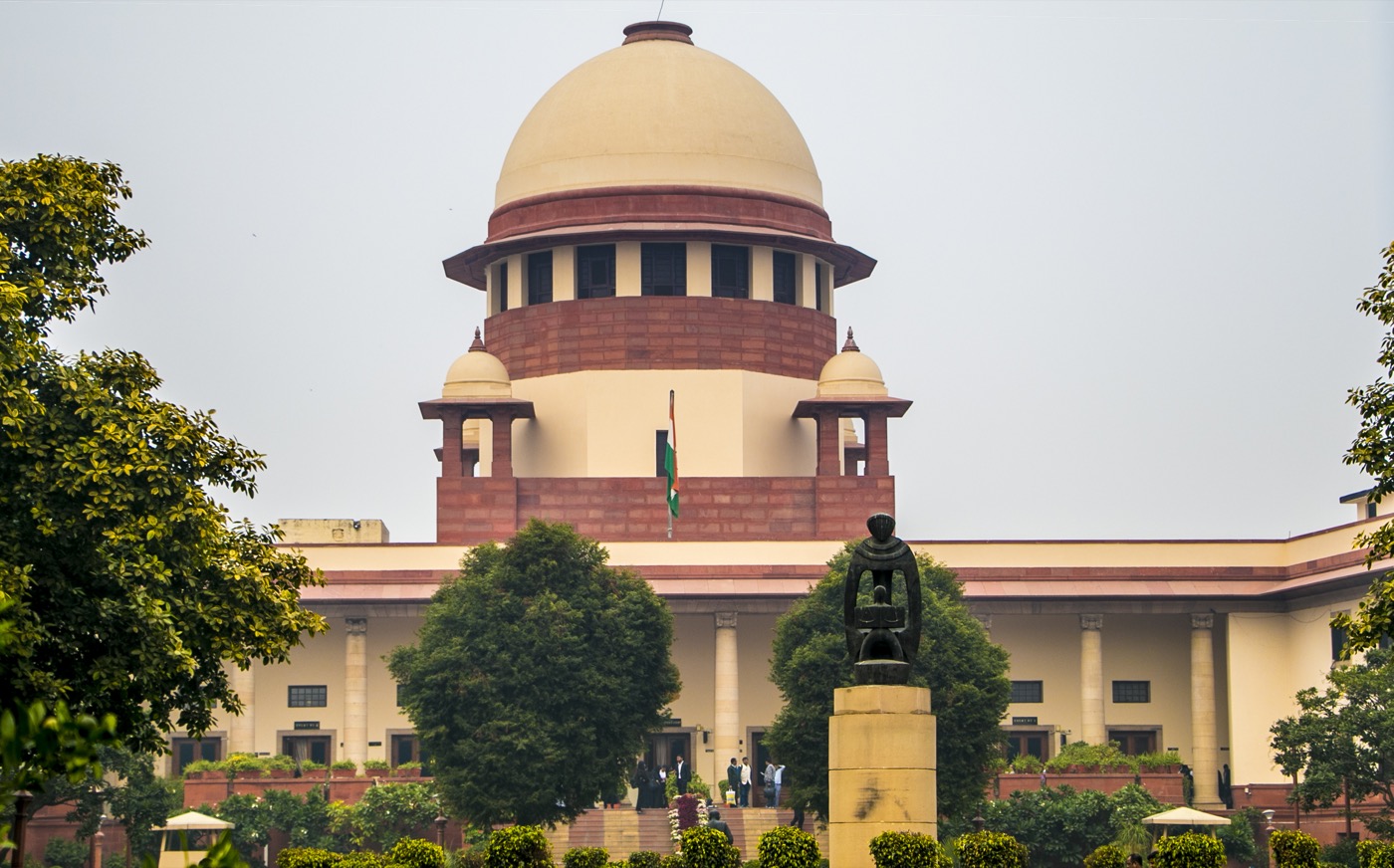
Featured image: The central wing of the Supreme Court of India in New Delhi, which houses the Chief Justice's courtroom, photographed on December 11, 2019. Photo by Subhashish Panigrahi, CC BY-SA 4.0, via Wikimedia Commons.
Kapil Sibal made his request on Tuesday morning, as the Supreme Court bench was about to rise for lunch, The Hindu reported. He spoke for the opposition. "We are asking for some interrogatories from the Election Commission," the senior advocate said, according to ETV Bharat.
Harish Salve, for the Election Commission of India, pushed back. "We have something to say, very serious prejudice," Salve said, LiveLaw reported. Chief Justice Surya Kant sat with Justices Joymalya Bagchi and V Mohana. The bench let the commission file objections. "We will examine the interrogatories issue and then take a call," Kant said, according to The Tribune. The hearing is set for December 9.
The 48 questions ask whether the three-member commission ever agreed, as a body, to the Special Intensive Revision (SIR) of India's electoral rolls. That revision is a house-to-house recheck of voter lists. Around 13 crore people, or 130 million, were excluded from the rolls during it, The Hindu reported on Tuesday. The paper gave no state breakdown. For families in India and for registered voters abroad, the case turns on whose names stay on the rolls.
Rahul Gandhi, the Leader of the Opposition in the Lok Sabha, filed the application on Monday, The Tribune reported. Mallikarjun Kharge, Akhilesh Yadav, Tejashwi Prasad Yadav and Supriya Sule joined him. So did Mahua Majhi of the Jharkhand Mukti Morcha, ETV Bharat and LiveLaw reported. Interrogatories are written questions answered under oath.
The questions go to Chief Election Commissioner Gyanesh Kumar and Election Commissioners Sukhbir Singh Sandhu and Vivek Joshi. For each SIR order, the leaders want a file number and a date, The Indian Express reported. They also ask how each one was approved. One question asks how often Sandhu or Joshi recorded a written objection between February 19, 2025, and October 26, 2026. The window covers 20 months.
An Express investigation on September 23 found that Sandhu and Joshi had objected on record 14 times in 10 months to steps taken under Kumar. Both men still sit on the commission. The application also cites a Right to Information reply, in which an appellate officer said the commission "has so far not taken any decision" on a nationwide SIR in 2025. The Express quoted it. The commission's order of June 24, 2025, said the revision would begin "in the entire country," LiveLaw reported.
The commission's October 26 counter-affidavit covered SIR orders from June 24, 2025, October 27, 2025, and May 14, 2026. All three rested on unanimous decisions, it said. The affidavit itself was "approved for filing" by "a unanimous decision of the three members," LiveLaw reported. It called the petitioners' allegations about its decision-making misconceived, according to The Indian Express. On May 27, the Supreme Court upheld its power to run the SIR in a judgment on Bihar's revision, LiveLaw reported. Bihar went first.
The BJP made a political case on Tuesday. Spokesperson Gaurav Bhatia accused the Congress of backing the SIR in the Andaman and Nicobar Islands and the south while opposing it elsewhere, The Hindu reported. He named Kerala's chief minister, V.D. Satheesan. "Why then is Rahul Gandhi opposing it?" Bhatia asked.
For dropped voters, the commission made a concession last week. Deputy Election Commissioner Bhanu Prakash Yeturu filed a supplementary affidavit on November 14, LiveLaw reported. It says filing Form 6 to rejoin the rolls will not by itself bring prosecution under Section 31 of the Representation of the People Act, 1950. Form 6 is the new-voter form. The voter must not be enrolled in another constituency, LiveLaw reported.
On November 6, the commission wrote to the chief electoral officers of Delhi, Maharashtra, Haryana, Andhra Pradesh, Jharkhand, Telangana and Nagaland, the affidavit says. Excluded voters there get another chance. Jharkhand's August draft roll left out 43,61,987 of the 2,64,63,236 electors on the earlier roll, Chief Electoral Officer K. Ravi Kumar said, according to The Pioneer. That is 16.5 percent.
In Jamshedpur, the East Singhbhum district election office posted a notice on May 22. It covered the district's list of "un-mapped" electors, its notice board shows. Jharkhand's final roll is due on November 30, under a revised schedule from K. Ravi Kumar's office, The Hans India reported. It was first due in October.
Indians abroad have their own route onto the rolls. A citizen who holds no other nationality can register as an overseas elector on Form 6A, the Embassy of India in Lima explains. The vote itself happens in India. Overseas electors cast it in person at their polling station and show their original passport.
OCI cardholders cannot vote. The Ministry of External Affairs lists voter registration under Section 16 of the 1950 Act among the rights they do not hold. They are not citizens. A relative at home whose name fell off a draft roll can still file Form 6. The commission has told the court that filing will not, on its own, lead to prosecution. That holds if the voter is not enrolled elsewhere.
It was not clear on Tuesday whether Sandhu or Joshi would answer in their own names. LiveLaw's account of the November 14 affidavit gives no count of excluded voters who have reapplied. Of the 48 questions, I keep returning to the plainest: what file number did the nationwide decision carry? Jharkhand's final roll is due on November 30. The court takes up the questions nine days later.

Comments
Loading comments…