Duffy blames an Arkansas router for grounding US flights, and outages keep coming
A nationwide FAA ground stop, a Microsoft email failure felt as far as Delhi, a Chase banking bug and a downed NSA network all hit within six days. Officials and the companies say there is no evidence of a cyberattack, and the cause of the ground stop is still under investigation.
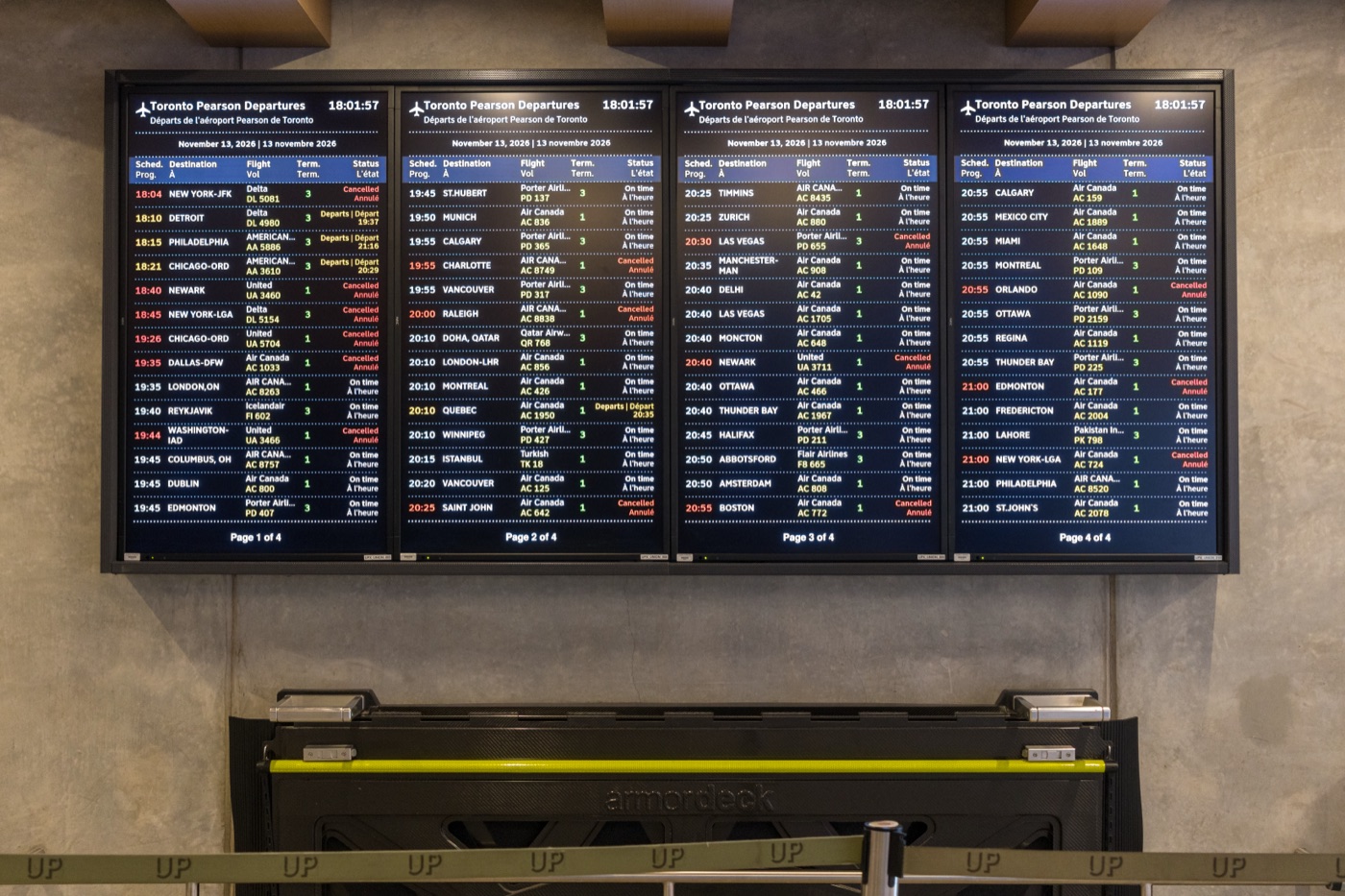
Featured image: A departure board for Toronto Pearson International Airport, on the UP Express platform at Union Station in Toronto, at 6:01 p.m. on November 13, 2026, during the FAA ground stop. Flights to Newark, Chicago and Dallas show as canceled, while Air Canada's 8:40 p.m. flight to Delhi is listed on time. Photo by Dillan Payne, CC BY-SA 4.0, via Wikimedia Commons.
Erin and Jake Britt boarded a flight from Washington to Fort Lauderdale at 3 p.m. on Friday, November 13. They never took off. By 5:30 p.m. they were off the plane, NPR reported, and the crew knew nothing more. "They seem just as in the dark," Erin Britt said.
The Federal Aviation Administration had frozen every departing flight in the United States at about 4 p.m. Eastern time, CNBC reported. The stop lasted more than four hours. FlightAware counted more than 9,000 US cancellations that Friday and roughly 6,500 on Saturday, CNBC reported.
The ground stop was the largest of five failures in six days. Microsoft email, Chase online banking, United Airlines departures and a classified National Security Agency network all faltered. Each time, officials, the companies or people familiar with the matter said there was no evidence of a cyberattack. Indian travelers felt it too. On November 13, IndiGo and Akasa Air warned passengers that their email support was impaired.
Transportation Secretary Sean Duffy has blamed a router. Crews for the contractor L3Harris Technologies were swapping copper lines for fiber at a remote FAA site in El Dorado, Arkansas, when a new router began firing more than 1,000 connection attempts about every five seconds, Duffy said. Radar feeds and aircraft communications faltered. A second router, in Amarillo, Texas, is also under review.
The two sites unsettled 17 of the FAA's 22 regional control centers, according to CNET. Duffy said it happened "either through contractor error or a faulty piece of equipment." FAA Administrator Bryan Bedford said there was "zero evidence" of anything nefarious, according to CNBC. On Tuesday the FAA paused new router installations, CNBC reported. Juniper Networks makes the routers. Its owner, HPE, said the devices appeared to work as intended. "They did not fail," a spokesman told The Wall Street Journal.
L3Harris said it was "supporting the FAA in its investigation," NPR reported. It said it had finished more than 70 percent of the conversion.
Some specialists doubt the single-router account. "It's not credible that one or even two routers would be an issue," Robert W. Mann Jr., an airline consultant, told CNET. He cited the network's backups. Ilia Rabinovich of the security firm Sygnia said "the redundancy part" surprised him most. It was not clear on Tuesday why those backups failed.
Duffy has turned the failure into a funding argument. On Friday he asked Congress for $50 billion to rebuild air traffic control, CNBC reported. That is more than he sought before. "We're using old equipment," he said on Saturday, according to NPR. Over 5,000 FAA copper lines await replacement by the end of 2028, CNET reported.
Democrats on the Senate Commerce Committee read the week differently. "Modernization cannot come at the expense of operational safety," they said in a joint statement. They want a briefing by Monday from the FAA, L3Harris and Juniper, CNBC reported. They also point to unspent money. Congress approved $12.5 billion for air traffic control in July 2025.
The first failure came a day before the ground stop. From 4:20 p.m. UTC on November 12, Exchange Online email was disrupted for almost 24 hours, according to Microsoft's preliminary report, as summarized by Cybersecurity News. Most users could not reach their mailboxes. A faulty server fix was to blame. "This was a technical issue not related to cyber or AI/agents," Microsoft said, Yahoo Finance reported.
In India it was just before 10 p.m. when the mail stopped. By Friday it had reached airline help desks. IndiGo said its flights "remain unaffected" and pointed passengers to its 6E Skai assistant, Outlook India reported. Akasa Air said its "email support services are currently experiencing delays." Air India rerouted its email, Gulf News reported.
On Monday, November 16, thousands of customers at Chase and other banks reported trouble with online accounts. Chase blamed "a software bug in on-premise hardware systems," Yahoo Finance reported. It said there was no evidence of a cyber link. That afternoon United Airlines delayed departures over a technology issue. Its pilots' union said apps carrying final aircraft weight data were affected, NBC News reported.
A classified network the NSA uses for internal communications was down on Tuesday, CNN reported, according to Reuters. CNN cited five people familiar with the matter. It said there was no immediate evidence of a cyberattack. In Manila, President Donald Trump played the week down. "Things like that happen," he told reporters. "It's fine."
Passengers on canceled flights will be rebooked or refunded in full, Bedford said on Saturday, according to NPR. He told them to contact their airline directly. Email is only one channel. On November 13, Akasa Air sent urgent cases to its round-the-clock care line. Air India said its phone and social media channels were working, Gulf News reported.
Microsoft has promised fuller repair details by November 20, Cybersecurity News reported. My question is about Arkansas: who tested the El Dorado router before it went live? Both routers now sit in an L3Harris lab in Florida, CNBC reported. It was not clear when the results would be released.



Comments
Loading comments…