The Chinese towns that make the world's socks, toothbrushes and Diwali lights
Datang makes 25 billion pairs of socks a year and Hangji a third of the world's toothbrushes. How China's one-product towns reached Indian and American homes.
How toothbrushes, socks, Diwali lights and thousands of other ordinary objects became part of an extraordinary economic transformation that began in 1978.
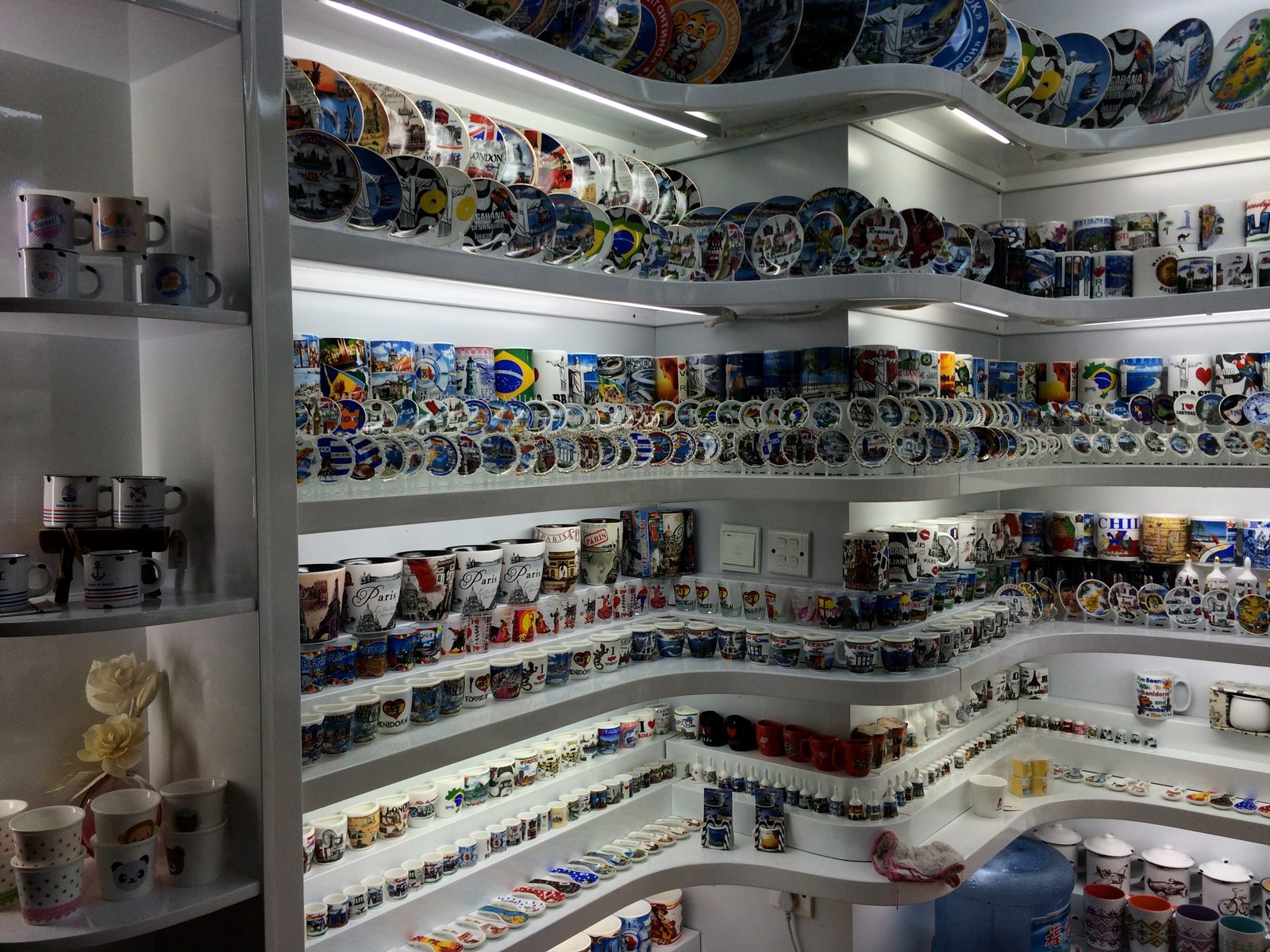
Top photo: Souvenir mugs and plates stacked on the shelves of a stall in the Yiwu International Trade Mart, Zhejiang, August 2014. Photo by iamdanw, CC BY 2.0, via Wikimedia Commons.
There is something reassuring about the familiar disorder of a home in the morning. Slippers lie beside the bed, one slightly turned beneath the other. Toothbrushes stand in a cup near the bathroom sink. Socks are pulled from a drawer, a shirt is buttoned, and a necktie is knotted in front of a mirror. Downstairs, the kettle boils while someone searches for a missing lunchbox lid. The objects are so familiar, so thoroughly absorbed into the routines of daily life, that their origins scarcely deserve a thought.
Yet scattered across these few rooms is an invisible map of China, a country where entire towns have devoted themselves to manufacturing the simplest necessities of modern life.
In Neikeng, a town in the southeastern province of Fujian, factories turn out more than a billion pairs of slippers annually, enough for roughly one in every eight people on the planet. Farther north, in Hangji, one of every three toothbrushes manufactured worldwide comes from an industry that has grown around this Jiangsu township.
The socks lead to Datang, in Zhejiang province, where some 25 billion pairs are produced each year, while the buttons on a shirt might have originated in Qiaotou, whose manufacturers turn out an estimated 60 billion buttons annually. Shengzhou, another Zhejiang city, is often called the world's necktie capital.
Without its label, a button or a pair of socks gives no clue to where it was made. The concentration of production is still extraordinary. A product that takes seconds to use and costs little to replace has become the organizing principle of an entire local economy.
Datang, which calls itself the world's sock capital, offers an especially revealing glimpse of the phenomenon. In its factories, knitting machines work through enormous quantities of yarn, producing socks in the colors, patterns and materials demanded by customers thousands of miles away. The town's estimated annual output of 25 billion pairs amounts to roughly three pairs for every person on Earth, an astonishing accomplishment for an industry whose beginnings were modest enough to fit inside a family home.
In the late 1970s, residents of Datang began acquiring secondhand knitting machines, adapting equipment and supplementing their agricultural earnings by selling socks. Some worked on hand-operated machines, making socks by hand before carrying them to nearby markets. The profits from one machine helped finance another; relatives joined the enterprise, small workshops multiplied, and merchants found opportunities supplying the yarn, elastic, dyes and equipment needed to keep production moving. Decades later, the town would become one of the most concentrated manufacturing centers in the world.
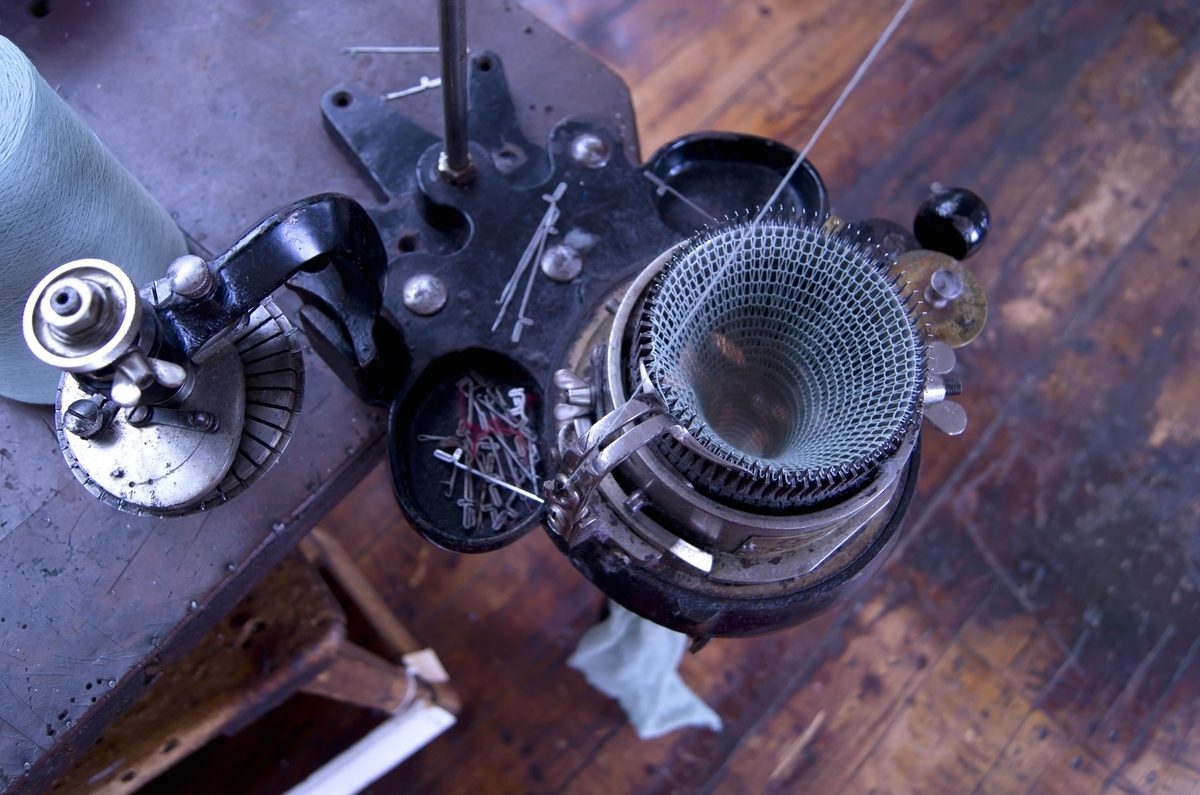 A hand-driven circular stocking-knitting machine, of the general type early small-scale sock makers used, in the collection of the Textile Industry Museum in Bergen, Norway, photographed in 2013. It has no connection to Datang. Photo by Tekstilindustrimuseet, CC BY-SA 4.0, via Wikimedia Commons.
The enterprise that emerged in Datang belonged to a much larger upheaval taking place across China.
In December 1978, two years after Mao Zedong's death, the Communist Party leadership gathered in Beijing for a meeting that would alter the economic direction of the country. Deng Xiaoping, who was emerging as China's paramount leader, championed reforms that loosened aspects of central planning, encouraged enterprise and eventually opened the country more widely to foreign investment and international trade. The transition was gradual, uneven and closely controlled by the state, but it created opportunities for commercial activity that had long been restricted.
This December will mark 48 years since that meeting, when few could have imagined that small workshops in China's countryside would eventually help supply the bathrooms, wardrobes and kitchens of much of the world.
Many of the earliest enterprises were tiny. Farmers began pursuing commercial ventures, families established workshops, and local merchants found themselves with greater freedom to buy and sell. In Yiwu, another Zhejiang city, traders had long traveled through the countryside exchanging brown sugar for chicken feathers and other discarded materials, often conducting business despite official restrictions on private commerce. In 1982, local authorities permitted a small-commodities market that began with a collection of stalls and sheds.
Today, the trading halls of Yiwu stretch across an immense commercial complex, where merchants arrange purchases of toys, household goods, artificial flowers, stationery, decorations and countless other inexpensive objects. Goods manufactured across China pass through its markets, while buyers from distant countries place orders with businesses that have spent decades learning how to produce almost anything in astonishing quantities.
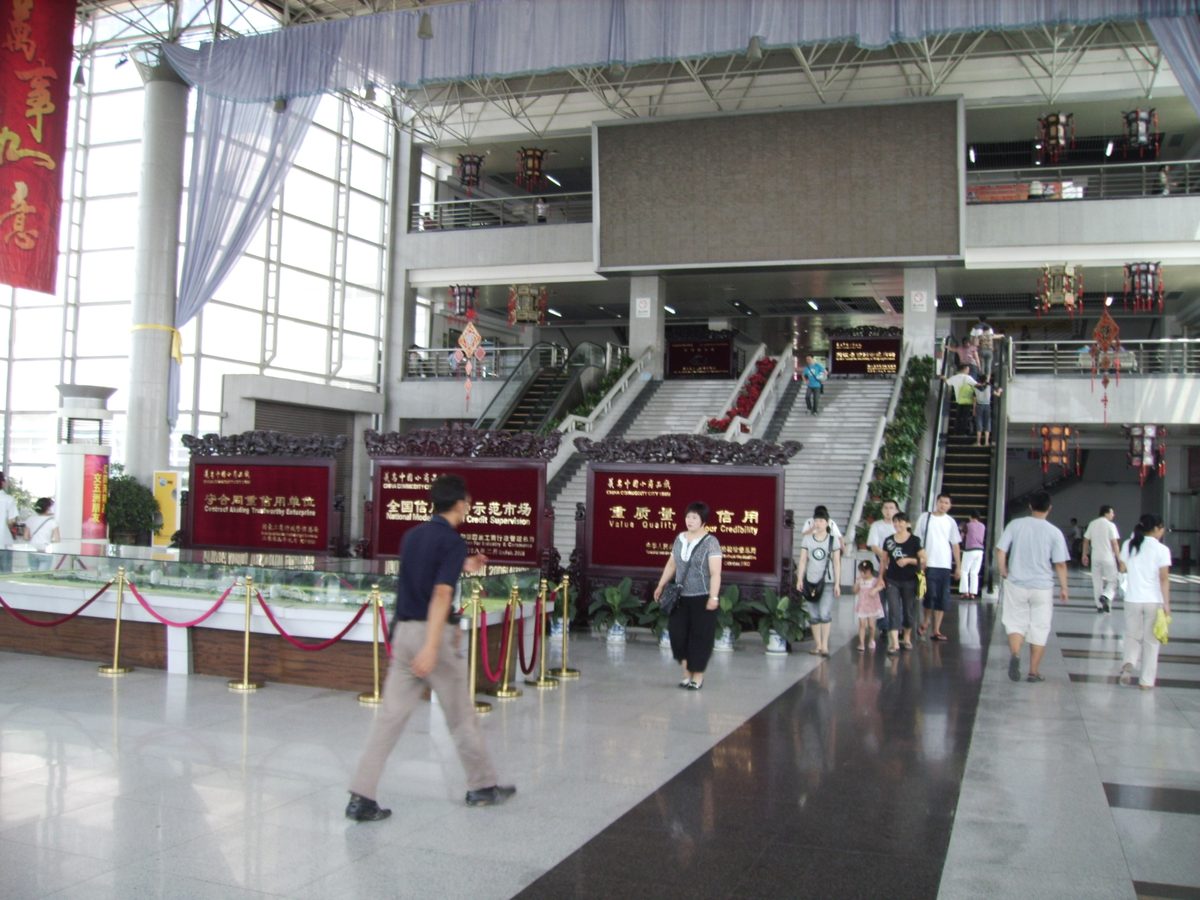 The entrance hall of Yiwu's Futian market, the first district of the city's wholesale trade complex, August 2008. Photo by Haluk Comertel, CC BY 3.0, via Wikimedia Commons.
A walk through Yiwu's trading halls can take a buyer from tinsel garlands to Halloween ghost masks, plastic Christmas trees and strings of colored lights, products manufactured for celebrations that have little connection with the traditions of the Chinese towns supplying them. Much of the world's festive merchandise travels through such trading networks, reaching consumers who may know the brand on the packaging but nothing of the factories behind it.
In India, the weeks before Diwali bring a familiar transformation to markets and residential streets. Shops display strings of colored bulbs, electric diyas and decorative lamps, while families unpack lights from the previous year, untangle the wires and test them before arranging them along balconies and doorways. The warm glow of traditional earthen lamps now mingles with the sharp brightness of LEDs, many manufactured in China or assembled in India using Chinese components.
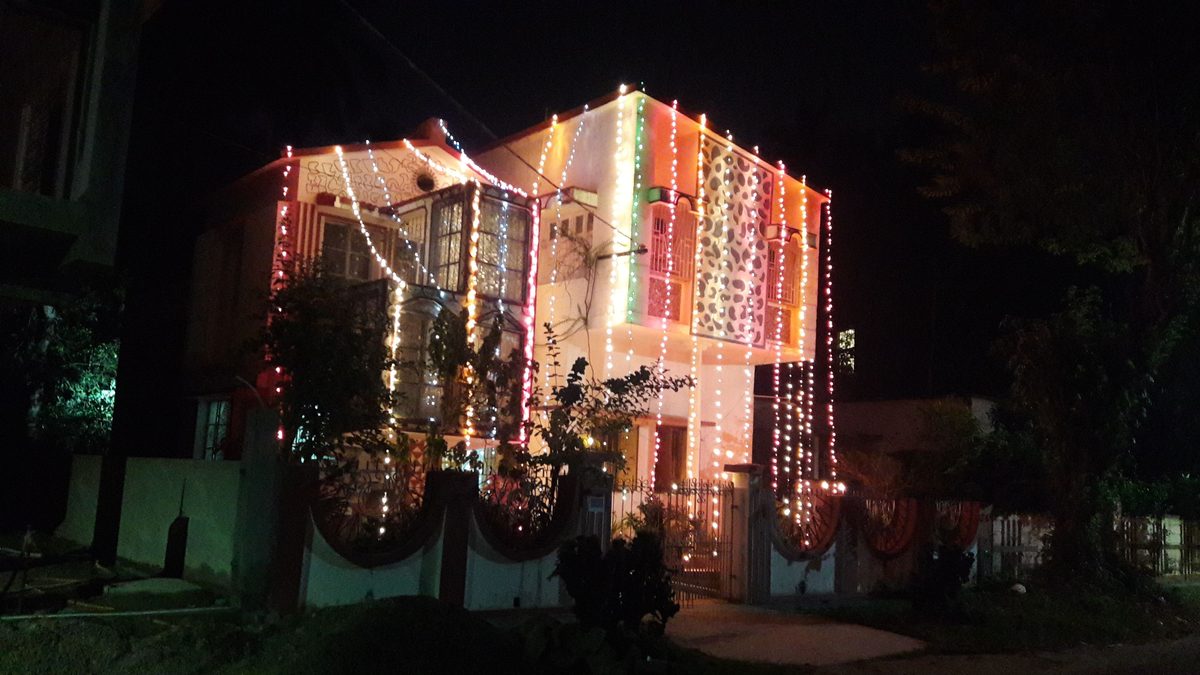 A family home in India decorated with strings of electric lights for Diwali, November 2018. Photo by Dew kodu pagli, CC BY-SA 4.0, via Wikimedia Commons.
In Delhi's Sadar Bazar, traders interviewed before Diwali in 2025 described Indian-made decorative lights gaining ground against Chinese imports, The Sunday Guardian reported. Urban customers were shifting to Indian lights, one shop owner said. Rural buyers still picked cheaper Chinese strips.
Across the Pacific, American families preparing for Christmas encounter a similar mixture of domestic tradition and international manufacturing. Boxes of ornaments emerge from cupboards, artificial trees are assembled and strings of lights are draped across porches. Chinese factories have supplied the great majority of Christmas decorations imported into the United States, their production schedules shaped by buying decisions made months before the first decorations appear in stores.
When tariff disputes between Washington and Beijing disrupted orders in 2025, manufacturers in China worried about customers canceling shipments that would ordinarily have been arranged well in advance. American retailers, meanwhile, faced the prospect of higher prices and fewer choices. The consequences of decisions made in government offices were being felt in Chinese workshops and American shopping aisles, long before the holidays arrived.
By then, China's transformation had extended far beyond the small enterprises of the reform era. Special economic zones established during the 1980s attracted foreign investment and new technologies, while the country's entry into the World Trade Organization in December 2001 accelerated its integration into global supply chains. International brands discovered that Chinese manufacturers could produce goods cheaply and quickly, drawing on closely connected networks of suppliers. Turnaround times were short.
The concentration of so much industrial activity in particular towns helped explain why manufacturing proved difficult to relocate, even when businesses elsewhere possessed more sophisticated equipment.
Fort Payne, Alabama, was once known as the Sock Capital of the World. Its mills employed generations of American workers, and by the early 2000s some factories were operating advanced knitting machines capable of producing socks at remarkable speed. When the Los Angeles Times compared Fort Payne with Datang in 2005, it found that the Chinese town's advantages extended beyond inexpensive labor.
An American manufacturer might wait two months for a replacement machine part, while a producer in Datang could turn to nearby specialists supplying machinery, yarn and components. A new order could draw on an entire community of businesses accustomed to working together. In effect, two industrial systems were competing. Each had developed in a very different way.
For American manufacturing towns, the growing competition from imported goods contributed to a painful period of industrial change, although automation, corporate sourcing decisions and other economic pressures also played their part. Consumers benefited from lower prices, while communities that had depended on particular industries struggled to replace the jobs and commercial networks they had lost.
India's relationship with Chinese manufacturing presents a different complication. The country has become a major producer of medicines, supplying affordable pharmaceuticals to markets around the world, yet many Indian manufacturers continue to rely on Chinese chemical ingredients and intermediates. According to figures released by the Indian government in February 2026, China accounted for 73.7 percent of India's imported active pharmaceutical ingredients, bulk drugs and drug intermediates by value during the 2024–25 financial year.
A strip of tablets manufactured and packaged in India may therefore contain ingredients whose production began in China. The label is accurate as far as it goes. It describes one stage of an industrial process that can extend across several countries. Similar arrangements are common in electronics, machinery and numerous other industries, where materials and components cross international borders before the final product is assembled.
Sometimes the direction of the trade is reversed.
At temples in southern India, devotees have offered their hair for generations as an act of religious devotion, a practice whose meaning belongs to a world far removed from international commerce. Yet hair collected at temples, alongside hair gathered from households and salons, enters a global industry in which raw and partly processed Indian hair may travel through Myanmar before reaching Chinese manufacturers.
In Xuchang, Henan province, businesses have developed a specialized industry transforming human hair into wigs and extensions for customers around the world. China exported $1.3 billion worth of hair products to the United States during the first half of 2026, according to customs figures reported by Reuters.
The journey from an Indian temple or village to a Chinese workshop and eventually an American beauty salon reveals another dimension of China's manufacturing strength. India supplies valuable raw material, but much of the industrial processing, styling, product development and international distribution takes place elsewhere.
The remarkable success of China's specialized towns has not insulated them from commercial pressures. Rising wages, environmental concerns, automation and competition from manufacturers in other countries have transformed the business models of many industrial clusters. A factory that once competed mainly by employing inexpensive labor may now invest in computerized machinery, design capabilities and direct online sales. Some manufacturers are relocating production to Vietnam, India and other countries, while Chinese suppliers themselves continue to provide the machinery and components used in those new factories.
The trade disputes of recent years have also exposed the vulnerabilities of a system in which producers and customers can be separated by oceans but remain deeply dependent on one another. Everyday life would carry on for a while after a sudden interruption in Chinese exports. Existing goods would continue to function, retailers would draw upon inventories, and alternative suppliers would eventually expand production.
Yet the replacement of a damaged appliance, the supply of an electronic component or the manufacture of a medicine could become considerably more difficult and expensive, particularly where production depends on specialized suppliers that have taken decades to develop.
The dependence runs in both directions. Chinese factories need international buyers, imported materials and access to markets just as foreign companies need reliable manufacturing partners. The efficiency created by bringing so much production into concentrated industrial communities has also made the consequences of disruption harder to contain within national borders.
In Datang, the knitting machines continue to turn, producing socks that will eventually disappear beneath trousers and shoes in countries whose customers may never hear the town's name. Elsewhere in Zhejiang, buttons are sorted and packed, neckties folded into boxes and festival decorations prepared for another season of international orders. Across China, factories producing the smallest components of daily life remain connected to a commercial transformation that began in the countryside and gathered force after the reforms of 1978.
Nearly half a century later, its effects are present in places too ordinary to attract much attention: the toothbrush left to dry beside a sink, the buttons on a child's school uniform, the medicine tucked into a kitchen drawer, the lights waiting in a cupboard until Diwali.
Their journeys have become part of our routines, even if we have seldom thought to trace them.



Comments
Loading comments…