OPT unemployment limit is still 90 days, with 150 on STEM OPT
F-1 graduates on Optional Practical Training can be unemployed for 90 days, and STEM OPT adds 60 more, for 150 in total. No 2026 rule or proposal has changed those limits, despite online claims of a cut to 60.
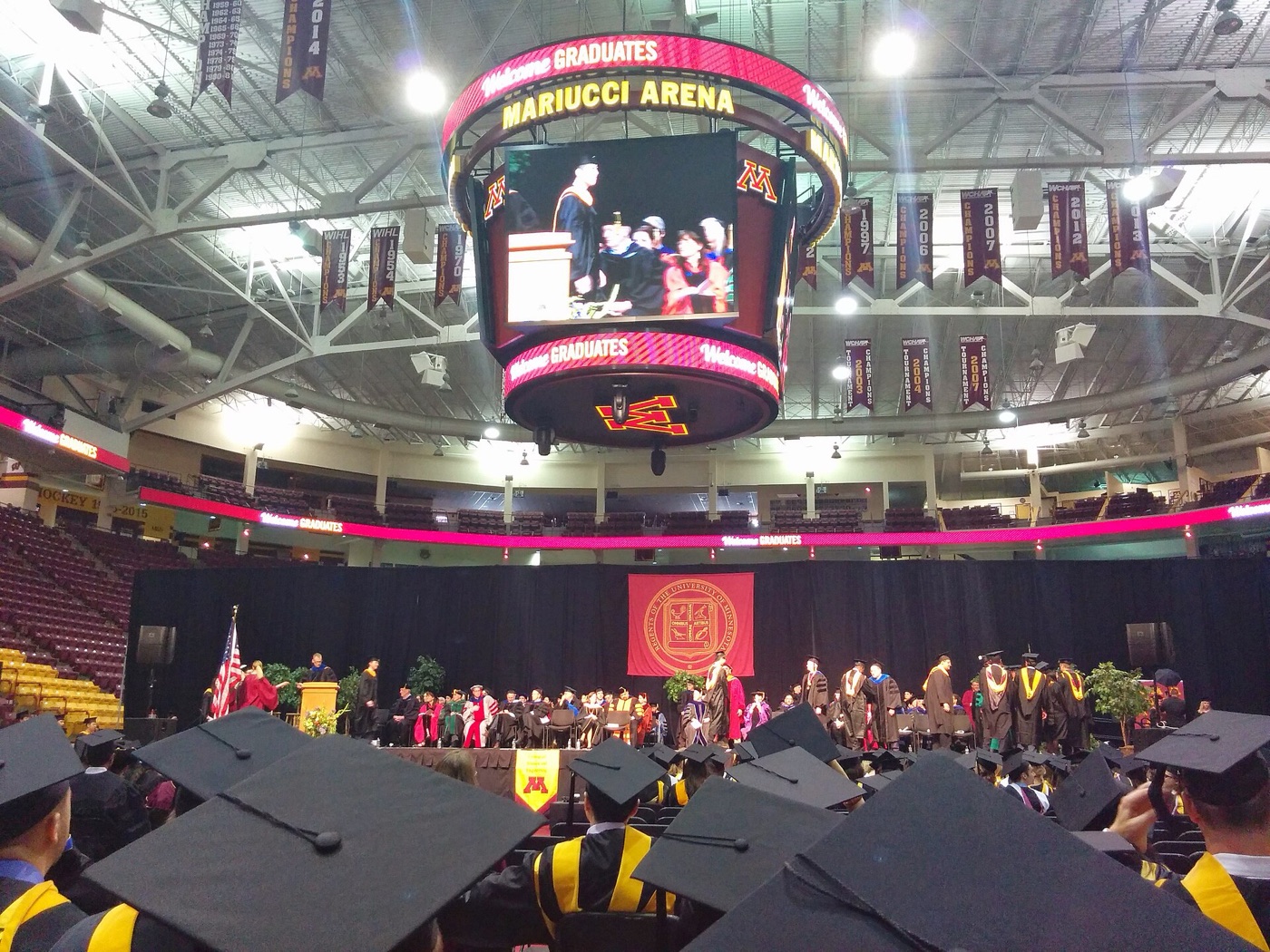
Top image: Science and engineering graduate students at their commencement in Mariucci Arena at the University of Minnesota in Minneapolis in May 2015. Photo by Runner1928, CC BY-SA 4.0, via Wikimedia Commons.
The limit has not changed. A graduate on post-completion Optional Practical Training (OPT) may be unemployed for 90 days in total, and the 24-month STEM OPT extension adds 60 more, for 150 across both periods. Those are the numbers in the federal regulation. No rule, proposed rule or Federal Register document published in 2026 has changed them, as of November 21.
The rule sits at 8 CFR 214.2(f)(10)(ii)(E). "During post-completion OPT, F-1 status is dependent upon employment," it reads. The government's eCFR, current to November 19, prints the 90-day and 150-day limits word for word as they stood at the end of 2025. Neither number has moved.
Claims of a cut to 60 days spread online this year, and the rule governs a large group. India had 182,201 students on OPT in 2025–26, up 26.8 percent from 143,740 a year earlier, according to the Institute of International Education's Open Doors India fact sheet. That was 53.7 percent of all Indian students.
F1Jobs, a jobs blog for international students, reported such a cut this year. It corrected the post in early November and now says the limit is still 90 days.
The Student and Exchange Visitor Program (SEVP) runs the SEVIS student database and updated its Unemployment Counter page on July 27, 2026. The page allows 90 days on post-completion OPT. STEM OPT gets 150, "which includes any days accrued while on post-completion OPT." A graduate who used 70 days before STEM OPT would start the extension with 80 left.
The Department of Homeland Security (DHS) released a proposal on October 7 for a fee of $70,000 for initial OPT and $30,000 for any later OPT, paid by the school. The Federal Register printed it on October 8. Homeland Security Secretary Markwayne Mullin signed it, and it says the fees would "combat fraud, strengthen the integrity of the immigration system, and protect U.S. workers." It leaves the unemployment paragraph untouched.
NAFSA chief executive Fanta Aw called the fee part of "a series of developments that creates deep uncertainty." Sarah Spreitzer, a vice president at the American Council on Education, said OPT is "one of the reasons that international students choose to study in the United States." She spoke to the Associated Press. Comments closed on November 9, and no final fee rule had appeared by November 21.
The fixed-stay rule that a Boston judge struck down on November 16 left the unemployment limits alone. It would have cut the 60-day departure period after OPT to 30 days. Commenters had asked DHS to pause the unemployment clock in some cases. The final rule called that "beyond the scope of this rulemaking."
A separate DHS proposal from September 11 would end a 60-day grace period for workers whose jobs end. It covers H-1B, H-1B1, L-1, O-1, TN and E visa holders. F-1 students are not on that list.
Counting starts on the start date printed on the work permit. SEVP's OPT policy guidance dates from 2010 and is still linked from its help pages. It counts each day without qualifying work, weekends included. Time abroad counts too, unless the student is on employer-approved leave or traveling for the job.
A job counts if it relates to the degree and runs at least 20 hours a week. The guidance allows more than one employer, self-employment and contract work. It also accepts unpaid volunteer or intern roles where labor laws permit, if they reach 20 hours a week.
STEM OPT is stricter. The regulation requires at least 20 hours a week under a Form I-983 training plan. The employer must use E-Verify, SEVP's STEM OPT page says. Students also confirm their details in a validation report every six months.
A student who exceeds the limit "has violated his or her status," the guidance says. The exceptions cover students who have left, applied to transfer or change education level, or otherwise kept status. SEVP officials "can manually terminate a student" who reaches the limit, its SEVIS help page on post-completion OPT says.
SEVIS treats a record with no employer as unemployed, the same SEVP page says. Graduates on OPT can update employer details and addresses in the SEVP Portal. Any job change must reach the DSO within 10 days, that page adds. For STEM OPT, the 10-day deadline is written into the rule.
In Britain, a Graduate visa lasts at least 18 months, and GOV.UK lists "look for work" among what holders can do. The page lists no unemployment limit.
Students in the United States can check their own count now. A designated school official (DSO) can see the days used and left in SEVIS. After a job loss, the end date goes into the SEVP Portal or through a DSO. STEM OPT students give the DSO a new Form I-983 within 10 days of starting at a new employer.
This article is general information, not legal advice. Talk to an immigration lawyer about your case.


Comments
Loading comments…